[CityUHK Research for the Future] From wired to wireless: CityUHK’s world-class research transforms wireless charging
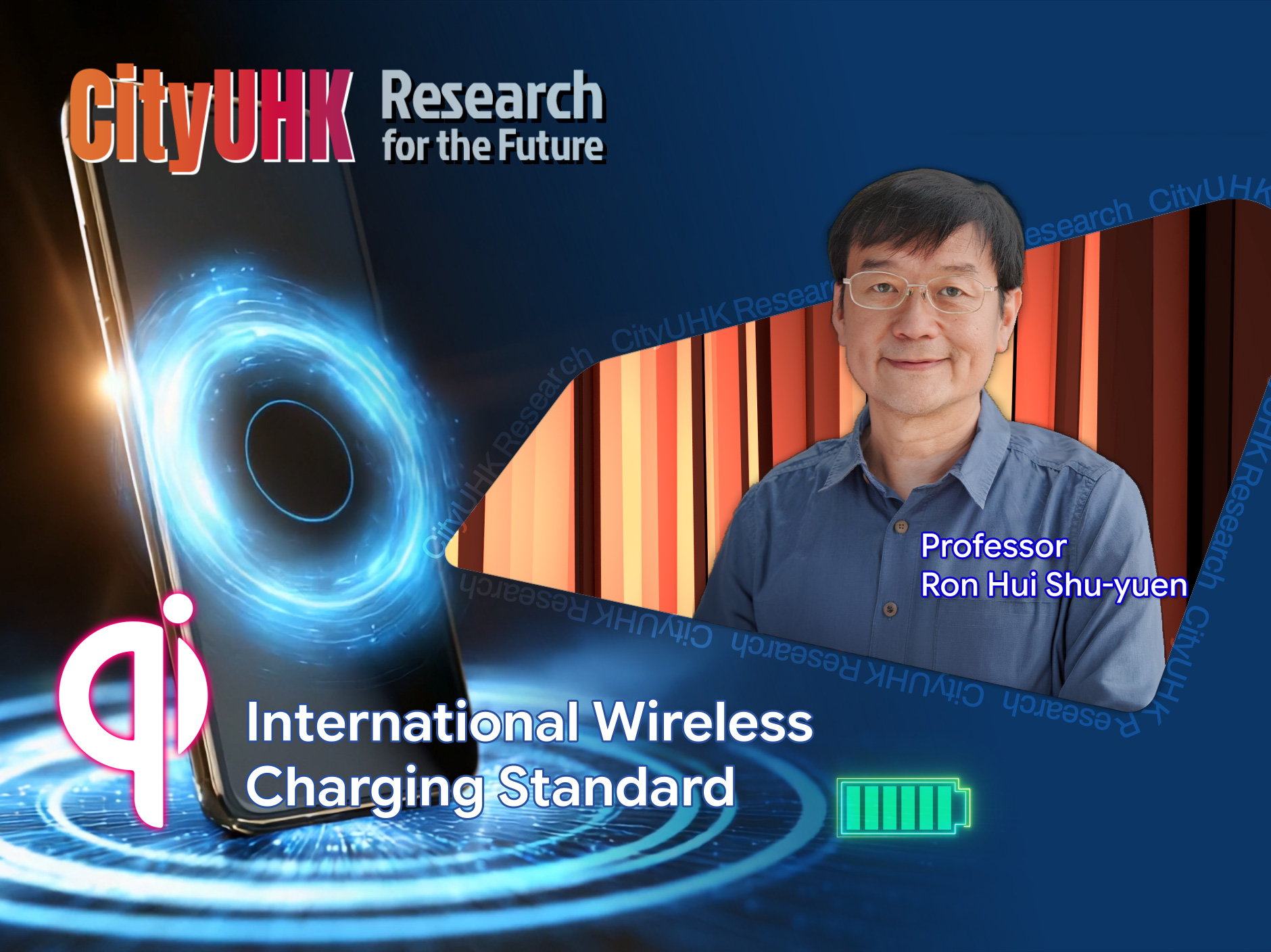
City University of Hong Kong (CityUHK) has long been committed to fostering innovation through world-class research and transforming cutting-edge discoveries into solutions that benefit society. Among its most impactful breakthroughs is the wireless power transfer technology developed by Professor Ron Hui Shu-yuen, Chair Professor in the Department of Electrical Engineering, and his team. Their pioneering work was adopted as the world’s first international wireless charging standard, Qi, solidifying CityUHK’s global leadership in the field. This CityUHK originated technology gave rise to the next generation Qi2 standard that has converted made wireless charging from a niche product into a global norm.
Professor Hui, an internationally renowned scholar in electronic engineering, joined CityUHK in 1996. At that time, mobile phones were becoming increasingly popular, yet chargers from different brands were incompatible, resulting in a significant global e-waste problem.
In the 1990s, Professor John Boys of Auckland University and Professor Hui started to work on modern wireless power transfer technologies. Professor Boys’ works focus on high-power applications that are now adopted in wireless charging of electric vehicles, whereas Professor Hui’s works aim at portable electronics, successfully developing the world’s first multi-layer coil-array design for wireless charging pads for portable electronic devices. The research outcome was published on the Institute of Electrical and Electronics Engineers Power Electronics Society’s flagship journal in 2007. This transmitter coil array structure generates a uniform magnetic flux across the charging surface, forming the fundamental concept of “free-positioning” feature for future wireless charging pads. Therefore, CityUHK is regarded as one of the birthplaces of modern wireless power technologies.
In the years that followed, the team achieved a series of innovations—including localised charging, compatibility checks, bi-directional communication and electromagnetic shielding—ultimately creating the world’s first wireless charging pad with free positioning capability. This system works for all portable electronic devices, allowing users to place their devices anywhere on the pad while supporting single and multiple loads simultaneously, completely redefining the charging experience.
Professor Hui’s research breakthroughs and patents attracted several companies, led by Philips Electronics and Convenientpower, to form the Wireless Power Consortium (WPC) in 2008. In 2010, the consortium launched Qi, the world’s first wireless charging standard for portable electronics. Today, more than 430 companies across industries have adopted the Qi standard, including well-known brands such as Apple, Samsung, Huawei, Hyundai, Toyota and Philips Electronics, as well as Qualcomm and Infineon from the semiconductor industry, and WiTricity, Mojo Mobility and Powermat from the wireless charging industry. Since its introduction, Qi wireless charging has dominated the wireless power transfer market within the consumer electronics sector. CityUHK has also transferred about 148 patented technologies of Professor Hui to industry. Among them, over 60 patents are related to wireless charging technologies.
In recent years, the impact of Professor Hui’s research has continued to grow. His work has been cited in numerous US patents filed by leading wireless power companies and inspired the development of the next generation Qi2 standard. Following review and refinement by the WPC Technical Committee, Qi2 enhances charging efficiency and user experience while preserving all key technologies contributed by Professor Hui to the original Qi standard—such as free positioning, localised charging, compatibility checks and handshaking protocols.
Between 2019 and 2025, billions of Qi-compatible smartphones were sold worldwide. An expanding range of emerging consumer and industrial products—such as earbuds cases, smart rings, tablets, power banks and medical devices—now also support wireless charging.
The WPC remarked that, “Professor Hui’s groundbreaking research and innovations have become the pillars of wireless charging technology. His contributions are deeply embedded in both Qi and Qi2. These technologies have not only shaped global standards but also empowered billions of people with convenient, reliable wireless power. As Qi evolves into Qi2 and beyond, the world continues to benefit from Professor Hui’s vision.”
The name Qi is derived from the Chinese character 「氣」, meaning “vital force”. The contributions of Professor Hui and his CityUHK team have not only driven the evolution of wireless charging, but—like Qi itself—continue to energise and sustain its momentum worldwide.
CityUHK has been committed to transforming research excellence into real-world applications that benefit society. The “CityUHK Research for the Future” series showcases the University’s prominent research projects over the years and how they contribute to building a sustainable, inclusive, and innovative future.