
News
The Office Tools Evolution Looking back to the era of WordStar, MultiMate, Freelance, VisiCalc, Lotus 123 and dBASE, these innovative tools helped a lot in increasing the office productivity. People used these office tools to perform basic editing functions, advanced word processing functions, desktop publishing, presentations, spreadsheet calculations and development of database applications.
With the aim to obtain timely feedback from our end users on the quality of CSC services, our staff have been randomly selecting end users each weekday and giving each one of them a call to see if the jobs being raised in the CSC Work Request Forms (CSCWR) were completed to their satisfaction. They are also invited to give suggestions or comments on how the CSC can further improve its services, and to speak to the CSC management team direct if they so wish.
A lot has been said about the benefits of implementing wireless LAN in the entire campus of CityU. As a matter of fact, the successful outcome of the pilot project was reported in the previous issue of Network Computing. The response was very positive and those staff and students engaged in the project recommended that the provision be extended to a larger number of classrooms. In view of this, the Computing Services Centre had requested funding to expand the project and to provide additional wireless connections in the classrooms, the academic departments and the common areas like the Library, the Mall and the student canteen. In addition, it was proposed that the number of video projectors be increased, and made available through a loan system for use in the classrooms. As an ample supply of notebooks is needed for the success of wireless LAN, the introduction of a notebook loan scheme was also proposed.
A wireless LAN (WLAN) is a flexible data communication system implemented as an extension to, or as an alternative for, a wired LAN within a building. Using radio frequency technology, WLAN receives and transmits data over the air, minimising the need for wired connections. As WLAN has gained great popularity in a number of industries in the last several years, it seems that the technology can also be used in education.
To meet the increasing demand of PC laboratories for conducting computer classes and hands-on tutorials, we have swapped Rooms J and K and equipped Room J with more PCs. After this swap, Room K is housed with 30 SUN UltraSparc 5 workstations while Room J has 50 PCs with large 17" XGA monitors. In addition, Room J is redecorated with newly designed furniture, arranging in U-shape layout similar to that of Room E which includes computer desks, printer tables and an instructor desk.
In this summer, the Computing Services Centre has been working on upgrading the PolyLink e-mail to a new Web-based e-mail system. The e-mail system is built upon the Sun Internet Mail Server (SIMS) system and the Mailspinner Web-based e-mail user interface running on the powerful Sun UltraSparc Enterprise servers. Besides having a better user interface and system performance, this new system also supports all open standard features, including the binary attachment feature, which is missing in our current PolyLink e-mail system.
In order to be y2k compliant, the DECNET and all the services depending on it, especially the Pathworks Mail, under Windows 95/DOS were phased out on 31 August 1999.These services were:“Email - PATHWORKS MAIL” “Personal Directory M: - Connect” “Personal Directory M: - Connect (Any Account)” “Change Account Password (Email, Open VMS)” “PC240 - Terminal Emulation Program” “Check Disk Quota (Email, Open VMS)” “Email - PATHWORKS MAIL” “Personal Directory M: - Connect” “Personal Directory M: - Connect (Any Account)” “Change Account Password (Email, Open VMS)” “PC240 - Terminal Emulation Program” “Check Disk Quota (Email, Open VMS)”
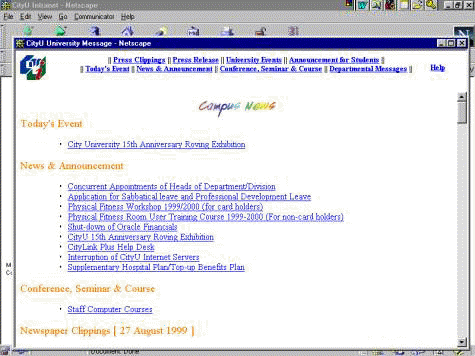
The CityU Intranet was successfully implemented in early August. Since then, University Messages followed suit and became Web-based. Therefore it is possible to add many interesting elements like pictures, images, sounds etc. to the messages. Incorporating hyperlinks also makes it easy to direct Web surfers to related or more detailed information. Most important of all, you can now read these messages wherever and whenever you have an Internet connection.If you are using your office networked PC, simply double click the
WeWe have been providing in-house dial-up facility for members of the University for several years. Though we always employ the most advanced technologies at the time of installation, as time goes by, the advancement of new telecommunication technologies is so rapid that it becomes impractical to keep on upgrading our existing modem pools to catch up with the contemporary standards. This results in a degradation of performance. On the other hand, the emphasis on using IT for teaching has stimulated a large crowd of users who need fast Internet access frequently and the demand for dial-up facility to support Web-based instructions keeps increasing. As such, there is an urgent need to replace our present dial-up equipment. However, sooner or later we will encounter another cycle of obsolescence. Therefore, the only way out is outsourcing.
 CityU IT ChatBot