
News
Recently, the University's student intranet has been replaced by the CityU e-portal. This marks the beginning of a new era in the use of electronic communications in the University. There is no doubt that the World Wide Web (WWW) has completely transformed the use of computer networks for distribution of information. Everybody, from large multi-national corporations to single individuals, is putting up WEB sites that promote and describe their organization or the services they provide.
The proliferation of virus is a common headache to the computer as well as Internet users, causing billions of dollars lost each year. As viruses nowadays turn trickier, there is no single cure to stop it from spreading feverishly. However, this does not mean there is nothing that we can do to protect our machines from being infected.
When we talk about the cost of a PC on campus, it is common that only the price of the PC is considered. In fact, this amount alone is far less than the Total Cost of Ownership (TCO) of the PC as other types of costs associated such as installation, software, networking, communications, applications and services provided on the campus network, maintenance and technical support etc. will inevitably be incurred when the PC is put into use.
City University's third annual WebCourse Fair 2003 kicked off on 14 January with a virtual exhibition showcasing the use of the Internet for teaching and learning. Around 30 teaching staff members shared online how they make use of audio-visual learning packages, online quizzes, self-assessment tools and 3D animations to stimulate students' interest.
Technology is moving in an ever-increasing speed. Staff and students alike are forever faced with the challenge of adapting quickly to the dynamic University computing environment. There is always a need to learn about new software features and how to make technology transitions, for example, migrating to a new operating system. In order to stay current with the technology trends, staff and students are encouraged to take advantage of the training opportunities on campus.How can the CSC help?
It has become common practice for Web content providers to put up Acrobat documents as reference since it allows better page layouts and formats, especially for long documents with chapters, sections or graphics. However, Acrobat documents are version dependent. We have been alerted by the Help Desk about users having difficulties in viewing them on the Web. Below is a description of some of the causes and our recommendations for best viewing these documents.
Password is a very important piece of information for any computing user. Together with your username, it gives you access to all computing services on the campus network. Every time you connect, you must provide the magic word. When the password has been leaked to an illegal person, he/she can pretend to be you, which means the intruder would then have access to your files, your e-mail, your personal information, and more.
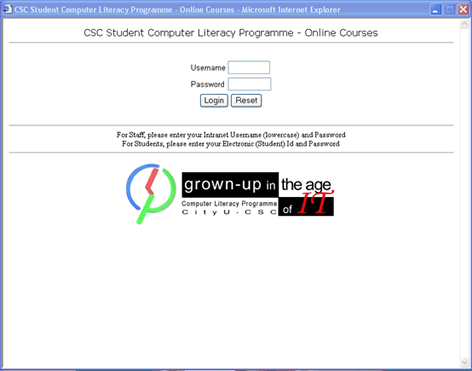
Over the years, thousands of students have attended the Student Computer Literacy Programme organised by the Computing Services Centre. In the last academic year, the Programme accepted more than 20,000 course enrolments in 20 types of training courses. In this academic year, we have already accepted more than 9,000 enrolments, but still there are many students who cannot attend our free computer training courses.
The Computing Services Centre (CSC) is very happy to report that we have successfully replaced the aged OpenVMS Alpha Cluster staff email server with a more powerful Sun ONE Messaging server on 8 October 2002. It is a major change of staff email server system in our University.The new email server not only boosts up the performance significantly, it also has richer and more user-friendly functionalities such as:
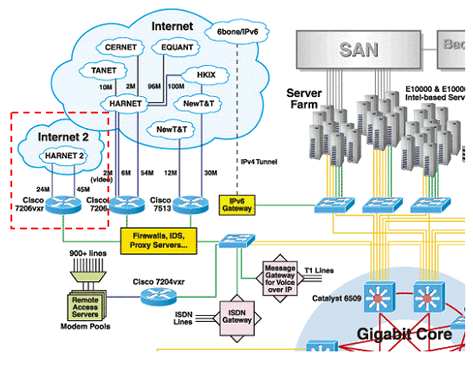
CityU is now connected to Internet2 through a 45 Mbps HARNET connection to Abilene via the STAR TAP (Science, Technology And Research Transit Access Point) interconnection exchange.What is Internet2?Internet2 is a collaborative effort of over 200 U.S. university members working in partnership with industry and government to support the development and deployment of advanced Internet technologies and applications for high-end academic experiment and research. Currently there are over 60 Internet2 corporate members and over 30 affiliate members participating in the Internet2 project. This project is funded by the National Science Foundation (NSF) and is coordinated by the University Corporation for Advanced Internet Development (UCAID), with the following primary goals:
 CityU IT ChatBot