
News
Some of the technical terms we use in our daily work were mentioned in our last issue. This issue, we shall continue to provide definitions of the ones that were often raised at the CSC Help Desk.
Spam, or junk mail, refers to unsolicited commercial e-mail (UCE) and unsolicited bulk e-mail (UBE). Example includes unsolicited advertisements. Spam spreads everywhere on the Internet nowadays and create problems to most of the e-mail users. Although e-mail companies and standards bodies are trying to work on new ways to deal with this problem, receiving junk mail is still unavoidable with today's e-mail standards and technology. All parties are trying their best to cut down the number of spam:
Unsafe attachments of e-mails may threaten the security or integrity of the recipient's computer when they are opened. For example, opening an e-mail attachment with extension such as ".exe", ".vbs" or ".scr" causes it to be executed as a program. Executing a malicious program may unleash harmful payloads (e.g. a computer virus) and damage your computer. Moreover, the virus writers may use tricks such as double file extensions (e.g. "readme.doc.exe") to disguise the malicious e-mail attachments.
The Sasser virus and its variants have been rampaging on the Internet since May 2004. According to the information provided by Symantec, Sasser is an Internet worm spreading through the MS04-011 (LSASS) vulnerability. This vulnerability is caused by a buffer overrun in the Local Security Authority Subsystem Service, and will affect all machines that are: - Running Windows XP or Windows 2000 - Haven't been patched against this vulnerability - Are connected to the Internet without a firewall

In recent years, most computers connect to external devices in a new way, known as Universal Serial Bus (USB). USB is an easy way to connect to numerous types of devices including printers, digital cameras, game pads, joysticks, keyboards, mouse devices, and storage devices etc. As USB is a very commonly used standard, let us look at it in more detail and see how it is supported in the University.USB versions
CityU is buzzing with excitement as the activities for the 20th birthday celebrations begin to unfold. What's the best way to keep abreast of the anniversary celebrations and stay informed of the new developments? Browse the 20th anniversary website and you will find the information you want.
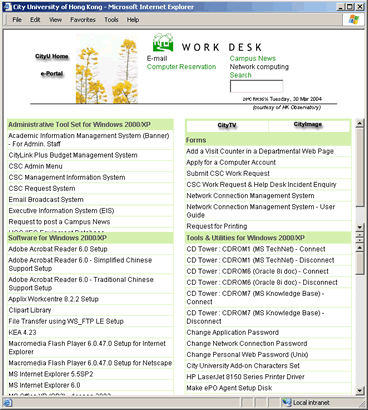
Within the CityU community, we often come across some common computer terms in our daily work; sometimes we just don't have a clue what they mean or how important they are in the community. This is very much reflected in the type of calls placed through the CSC Help Desk. Quite often novice users simply are not familiar with the technical jargons or the names of computer tools or systems that are available to them on the campus network.
The Network Connection Management System (NCMS) is a Web-based system that provides a single-stop for registration and maintenance of the network connection database of the campus network. The database contains both data (wired and wireless) and voice (PBX and VoIP) network connections in the Main Campus and the Student Residences.
Everyday, when you are working with your PC in your office drawing up important documents, and utilizing resources offered by the campus network, have you ever wondered if your data is 100% safe or whether there is protection of any sort to prevent intrusion from outsiders? In order to untangle some of your concerns, the following article will give you some ideas on what has been done to protect our campus network and what you can do to enhance the security of your own PC.Perimeter Firewall
In the early days, as long as computer viruses were transferred by floppy disks, they spread slowly. However, e-mail has changed all that. Now you can exchange files much more quickly and infecting your PC is as easy as clicking on an icon - or easier. E-mail has become the biggest source of viruses. It is because nowadays many viruses can spread themselves automatically by sending virus-contained e-mail to every address in the address book on the infected computer.
 CityU IT ChatBot