
News
Last issue, we mentioned the acquisition of the Network Storage System (NSS) as the standard platform for central storage, and the Storage Area Network (SAN) is chosen as the NSS architecture for deployment. This issue, we will focus on the acquisition of a centralised backup solution (CBS) as another part of the storage management improvement.Benefits of CBS
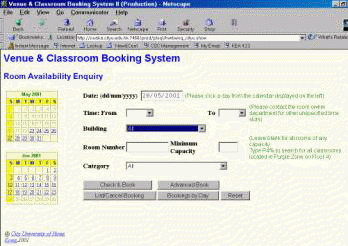
Is it possible to book University venues on the Web? The answer is yes and it can be achieved through the “Venue and Classroom Booking System” under the “Facilities Booking” menu on the CityU Intranet. Through a common Web interface, all CityU staff and student societies can access this system both on- and off-campus easily and quickly.
Today, servers across the LANs/WANs need to provide fast, reliable, ubiquitous access to data as required by various applications. In particular, mission-critical applications require data storage that can be operational all year round as well as can be expanded easily without interrupting any application currently running. At present, all server data is stored in the direct attached storage. To manage effectively the vast amount of data volume scattered among the some 50 central servers poses a great challenge to the Computing Services Centre (CSC).
Recently, tenders have been invited for a total network upgrade solution which includes a comprehensive network upgrade plan, plus the supply, installation, testing and commissioning of all the networking hardware and software required for the upgrade. After careful consideration, the tender finally went to the PCCW with the employment of Cisco products. Within the next 6 to 36 months, the CityU campus network will undergo a tremendous upgrade and soon all end users will be able to enjoy a new advanced network with high performance, resilience, flexibility and scalability.
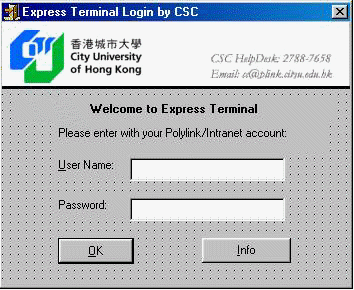
The 38 Express Terminals located all over the campus have been a very handy means for the CityU community to access the campus network and the Internet ever since their set-up by the Computing Services Centre (CSC). However, this handiness also attracts the attention of some outsiders or even hackers. Even though the 5-minute time-out mechanism is implemented for Express Terminals that are left idle or without logout, there may still be a chance for the machines to be misused or even hacked. In order to avoid such risk, a password security program is to be applied.
On As of 1 April 2001, the captioned ordinance has taken effect and one of the aims of the amended laws is to combat corporate copyright piracy activities. In order to avoid any violation of the laws, all departments and their research centres must ensure that legal copies and sufficient licences for the software installed or to be installed on their Staff LAN servers, Student LAN or any other servers, individual PCs and/or workstations were or will be acquired, and that their licensing conditions are complied with or will be rectified.
Many CityU colleagues use the Microsoft Word (MS Word) to type their papers, memos, documents, etc. However, there are a number of different versions of MS Word, such as Word 6.0, Word 95, Word 97 and Word 2000 which are divided into the Chinese and English versions. When users send some documents to the others, the recipients may find that they cannot open the documents with their MS Word. Even if the documents can be opened, the Chinese characters in the documents may not be shown properly.
Inside the Enterprise Competency Centre (ECC), there stands the high-performance computer, Sun Enterprise 10000 system, with 40 (400MHz, 8MB cache) CPUs, 14GB memory and 216 GB disk space, providing over 17Gflops of processing power.It is particularly useful for research projects that require intensive CPU power, large amount of memory and massive disk storage. Normally, the machine is divided into two separate and equal domains for different users. Use of the entire machine as a single domain is possible with prior arrangement.
On 19 April 2001, the new Banner Human Resources (HR) System was launched. It replaced the old Personnel Record System that had been in use since 1991. The new system has many advantages over the old one.Being one of the modules in the CityU Administrative Information Management System (AIMS), the Banner HR System fully integrates with other modules such as the Student module and the Alumni module. As the personal data can be shared among these modules, data redundancy is therefore eliminated to achieve better data integrity. Furthermore, staff movement is reflected immediately in the other modules. This integration has indeed provided the University with an infrastructure for better data management of the administrative systems as well as the executive information systems.
Over the years, the Unix machines, especially the Sun Solaris systems, have been widely accepted and deployed for various academic activities. However, with the increase of these Sun machines, system management, in particular security management, has become a major issue for a number of departments especially those that do not have technical staff for providing the support.In this regard, the Information Services Advisory Committee (ISAC) has endorsed the Computing Services Centre (CSC) to provide a campus-wide solution to all departments. Towards the end of last November, the CSC was pleased to announce that an agreement had been made with the Sun Enterprise Services. The Software Maintenance Support Scheme was adopted and it commenced as from 1st December 2000.
 CityU IT ChatBot