
News

With the advancement of broadband internet services, high quality video on the web becomes possible. Watching movie trailers over the net is now a common activity among movie lovers and many webmasters have begun to enrich their web sites by incorporating video presentations. To support the e-Learning activities, the Computing Services Centre (CSC) has recently upgraded the video streaming service both in the video encoding and the streaming servers such that video teaching materials can be accessed anywhere by taking advantage of the bandwidth increase of Internet access. The following is a brief account of the technologies involved in this upgrade.
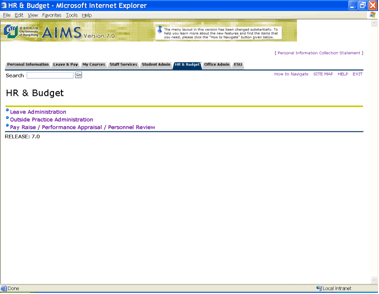
AIMS (Administrative Information Management System) was first launched in 1998/99. At that time, there were functions available only to students. As time goes on, more and more AIMS functions have been developed. Up to now, there are hundreds of them with application systems varying from student, human resources, financial to alumni. Other projects include donation, student residence, event, etc.
The Policy on the Registration and Use of University Domain Names was approved by the Management Board at the 152nd meeting held on 28 November 2005, and below was the decision made: Policy on the Registration and Use of University Domain Names
Currently there is a limited courtesy email service scheme for long-serving staff (i.e. staff serving 10 years or more) who are leaving the University. The email addresses under this scheme assume the same format as those for alumni (i.e. EID@alumni.cityu.edu.hk, which might give rise to confusion and inconvenience). Over 150 former staff are now using this service.
Why standardize on a common Chinese language environment There are many coding standards today that define how an alphabet or a character of a language is represented in a computer. These standards typically define uniquely the corresponding numerical value that represents each alphabet or character (including some special symbols that come or work with a language) of a language as well as the number of bytes necessary to represent all possible numerical values assumed by the entire set of characters or alphabets. The main Chinese language coding standards in the past such as BIG-5, GB, etc were designed to support only a single language while the more recent ones like Unicode support multiple languages. To complicate the matter further, even under the same Chinese coding standard, the same character can be represented by bytes of different length, either in fixed or variable length.

The “2006 e-Learning Forum for Greater China” at City University of Hong Kong (CityU) gathered together 200 key participants from higher education institutions in Hong Kong, the mainland, Taiwan and Singapore to share their experience in and examine issues on e-learning relevant to the Greater China region. The two-day forum (19 to 20 May) was organized by CityU and Blackboard Inc.
When the Hot Line Service evolved to the Help Desk in September 1997, a commercial Help Desk software was deployed to assist the day-to-day operations of the office.
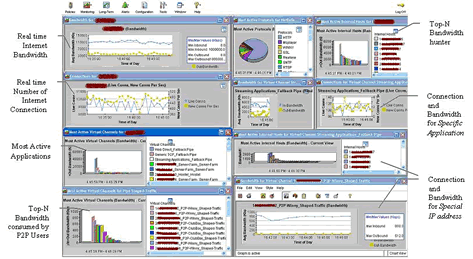
Overview Everyday, new viruses, worms and software security vulnerabilities of all types are discovered on the Internet. Network security is becoming an ongoing network monitoring and management activity. In response to these security hazards, the Computing Services Centre (CSC) is continuously making use of the most advanced technologies and security management devices to protect the campus network.
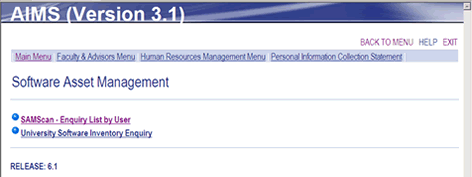
To comply with the Copyright Ordinance, the Management Board endorsed the implementation of a Software Asset Management Scheme in the University in July 2002.To implement the scheme, two application systems have been developed for use by all departments. They are the Software Inventory System and the software scanning tool, named SAMScan.
Background The sophistication of IT crime increases as technology advances. Widespread of scams are rampaged through the popular use of the Internet and email. Among all IT crimes, they are dominated by phishing and identity theft activities[1]. Phishing is a high-tech scam that uses spam email or fake web pages to deceive consumers into disclosing their credit card numbers, bank account information, identity numbers, passwords, and other sensitive personal information[2]. It is the fastest growing Internet attack and everyone is at risk as the unsolicited email and fake web sites are now encountered almost on a daily basis. Phishing attackers are getting more sophisticated in adopting social engineering skills, and reaching every corner where there is Internet users.
 CityU IT ChatBot