score_weight
1.5
Position
- Any -

BSc Computing Mathematics (Streams: Enriched Mathematics / Financial Mathematics / Global Research Enrichment and Technopreneurship (GREAT))

College/School
Subtitle
理學士 (計算數學) (專修範疇: 數學精研 / 金融數學 / 環球精研與科創)
Thumbnail
Image
1206_JBDP
Academic Year of Entry
Admission Code

1206 (JS1206)

Indicative Intake Target

Local Places:

36 (For First Year and Advanced Standing I Entries)*


Non-Local Places  
(All CityUHK programmes except Chinese Mainland Gaokao):

Around 500

Normal Duration of Programme
4 years
Programme / Major Leader
Prof. DAI Dan

PhD (City University of Hong Kong, HK)

+852 3442 5995

Admissions Tutor
Prof. LO Wing-cheong

PhD (University of California, Irvine, USA)

+852 3442 2578

Remarks

* for JUPAS and non-JUPAS admissions

Why BSc Computing Mathematics?

Mathematics is the language of science. It forms the foundation for various disciplines, such as artificial intelligence, computer science, data science, economics, engineering, physics, and even social sciences. Learning mathematics develops our ability of logical reasoning, precision, critical thinking, such that we can organize and analyze complex information, tackle complex problems in many different areas of your life and career. The programme provides students with a strong background of mathematical theory, skills and tools for mathematical modelling, scientific computation and technical computer software. Our graduates are in high demand in many sectors, including finance, technology, education, etc.. 

Entrance Requirements
JUPAS Applicants

JUPAS Entrance Requirements

JS1206 BSc Computing Mathematics
HKDSE SubjectMinimum Level Required
English LanguageLevel 3
Chinese LanguageLevel 3
MathematicsLevel 3
Citizenship and Social DevelopmentAttained
Elective 1Level 3 in one elective subject from: 
- Biology 
- Business, Accounting and Financial Studies 
- Chemistry 
- Information and Communication Technology 
- M1/M2 
- Physics
Elective 2Level 3

Notes:  
- Besides Category A elective subjects, Mathematics extended modules (M1/M2) and “other languages” can also be used to meet the elective requirement. If students take both M1 and M2, they are counted as one subject only.  
- Applied Learning subjects are not counted as elective subjects.  
- For details of the alternative Chinese Language qualifications acceptable by the University for Non-Chinese Speaking (NCS) students, please click here.

Students seeking admission to the Department of Mathematics are strongly advised to study:

Mathematics Extended Part Algebra and Calculus (Module 2) or Calculus and Statistics (Module 1), particularly Module 2 (Algebra and Calculus)

Direct/Non-JUPAS Applicants

Direct/ Non-JUPAS Applicants Entrance Requirements

To be considered for admission, you must satisfy the General Entrance Requirements and have studied a science-related subject such as Mathematics, Further Mathematics or Statistics at a high school or post-secondary institution.

For programme specific requirements on IB Mathematics, please click here.

As direct applicants are selected according to a variety of qualifications, selection is made on a case-by-case basis. Performance in selection tests and interviews, where applicable, is also an important assessment criterion.

Department of Mathematics

The Department specialises in applied and computational mathematics. Undergraduate teaching is backed up by extensive research on a wide range of topics. This places us in close contact with many modern uses of mathematics. Our programme is both relevant and up-to-date.

We are proud of our academic staff, many of whom are internationally renowned scholars. For example, Professor Philippe G. Ciarlet, member of the French Academy of Sciences and of seven other academies, was Chair Professor of the Department until August 2011. He joined the office of the College of Science and Engineering in September 2011 as University Distinguished Professor. Professor Ciarlet has received numerous distinctions, among which a Grand Prize of the French Academy of Sciences and an Alexander von Humboldt Research Award.

Professor Ciarlet is currently Emeritus Professor of the Department, and Senior Fellow in the Institute for Advanced Study of City University of Hong Kong.

本系專長於數學的實際應用及計算,系內同仁廣泛而深入的研究為良好的教學提供了紮實的基礎,教學內容緊密地聯繫現代數學的應用。我們的數學課程既緊貼時代發展,又具有實際運用價值。

本系的教員令我們深感自豪,當中不乏享譽國際的學者。法國科學院兼另外七間學院院士Philippe G. Ciarlet 教授,曾任本系講座教授至二零一一年八月,九月開始出任科學及工程學院大學傑出教授。Ciarlet 教授獲頒多個獎項,其中包括法國科學院的法國科學大獎及洪堡研究獎。

Ciarlet 教授現為香港城巿大學數學系的榮休教授,高等研究院資深院士。

Our Target

We aim at equipping students and producing graduates with strong backgrounds in data analysis, mathematical modelling, scientific computing and technical computer software. Students are trained to think quantitatively and analyse problems critically.  Our graduates contribute to the commercial, financial and industrial sectors in Hong Kong and throughout Greater China. The programme focuses on linking the applied areas of mathematics and computing.

Major Aims

The Bachelor of Science in Computing Mathematics programme was introduced in 1994. This major is unique in Hong Kong.  It emphasizes the balance between theories and their applications to practical problems, with a special focus on applied mathematics linked to computational aspects.

The major aims at equipping students and producing graduates with a strong background in:

  • data analysis
  • mathematical modelling
  • scientific computing
  • technical computer software

Students are trained to think quantitatively and analyse problems critically.

As graduates of our programme, they are in hot demand in a number of fields, including data analysis, business intelligence analysis, mathematical modelling, quantitative business planning, and scientific programming. There is also a demand for mathematics teachers in Hong Kong secondary schools.  Most graduates entered the workforce in business, finance and education sectors.

Apart from joining the workforce, some of our graduates further their studies locally or in overseas universities, such as University of Cambridge and University of Oxford in UK, University of Toronto in Canada, Harvard University, Yale University, New York University, University of Chicago and Universities of California in the US, and ETH Zurich in Switzerland.

計算數學理學士課程於一九九四年開辦,著重理論和應用數學的平衡,尤其是與科學計算之關連。本課程旨在為學生在數據分析、數學模型、科學計算及專業軟件方面建立鞏固的學術根基,並提供數量思考與分析解難能力的培訓。畢業生為各行各業羅致的對象,包括數據分析、數學模型、科學程式編排、數學科教師等。大部份畢業生於商界、金融界或教育界開展事業。

除了開展職業生涯,部份畢業生在本地或海外繼續升學,例如:英國劍橋大學及牛津大學、加拿大多倫多大學,美國哈佛大學、耶魯大學、紐約大學、芝加哥大學及加州大學,以及瑞士蘇黎世聯邦理工學院等。

What You Will Be Studying

Students are required to complete 121 credit units in different courses. The major covers communication skills, general studies, and core subjects in Complex Analysis, Computing and Programming Techniques, Differential Equations, Discrete Mathematics, Linear Algebra, Mathematical Analysis, Numerical Methods, Optimization, Ordinary Differential Equations, Partial Differential Equations, and Probability and Statistics.

Electives include Actuarial Science, Applied Functional Analysis, Applied Statistics, Computational Geometry, Dynamical Systems and Chaos, Finite Element Method, Introduction to Stochastic Processes, Mathematical Finance, Modelling and Partial Differential Equations, and Sampling Survey Methods for Social and Market Research.

Students also need to satisfy the university requirements in language and Chinese civilization.  The curriculum is very flexible.  The university requirement for gateway education and free electives give students opportunities to develop their own interests in other subjects.

Curriculum Structure

Please visit the ‘Undergraduate Catalogue’ for the programme’s curriculum structure details.

Start Your Career Here

As a graduate of our major, you will find yourself in hot demand in a number of fields, including data analysis, business intelligence analysis, mathematical modelling, quantitative business planning, and scientific programming. There is also a demand for mathematics teachers in Hong Kong secondary schools. Most graduates entered the workforce in business, finance and education sectors.

Industrial Training and International Exchange

The College of Science (CSCI) and the Department offer work placement opportunities through various internship schemes that provide students with full-time job attachments in firms not only in Hong Kong, but also in the Pearl River Delta region and overseas. Through such placements, students will:

  • broaden their experience and enhance their employability;
  • develop problem-solving abilities and interpersonal skills;
  • gain solid experience in a real-world work environment; and
  • learn the right attitudes towards work and professionalism.

For details, please visit the College of Science’s internship schemes website.

Furthermore, for students to broaden their educational horizons, gain language experience and enhance their awareness of different cultures, the Department, College and University offer over 110 credit-bearing exchange programmes with various partner institutions around the world, including universities in Australia, Canada, Europe, the US and the Asia-Pacific region.

For details, please visit the University's outbound exchange programme website.

Joint Bachelor's Degree Programme
Did You Know?

The Programme emphasizes on applied mathematics, numerical computations and their applications on science, engineering, finance and AI commerce. 
本課程強調應用數學、計算方法及其在科學、工程、金融及智能商貿上的應用。

Direct Admission to Joint Bachelor’s Degree Programme with Columbia University

Starting in 2026/27, high school applicants can directly apply for Year 1 entry to the prestigious Joint Bachelor’s Degree Programme offered by CityUHK and Columbia University. Graduates will earn degrees from both institutions. For JUPAS applicants, a separate application to Columbia University is required after submitting the JUPAS application.

Programme Video
Programme Brochure
Contact Type
Phone
Contact Value

+852 3442 8643

Contact Type
Fax
Contact Value

+852 3442 0250

Contact Type
Email
Contact Value
Admission Year
Programe A-Z
author_college
Title (For sorting)
607
Programme Calculation Method
Best 5 Subjects
Non-JUPAS Year 1 Admission
Non-JUPAS Senior Year Admission
International Admission
Mainland Non-Gaokao Admission
Deadline applicable to all types of Admission
Historical Data
Interview Arrangement - Direct Yr1

On a selective basis
- Mid-January to Mid-February 2027
- Individual interview
- English and Cantonese

Interview Arrangement - JUPAS

On a selective basis 
- June 2027 
- Group interview (40 minutes) 
- English
Late Application (Deadline applicable to all types)
Off
Late Application (International Admission)
Off
Late Application (Mainland Non-Gaokao Admission)
Off
Late Application (Non-JUPAS Senior Year Admission)
Off
Late Application (Non-JUPAS Year 1 Admission)
Off
Maths Core / M1 / M2 Calculation as one Subject
Off
Minimum Entrance Requirement (Core)
Historical Data Display
On
Reduce the font size?
On

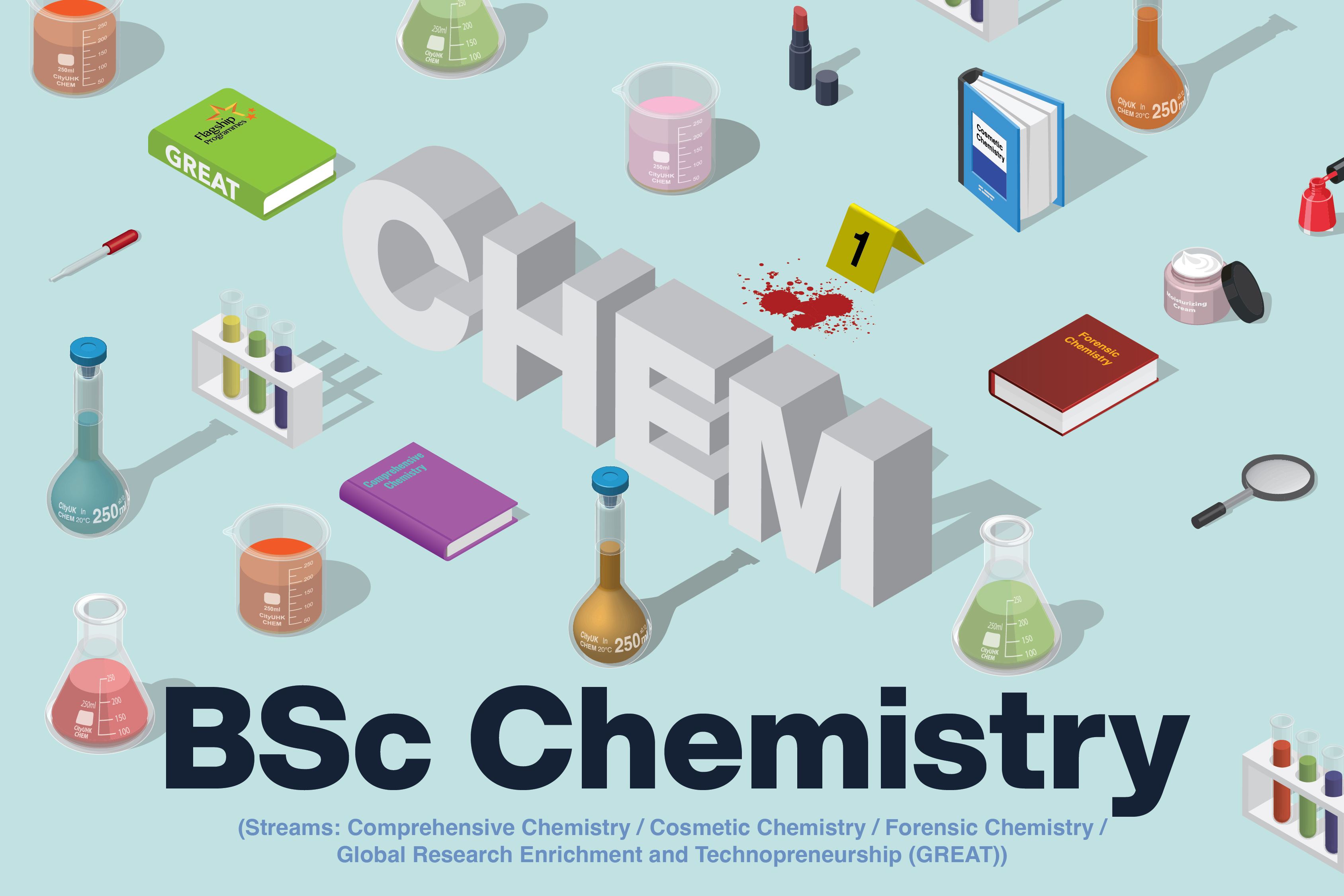
BSc Chemistry (Streams: Comprehensive Chemistry / Cosmetic Chemistry / Forensic Chemistry / Global Research Enrichment and Technopreneurship (GREAT))

College/School
Subtitle
理學士(化學) (專修: 綜合化學 / 化妝品化學 / 鑑證化學 / 環球精研與科創)
Thumbnail
Image
CHEM
Academic Year of Entry
Admission Code

1202 (JS1202)

Indicative Intake Target

Local Places:

44 (For First Year and Advanced Standing I Entries)*


Non-Local Places  
(All CityUHK programmes except Chinese Mainland Gaokao):

Around 500

Normal Duration of Programme
4 years
Programme/Major Leader
Prof. LO Kam Wing Kenneth

PhD (HKU)

Remarks

* for JUPAS and non-JUPAS admissions

Why BSc Chemistry?

The BSc Chemistry programme offers a comprehensive integration of theory and practice. With a focus on the practical application of knowledge, this programme provides students with a deep understanding of important scientific issues, current technologies, and future challenges, all within the context of local, regional, and global needs.        

The majority of courses within the programme include a lab component that effectively complements the lectures and tutorials, offering students the opportunity to gain valuable, hands-on experience. This practical experience is essential for students as they prepare for future employment or further study within the field of chemistry.

Entrance Requirements
JUPAS Applicants

JUPAS Entrance Requirements

JS1202 Chemistry
HKDSE SubjectMinimum Level Required
English LanguageLevel 3
Chinese LanguageLevel 3
MathematicsLevel 3
Citizenship and Social DevelopmentAttained
Elective 1Level 3 in Chemistry
Elective 2Level 3
OR
HKDSE SubjectMinimum Level Required
English LanguageLevel 3
Chinese LanguageLevel 3
MathematicsLevel 2
Citizenship and Social DevelopmentAttained
Elective 1Level 3 in Chemistry
Elective 2Level 3 in one elective subject from: 
- Biology 
- Business, Accounting and Financial Studies 
- Design and Applied Technology
- Information and Communication Technology
- Physics

Notes:  
- Besides Category A elective subjects, Mathematics extended modules (M1/M2) and “other languages” can also be used to meet the elective requirement. If students take both M1 and M2, they are counted as one subject only.  
- Applied Learning subjects are not counted as elective subjects.  
- For details of the alternative Chinese Language qualifications acceptable by the University for Non-Chinese Speaking (NCS) students, please click here.

Direct/Non-JUPAS Applicants

Direct/ Non-JUPAS Applicants Entrance Requirements

To be considered for admission, you must satisfy the General Entrance Requirements and have studied a subject related to Chemistry at a high school or post-secondary institution.

Curriculum Structure

For details of the programme’s curriculum structure, please visit the "Undergraduate Catalogue".

Department of Chemistry

The Department of Chemistry (CHEM) fosters an interdisciplinary approach in teaching and research. CHEM is committed to training science graduates to meet the demand for technical, educational and industrial professionals in Hong Kong. The study programmes offered by CHEM are designed to develop the knowledge, skills and attitudes that students need to achieve fulfilling personal development and a successful career.   

學系著重跨學科的學習和應用,課程融合化學理論和實踐,學習方式多元化,為學生奠定堅實的知識基礎,培養學生慎思明辨的態度,訓練學生掌握必需的技巧,如批判性思考,解難能力等。課程亦提供不少實習及交流機會,有助學生吸取工作經驗及擴闊視野,對將來的事業發展有極大裨益。   

CHEM currently offers BSc in Chemistry. 

This major integrates theory and practice. By focusing on the application of knowledge, it helps students understand important scientific issues, current technologies and future challenges in light of local, regional and global needs. Most of the courses have a lab component that complements the lectures and tutorials and enables students to acquire hands-on experience in preparation for their future employment or further study. 
 

Our Target

The Chemistry major aims to provide students with a firm foundation in chemistry that will equip them with the knowledge, understanding, skills and attitudes required to achieve personal development and find suitable employment in the industrial, commercial, government and educational sectors.

What You Will Be Studying

This major offers core courses covering foundational topics in analytical chemistry, inorganic chemistry, organic chemistry and physical chemistry. It also includes a wide range of electives on current and emerging areas in chemical science. Students can specialize in one of the streams to attain the necessary knowledge and skills, which can be applied in the real-life: 

  • Comprehensive Chemistry             
    (accredited by the Royal Society of Chemistry)  
  • Cosmetic Chemistry  
  • Forensic Chemistry  
  • Global Research Enrichment and Technopreneurship (GREAT)  

In addition, talented students can complete two degrees with an accelerated pace by selecting:   

  • Undergraduate plus Taught Postgraduate Degree Programme; or 
  • Joint Bachelor’s Degree Programme with the University of Manchester.
Start Your Career Here

Graduates can expect to make a significant contribution in both the government and private sectors. You may seek employment in various government departments (such as the Environmental Protection Department, Government Laboratory or the Agriculture, Fisheries and Conservation Department), consultancy companies, laboratories and the commercial, industrial or educational sectors. Alternatively, you may choose to pursue postgraduate studies.

Industrial Training and International Exchange

The College of Science and the Department offer work placement opportunities through internship schemes that provide students with full-time job attachments to firms not only in Hong Kong, but also in the Great Bay Area and overseas. Through such placements, students will:

  • gain solid experience in a real-life work environment; 
  • develop problem-solving abilities and interpersonal skills;
  • learn the right attitudes towards work and professionalism; and
  • broaden their experience and enhance their employability.

For details, please visit the College's website.


Furthermore, to help students broaden their educational horizons, gain language experience and enhance their awareness of different cultures, the Department, College and University offer credit-bearing exchange programmes with various partner institutions around the world, including universities in Australia, Canada, Europe, the US and the Asia-Pacific region.

For details, please visit the University’s outbound exchange programme website and the Department of Chemistry's outbound exchange programme website.


The Department also organises out-of-classroom learning activities to broaden students’ learning interests. These include:

  • Industrial Attachment and Overseas Internship Schemes, which help students acquire work experience in various local, regional and international companies and organisations.
  • Student Exchange Programmes, which provide students with opportunities to experience foreign cultures and enhance their intercultural and interpersonal skills while studying abroad.
  • Summer Research Scholarship Scheme, which pairs students with staff research groups to promote a research culture among undergraduate students.
Professional Recognition

Chemistry graduates are eligible for:

Bonus Features

Our courses are practical and based on examples from the local region. Many courses are augmented with laboratory sessions and out-of-classroom learning activities.

We aim to facilitate your active learning, rather than forcing you to memorise information. We use a range of strategies to help you learn, including:

  • web-based software to enhance your discussion of course materials;
  • the Personal Response System, an electronic device used in the classroom to gauge your understanding during lessons;
  • problem-based learning schemes that stimulate you to apply subject knowledge to solve daily life problems related to chemistry; and
  • open book examinations in some courses to encourage you to read widely and enhance your comprehension skills.
Did You Know?

This major provides basic and professional training in the areas of chemistry. Graduates can seek career opportunities in the industrial, governmental and educational sectors.

The major has close relationships with the government and industrial sectors, with the goal of nurturing the next generation of chemistry professionals.

What can CHEMISTS do?
BSc Chemistry 理學士(化學)
Programme Brochure
Contact Type
Phone
Contact Value

3442-7404

Contact Type
Email
Admission Year
Programe A-Z
author_college
Title (For sorting)
604
Programme Calculation Method
Best 4 Subjects
Non-JUPAS Year 1 Admission
Non-JUPAS Senior Year Admission
International Admission
Mainland Non-Gaokao Admission
2nd Rule nid
472
Deadline applicable to all types of Admission
Historical Data
Interview Arrangement - Direct Yr1

On a selective basis
- December 2026 to May 2027
- Individual interview
- English 

Interview Arrangement - JUPAS

When necessary

Late Application (Deadline applicable to all types)
Off
Late Application (International Admission)
Off
Late Application (Mainland Non-Gaokao Admission)
Off
Late Application (Non-JUPAS Senior Year Admission)
Off
Late Application (Non-JUPAS Year 1 Admission)
Off
Maths Core / M1 / M2 Calculation as one Subject
Off
Minimum Entrance Requirement (Core)
Historical Data Display
On
Reduce the font size?
On

BSc Data and Systems Engineering (Features: Data Science / FinTech & Decision Analytics / Industrial AI / Smart City)

College/School
Subtitle
理學士(數據與系統工程) (特點: 數據科學 / 金融科技 / 工業人工智能 / 智慧城市)
Thumbnail
Image
programme default img
Academic Year of Entry
Admission Code

1074 (JS1074)

Indicative Intake Target

Local Places:

18 (For First Year and Advanced Standing I Entries)*


Non-Local Places  
(All CityUHK programmes except Chinese Mainland Gaokao):

Around 500

Normal Duration of Programme
4 years
Programme Leader and Admissions Tutor
Prof Xinyue LI

BA and MSc (University of Chicago), PhD (Yale University)

Deputy Programme Leader
Prof Hao PENG

BSc (Sun Yat-sen University), MSc (Indiana University), PhD (University of Michigan)

Remarks

* for JUPAS and non-JUPAS admissions

Why BSc Data and Systems Engineering?

Data Science PLUS 

The programme offers solid foundation in data science and intelligent systems, where students will learn to analyse, manage and improve enterprise­ class systems using big data. Graduates will be equipped with necessary tools and skills to solve emerging real-world application problems and become big data professionals in the following fields:

• FinTech & Decision Analytics

• Industrial Al

• Smart City

Entrance Requirements
JUPAS Applicants

JUPAS Entrance Requirements

JS1074 BSc Data and Systems Engineering
HKDSE SubjectMinimum Level Required
English LanguageLevel 3
Chinese LanguageLevel 3
MathematicsLevel 3
Citizenship and Social DevelopmentAttained
Elective 1Level 3
Elective 2Level 3

Notes:  
- Besides Category A elective subjects, Mathematics extended modules (M1/M2) and “other languages” (at grade E or above) can also be used to meet the elective requirement. If students take both M1 and M2, they are counted as one subject only.  
- Applied Learning subjects are not counted as elective subjects.  
- For details of the alternative Chinese Language qualifications acceptable by the University for Non-Chinese Speaking (NCS) students, please click here.

Direct/Non-JUPAS Applicants

Direct/ Non-JUPAS Applicants Entrance Requirements

To be considered for admission, you must satisfy the General Entrance Requirements. For programme specific requirements on IB Mathematics, please click here.

Curriculum Structure

First Year Curriculum

First-Year Curriculum

CoursesNo. of Credit Units
General EducationUniversity Requirements

• GE1401 University English; and  
• Discipline-specific English; and  
• GE1501 Chinese Civilisation - History & Philosophy

• GE1601 Whole-Person Development

10
School Specified Requirements

School Specified GE courses for normative four-year degree:  
​

CS1315Introduction to Computer Programming
SDSC2003Human Contexts and Ethics in Data Science
CS3402Database Systems

9


Distributional Requirements

At least one course from each of the three areas:

Area 1: Arts and Humanities  
Area 2: Study of Societies, Social and Business Organisations  
Area 3: Science and Technology

12
School Requirement / Major Requirement
MA1503Linear Algebra with Applications
MA1508Calculus
8
Major RequirementSDSC2004 Data Visualization3
Total No. of Credit Units:42

For details of the programme’s curriculum structure, please visit the ‘Undergraduate Catalogue’.

What You Will be Studying

Offering a solid foundation in data science and intelligent systems, the BSc Data and Systems Engineering programme equips students with strong analytical and decision-making skills, enabling them to analyse, manage and improve enterprise-class systems. The enterprises considered may be businesses, governmental institutions or service-oriented engineering organisations. Main data science application subjects in this program covers data-driven financial technologies, smart city, artificial intelligence, and industrial internet of things.

BSc Data and Systems Engineering students are nurtured to become analytically minded and versatile graduates capable of collecting, analysing and interpreting big data. With such skills, they are proficient at transforming vast amounts of information into actionable insights, enhancing decision-making in their organisations.

The programme provides three flexible categories of advanced knowledge:
a) FinTech & Decision Analytics
b) Industrial AI
c) Smart City
 

理學士(數據與系統工程):課程注重建立學生的數據分析思維以致應用數據科學技能來描繪現實中的各類複雜系統與過程,培養學生成為數據分析、系統建模、知識發現和決策優化的專業人才。教學上涵蓋數據統計分析、知識挖掘、系統工程、人工智能等專題。讓學生有機會認識數據科學於社會和業界的廣泛應用層面及實踐需求,同時強化學生對資料採集、分析和應用創新的實踐能力。本課程涵蓋以下三個選修範疇:

1) 金融科技
2) 工業人工智能
3) 智慧城市
 

Career Prospects

The unique power of data science knowledge and technology is gaining unprecedented attention in the job market, as big data analytics, data mining, machine learning and artificial intelligence become more and more relevant to mainstream industries. It is no wonder that data science has been heralded by the Harvard Business Review as one of the hottest fields in the 21st century. Data scientists solve some of the hardest problems that businesses face, and their work is relevant to almost all realms of business.

CityUHK’s BSc Data and Systems Engineering is a unique programme to offer students a solid foundation in data science analytics, fostering their ability to apply emerging data science knowledge and technologies to produce advanced solutions to real emerging system-level business and industrial problems. Graduates with such solid theoretical knowledge and rich practical experience capable of working alongside domain experts are in great demand in virtually all fields, including but not limited to the following.

• Finance and Banking
• Innovative Industry
• E-commerce
• IT and Software Companies
• Smart City
• Logistics and Transportation Systems
• Retail and Digital Marketing
• Power and Energy
• Healthcare and Medical Research
• Government and Public Organisations
• Consultancy
• Education and Research
• Small Business, Start-ups, Multi-industry Opportunities

Scholarships and Financial Assistance

Scholarships are available, please refer to the details at https://www.cityu.edu.hk/scholarship/.

Student Exchange / Internship

The Department provides student exchange and internship opportunities to our students to gain international perspectives, global engagement and industry experience.

Students may choose between the overseas student exchange opportunities at world-leading institutions provided by the Department or the University. Paying the tuition at CityUHK, students will spend a study semester abroad and may transfer the academic credits earned at the host institution to fulfil the graduation requirement.

The Department also partners with premier corporates in a wide range of sectors to offer internship opportunities relevant to our majors. With these placements, students are expected to gain practical knowledge and hands-on experience in real-world applications.

Programme Brochure
Contact Type
Phone
Contact Value

+852 3442 7887

Contact Type
Email
Contact Value
Admission Year
Programe A-Z
author_college
Title (For sorting)
310
Programme Calculation Method
3 Core + 2 Elective Subjects
Non-JUPAS Year 1 Admission
Non-JUPAS Senior Year Admission
International Admission
Mainland Non-Gaokao Admission
Deadline applicable to all types of Admission
Historical Data
Interview Arrangement - Direct Yr1

On a selective basis
- From December 2026 onwards
- Group interview 
- English 

Interview Arrangement - JUPAS

When necessary

Late Application (Deadline applicable to all types)
Off
Late Application (International Admission)
Off
Late Application (Mainland Non-Gaokao Admission)
Off
Late Application (Non-JUPAS Senior Year Admission)
Off
Late Application (Non-JUPAS Year 1 Admission)
Off
Maths Core / M1 / M2 Calculation as one Subject
Off
Minimum Entrance Requirement (Core)
Historical Data Display
On
Reduce the font size?
On

BSc Data Science (Features: Data Science / Machine Learning / Data Mining / Big Data Analysis)

College/School
Subtitle
理學士(數據科學) (特點: 數據科學 / 機器學習 / 數據挖掘 / 大數據分析)
Thumbnail
Image
programme default img
Academic Year of Entry
Admission Code

1072 (JS1072)

Indicative Intake Target

Local Places:

28 (For First Year and Advanced Standing I Entries)*


Non-Local Places  
(All CityUHK programmes except Chinese Mainland Gaokao):

Around 500

Normal Duration of Programme
4 years
Programme Leader and Admissions Tutor
Prof Yu YANG

BEng (Hefei University of Technology), MEng (University of Science and Technology of China), PhD (Simon Fraser University)

Deputy Programme Leader
Prof Zimu ZHOU

BEng (Tsinghua University), PhD (The Hong Kong University of Science and Technology)

Remarks

* for JUPAS and non-JUPAS admissions

Why BSc Data Science?

Data Science DEEP

The programme provides essential trainings like quantitative knowledge, statistics, data mining technology and computing tools for emerging real­ world applications.  

In an inter-professional setting, students are given the tools to build theoretical and methodological knowledge in data science, communication skills and ethic awareness. There are three flexible areas of advanced knowledge:

  • Artificial  Intelligence (Al)
  • Social Media Analytics
  • Statistical Learning
Entrance Requirements
JUPAS Applicants

JUPAS Entrance Requirements 

JS1072 BSc Data Science
HKDSE SubjectMinimum Level Required
English LanguageLevel 3
Chinese LanguageLevel 3
MathematicsLevel 3
Citizenship and Social DevelopmentAttained
Elective 1Level 3
Elective 2Level 3

Notes:    
- Besides Category A elective subjects, Mathematics extended modules (M1/M2) and “other languages” (at grade E or above) can also be used to meet the elective requirement. If students take both M1 and M2, they are counted as one subject only.     
- Applied Learning subjects are not counted as elective subjects.     
- For details of the alternative Chinese Language qualifications acceptable by the University for Non-Chinese Speaking (NCS) students, please click here. 

Direct/Non-JUPAS Applicants

Direct/ Non-JUPAS Applicants Entrance Requirements

To be considered for admission, you must satisfy the General Entrance Requirements. For programme specific requirements on IB Mathematics, please click here.

Curriculum Structure

First-Year Curriculum

First-Year Curriculum

CoursesNo. of Credit Units
General EducationUniversity Requirements

• GE1401 University English; and   
• Discipline-specific English; and   
• GE1501 Chinese Civilisation - History & Philosophy

• GE1601 Whole-Person Development

10
College Specified Requirements

College Specified GE courses for normative four-year degree:   
​

CS1315Introduction to Computer Programming
SDSC2003Human Contexts and Ethics in Data Science
CS3402Database Systems

9


Distributional Requirements

At least one course from each of the three areas:

Area 1: Arts and Humanities   
Area 2: Study of Societies, Social and Business Organisations   
Area 3: Science and Technology

12
College Requirement / Major Requirement
MA1503Linear Algebra with Applications
MA1508Calculus
8
Major RequirementSDSC2004 Data Visualization3
Total No. of Credit Units:42

For details of the programme’s curriculum structure, please visit the ‘Undergraduate Catalogue’ 

What You Will be Studying

The BSc Data Science aims to provide data science graduates with essential training in the quantitative methods, statistical analysis techniques, data mining technology and computing tools required for the effective use and analysis of big and complex data for real-world applications that involve making sense of complex data to realize planning and decision making. The programme develops strong and interdisciplinary training in the ability to build data analysis reasoning, communication skills and ethic awareness in realistic inter-professional settings for commercial or public policy problems in various disciplines.

The programme provides three flexible areas of advanced knowledge:

  1. Artificial Intelligence
  2. Social Media Analytics
  3. Statistical Learning


理學士(數據科學):課程旨在為學生建立紥實的數據科學基礎和理論知識,並透過跨學科的培訓,提供如定量知識、統計學習、數據挖掘技術和電腦科學等課題,幫助學生融會貫通各領域和產業的專業需求,有效地分析和使用大數據和複雜資訊,建立分析推理能力、溝通技巧和道德意識。本課程具備以下三個範疇讓學生針對個人興趣進行選修:

  1. 人工智能
  2. 社交媒體分析
  3. 統計學習
Career Prospects

The unique power of data science knowledge and technology is gaining unprecedented attention in the job market, as big data analytics, data mining, machine learning and artificial intelligence become more and more relevant to mainstream industries. It is no wonder that data science has been heralded by the Harvard Business Review as one of the hottest fields in the 21st century. Data scientists solve some of the hardest problems that businesses face, and their work is relevant to almost all realms of business.

CityUHK’s BSc Data Science is a unique programme to offer students a rigorous theoretical and methodological knowledge of data science along with in-depth analysis and evaluation for applied problems. Graduates with such solid theoretical knowledge and rich practical experience capable of working alongside domain experts are in great demand in virtually all fields, including but not limited to the following.

• Finance and Banking
• Innovative Industry
• E-commerce
• IT and Software Companies
• Smart City
• Logistics and Transportation Systems
• Retail and Digital Marketing
• Power and Energy
• Healthcare and Medical Research
• Government and Public Organisations
• Consultancy
• Education and Research
• Small Business, Start-ups, Multi-industry Opportunities

Scholarships and Financial Assistance

Scholarships are available, please refer to the details at https://www.cityu.edu.hk/scholarship/.

Student Exchange / Internship

The Department provides student exchange and internship opportunities to our students to gain international perspectives, global engagement and industry experience.

Students may choose between the overseas student exchange opportunities at world-leading institutions provided by the Department or the University. Paying the tuition at CityUHK, students will spend a study semester abroad and may transfer the academic credits earned at the host institution to fulfil the graduation requirement.

The Department also partners with premier corporates in a wide range of sectors to offer internship opportunities relevant to our majors. With these placements, students are expected to gain practical knowledge and hands-on experience in real-world applications.

Programme Brochure
Contact Type
Phone
Contact Value

+852 3442 7887

Contact Type
Email
Contact Value
Admission Year
Programe A-Z
author_college
Title (For sorting)
307
Programme Calculation Method
3 Core + 2 Elective Subjects
Non-JUPAS Year 1 Admission
Non-JUPAS Senior Year Admission
International Admission
Mainland Non-Gaokao Admission
Deadline applicable to all types of Admission
Historical Data
Interview Arrangement - Direct Yr1

On a selective basis
- From December 2026 onwards
- Group interview 
- English 

Interview Arrangement - JUPAS

When necessary

Late Application (Deadline applicable to all types)
Off
Late Application (International Admission)
Off
Late Application (Mainland Non-Gaokao Admission)
Off
Late Application (Non-JUPAS Senior Year Admission)
Off
Late Application (Non-JUPAS Year 1 Admission)
Off
Maths Core / M1 / M2 Calculation as one Subject
Off
Minimum Entrance Requirement (Core)
Historical Data Display
On
Reduce the font size?
Off

Data Science (Majors: BSc Data Science / BSc Data and Systems Engineering)

College/School
Subtitle
數據科學 [主修:理學士 (數據科學) / 理學士 (數據與系統工程)]
Thumbnail
Image
programme default img
Academic Year of Entry
Admission Code

1071 (JS1071)

Indicative Intake Target

Local Places:

20 (For First Year Entry)*


Non-Local Places  
(All CityUHK programmes except Chinese Mainland Gaokao):

Around 500

Normal Duration of Programme
4 years
Programme Leader and Admissions Tutor
Prof Xinyue LI

BA and MSc (University of Chicago), PhD (Yale University)

Deputy Programme Leader
Prof Hao PENG

BSc (Sun Yat-sen University), MSc (Indiana University), PhD (University of Michigan)

Remarks

* for JUPAS and non-JUPAS admissions

Why Data Science (Majors: BSc Data Science / BSc Data and Systems Engineering)?

Data Science focuses on solving problems and advancing societies using vast amounts of data. Students of 1071 will have a free choice of majors (BSc Data Science or BSc Data and Systems Engineering) after one year of study.

Entrance Requirements
JUPAS Applicants

JUPAS Entrance Requirements

JS1071 Data Science (Majors: BSc Data Science / BSc Data and Systems Engineering)
HKDSE SubjectMinimum Level Required
English LanguageLevel 3
Chinese LanguageLevel 3
MathematicsLevel 3
Citizenship and Social DevelopmentAttained
Elective 1Level 3
Elective 2Level 3

Notes:  
- Besides Category A elective subjects, Mathematics extended modules (M1/M2) and “other languages” (at grade E or above) can also be used to meet the elective requirement. If students take both M1 and M2, they are counted as one subject only.  
- Applied Learning subjects are not counted as elective subjects.  
- For details of the alternative Chinese Language qualifications acceptable by the University for Non-Chinese Speaking (NCS) students, please click here.

Direct / Non-JUPAS Applicants

Direct/ Non-JUPAS Applicants Entrance Requirements

To be considered for admission, you must satisfy the General Entrance Requirements. For programme specific requirements on IB Mathematics, please click here.

Admission Arrangements

Applicants to this programme (admission code: 1071) will be considered for admission to first-year studies at the Department of Data Science. Students will have a free choice of majors (current major options: BSc Data Science, BSc Data and Systems Engineering) offered by the Department after one year of study.

Curriculum Structure

First-Year Curriculum

First-Year Curriculum

CoursesNo. of Credit Units
General EducationUniversity Requirements

• GE1401 University English; and 
• Discipline-specific English; and 
• GE1501 Chinese Civilisation - History & Philosophy

• GE1601 Whole-Person Development

10
College Specified Requirements

College Specified GE courses for normative four-year degree: 
​

CS1315Introduction to Computer Programming
SDSC2003Human Contexts and Ethics in Data Science
CS3402Database Systems

9


Distributional Requirements

At least one course from each of the three areas:

Area 1: Arts and Humanities 
Area 2: Study of Societies, Social and Business Organisations 
Area 3: Science and Technology

​12
College Requirement / Major Requirement
MA1503Linear Algebra with Applications
MA1508Calculus
8
Major RequirementSDSC2004 Data Visualization3
Total No. of Credit Units:42

For details of the programme’s curriculum structure, please visit the ‘Undergraduate Catalogue’.

Department of Data Science

The Department of Data Science (DS), the first independent school in the region to focus on data science and its applications, aims to nurture future data science talent, which is urgently needed in numerous industries and by society at large. Boasting world-class faculty and an outstanding infrastructure and vision, the Department aspires to become a trailblazer in data science in Hong Kong and beyond.  

The DS offers interdisciplinary curricula for undergraduate students. These curricula not only provide a solid foundation in data science and a state-of-the-art spectra of data science subjects, but also offer students the chance to undertake projects and courses connected with promising application areas in data science, such as systems analytics, social media analysis, FinTech & Decision Analytics, Smart City, Artificial Intelligence and statistical learning approaches. Fostering intellectual curiosity and autonomy, the DS provides students with ample opportunities to participate in open-ended projects and realise their dream data science products. Through its extensive industrial partnerships and networks, the DS will prepare a new breed of data science professionals to excel in inter-disciplinary and cross-functional collaboration.

What You Will be Studying

A qualified data scientist or data engineer is trained in a range of computing, mathematics, statistics, and business-oriented topics, gaining a core collection of interdisciplinary skills. The BSc Data Science (BScDS) programme and BSc Data and Systems Engineering (BScDSE) programme will prepare students to become a data science professional with solid theoretical knowledge and rich practical experience. The programmes will offer you a solid foundation in the following areas.

Mathematics and computer programming in data science Statistical learning, machine learning and deep learning Artificial intelligence System modelling, simulation and optimization

Three flexible areas of advanced knowledge (BSc Data Science)

  • Artificial Intelligence (AI)
  • Social Media Analytics
  • Statistical Learning

Four flexible categories of advanced knowledge (BSc Data and Systems Engineering)

  • FinTech & Decision Analytics
  • Industrial AI
  • Smart City
Programme Mission

City University of Hong Kong offers two unique undergraduate programmes, BSc Data Science and BSc Data and Systems Engineering, which are designed to cultivate data science professionals capable of applying and creating the data science knowledge required to support social and economic development in Hong Kong and beyond. Data science, as a rapidly growing field, focuses on solving problems and furthering social progress using vast amounts of data collected in various industries, commerce and applied sciences. A data science professional is trained to use and extract insights from these data,  apply to and solve real-world problems in the data realm responsibly.

BSc Data Science cultivates data scientists and data science professionals with rigorous theoretical and methodological knowledge of data science along with in-depth analysis and evaluation for applied problems.

BSc Data and Systems Engineering cultivates data scientists and advanced data engineers with a solid understanding of the tools and techniques, with a focus on managing data and applying data science techniques to solve social, business and industrial problems.

數據科學發展迅速,着重於利用大量從各行業、商業、應用領域收集的數據去解決相關問題及作出改善。學生在第一學年須修讀數學、電腦、數據科學入門等基礎科學科目。在完成第一學年後,自由選讀「理學士(數據科學)」或「理學士(數據與系統工程)」其中一個主修課程和相關科目。

「理學士(數據科學)」及「理學士(數據與系統工程)」分別針對數據科學的應用和研究範疇。

理學士(數據科學):旨在培育擁有紥實的數據科學理論及知識基礎的未來數據科學家,並探索新的數據科學研究方法。

理學士(數據與系統工程):旨在培育擁有紥實的數據科學工具知識及技巧的未來數據科學家。課程着重於數據科學於社會及經濟上的實際應用。

Career Prospects

Please refer to the BSc DS and BSc DSE programme information for details.

Scholarships and Financial Assistance

Scholarships are available, please refer to the details at https://www.cityu.edu.hk/scholarship/.

Student Exchange / Internship

The Department provides student exchange and internship opportunities to our students to gain international perspectives, global engagement and industry experience.

Students may choose between the overseas student exchange opportunities at world-leading institutions provided by the Department or the University. Paying the tuition at CityUHK, students will spend a study semester abroad and may transfer the academic credits earned at the host institution to fulfil the graduation requirement.

The Department also partners with premier corporates in a wide range of sectors to offer internship opportunities relevant to our majors. With these placements, students are expected to gain practical knowledge and hands-on experience in real-world applications.

Programme Brochure
Contact Type
Phone
Contact Value

+852 3442 7887

Contact Type
Email
Contact Value
Admission Year
Programe A-Z
author_college
Title (For sorting)
304
Programme Calculation Method
3 Core + 2 Elective Subjects
Non-JUPAS Year 1 Admission
Non-JUPAS Senior Year Admission
International Admission
Mainland Non-Gaokao Admission
Deadline applicable to all types of Admission
Historical Data
Interview Arrangement - Direct Yr1

On a selective basis
- From December 2026 onwards
- Group interview 
- English

Interview Arrangement - JUPAS

When necessary

Late Application (Deadline applicable to all types)
Off
Late Application (International Admission)
Off
Late Application (Mainland Non-Gaokao Admission)
Off
Late Application (Non-JUPAS Senior Year Admission)
Off
Late Application (Non-JUPAS Year 1 Admission)
Off
Maths Core / M1 / M2 Calculation as one Subject
Off
Minimum Entrance Requirement (Core)
Historical Data Display
On
Reduce the font size?
Off

AI, Computing and Transformation (ACT) (Features: Free Choice of Major / One-to-One Advisor / Elite Work Placement / Executive Mentor Scheme / Premium Overseas Exchange / Internship Exchange)

College/School
Subtitle
人工智能 · 計算 · 突破課程 (特點: 自由選擇學院專業學科 / 一對一專業導師 / 精英學生實習培訓 / 專業導師指導計劃 / 頂尖海外大學交流)
Thumbnail
Image
Default image_flagship
Academic Year of Entry
Admission Code

1070 (JS1070)

Indicative Intake Target

Local Places:

10 (For First Year Entry)*


Non-Local Places  
(All CityUHK programmes except Chinese Mainland Gaokao):

Around 500

Normal Duration of Programme
4 years
Director of Flagship Programme
Prof Qi WU

BEng (Wuhan University), MSc (Peking University), PhD (Columbia University)

Remarks

* for JUPAS and non-JUPAS admissions

Why AI, Computing and Transformation (ACT)?

AI, Computing and Transformation (ACT) is one of the Flagship Programmes offered by CityUHK. The ACT option stands as a pioneering approach initiative in data science, computer science and AI education. It aims to offer exceptional students a comprehensive education in these fields, and unparalleled opportunities to gain valuable international exposure and practical experience through overseas exchanges and elite work placements at renowned universities and leading worldwide companies.


Key features

Students admitted to the ACT programme will enjoy the exclusive features, including:


Free choice of majors: Admitted students will have the flexibility to select their preferred major upon accepting the offer. The available majors for the ACT stream option are:

  • BSc Computer Science (ACT stream)
  • BSc Cybersecurity (ACT stream)
  • BSc Data Science (ACT stream)
  • BSc Data and Systems Engineering (ACT stream)


1. Personalized one-to-one advising: Each admitted student will be assigned a dedicated faculty member who will provide personalized guidance and support throughout the academic studies.

2. Cross cultural exposure: Students will be given priority to participate in the Cultural and Language Immersion Scheme organized by the College of Computing. This scheme aims to foster cross-cultural competence and preparing students for future international exchanges, enhancing their global perspectives.

3. Elite work placement: Students will have the opportunity to gain practical experience and expand their professional network through placement at reputable companies. During these placements, they will be exposed to high level tasks and supervised by senior level staff.

4. Executive Mentor Scheme: Each student will be paired with a senior professional who will serve as their executive mentor. This programme aims to deepen the understanding of the industry and enhancing the entrepreneurship skills.

5. Premium overseas exchange/Internship exchange: Students will be arranged to pursue an attachment at a prestigious overseas university such as MIT and Imperial College London, for exchange or engage in a summer programme.

Entrance Requirements
JUPAS Applicants

JUPAS Entrance Requirements

JS1070 AI, Computing and Transformation (ACT) (Features: Free Choice of Major / One-to-One Advisor / Elite Work Placement / Executive Mentor Scheme / Premium Overseas Exchange / Internship Exchange)
HKDSE SubjectMinimum Level Required
English LanguageLevel 3
Chinese LanguageLevel 3
MathematicsLevel 3
Citizenship and Social DevelopmentAttained
Elective 1Level 3
Elective 2Level 3

Notes:  
- Besides Category A elective subjects, Mathematics extended modules (M1/M2) and “other languages” (at grade E or above) can also be used to meet the elective requirement. If students take both M1 and M2, they are counted as one subject only.  
- Applied Learning subjects are not counted as elective subjects.  
- For details of the alternative Chinese Language qualifications acceptable by the University for Non-Chinese Speaking (NCS) students, please click here.

Direct/Non-JUPAS Applicants

To be considered for admission, you must satisfy the General Entrance Requirements.

Admission Arrangements

Applicants to this programme will have a free choice of majors offered by the Department of Computer Science, and the Department of Data Science. The major options are:

  • BSc Computer Science (ACT stream)
  • BSc Cybersecurity (ACT stream)
  • BSc Data Science (ACT stream)
  • BSc Data and Systems Engineering (ACT stream)


Curriculum Structure

For details of the programme curriculum structure, please visit the “Undergraduate Catalogue”.

College of Computing

College of Computing
The College of Computing, comprising the Department of Biostatistics, Department of Computer Science and the Department of Data Science, aspires to serve as a centre of excellence in the integrated study of computer science, data science, and statistics, harnessing the synergies among these disciplines to conduct cutting-edge, collaborative research that develops advanced analytical tools and AI-powered solutions to tackle complex global challenges. We are committed to nurturing a diverse community of international learners, equipping them with the technical expertise, analytical skills, and interdisciplinary mindset needed to drive impactful change in various industries and sectors. The undergraduate programmes are offered by the Department of Computer Science and the Department of Data Science.

Department of Computer Science
The Department of Computer Science was established in 1984, and has evolved from a teaching-oriented department into one that excels in both teaching and research.

In addition to offering traditional courses such as foundations of computer science, computer architecture and software engineering, the curriculum exposes students to the latest advances in cloud computing, machine learning, and bioinformatics. Students have the opportunity to undertake a major design and development project in areas such as electronic commerce, virtual reality, multimedia, computer vision, cloud computing, information security and cybersecurity.

Department of Data Science
The Department of Data Science, the first department in the region to focus on data science and its applications, aims to nurture future data science talent, which is urgently needed in numerous industries and by society at large. Boasting world-class faculty and an outstanding infrastructure and vision, the department aspires to become a trailblazer in data science in Hong Kong and beyond.  

The department offers interdisciplinary curricula for undergraduate students. These curricula not only provide a solid foundation in data science and a state-of-the-art spectra of data science subjects, but also offer students the chance to undertake projects and courses connected with promising application areas in data science, such as systems analytics, social media analysis, the Internet of Things (IoT), Smart City, Artificial Intelligence and statistical learning approaches. Fostering intellectual curiosity and autonomy, the department provides students with ample opportunities to participate in open-ended projects and realise their dream data science products. Through its extensive industrial partnerships and networks, the department will prepare a new breed of data science professionals to excel in inter-disciplinary and cross-functional collaboration.
 

What You Will be Studying

AI, Computing and Transformation (ACT) programme will prepare students to become professionals with solid theoretical knowledge and rich practical experience. The programmes will offer you a solid foundation in the following areas.

BSc Computer Science (ACT stream)
•    Computer Systems
•    Algorithm Design and Analysis and Mathematics
•    Software Engineering

BSc Cybersecurity (ACT stream):
•    Operating Systems
•    Problem Solving and Analysis
•    Programming and Modelling
•    Data Structures
•    Software Security and Design

BSc Data Science (ACT stream):
•    Artificial Intelligence (AI)
•    Social Media Analytics
•    Statistical Learning

BSc Data and Systems Engineering (ACT stream):
•    FinTech
•    Industrial AI
•    Smart City
•    Internet of Things (IoT)

Programme Mission

BSc Computer Science (ACT stream)

The major provides students with a thorough grounding in the theoretical and practical aspects of the computer science discipline necessary for successful careers as professional software developers, system architects/analysts, technology officers, etc., in the continually developing information technology environment.


BSc Cybersecurity (ACT stream)

The major provides a comprehensive undergraduate education with a balanced emphasis on both foundational computer science and systematic cybersecurity training. The curriculum is designed to ensure that students gain a solid understanding of the cybersecurity principles, practical skills in various security domains, and the managerial knowledge required to oversee or contribute to a cybersecurity team, all built upon a solid foundation of computer science education.


BSc Data Science (ACT stream)

The major cultivates data scientists and data science professionals with rigorous theoretical and methodological knowledge of data science along with in-depth analysis and evaluation for applied problems.


BSc Data and Systems Engineering (ACT stream)

The major cultivates data scientists and advanced data engineers with a solid understanding of the tools and techniques, with a focus on managing data and applying data science techniques to solve social and economic problems.

Career Prospects

BSc Computer Science (ACT stream)
Graduates of this major will have good employment opportunities in the field of information technology. They will be equipped for jobs which involve state-of-the-art technology and design and construction of large software systems. The provision of study streams allows students to pursue specializations in state-of-the-art technology such as data science, cloud computing and mobile applications, further enhancing their career prospect in these areas.

BSc Cybersecurity (ACT stream)
Cybersecurity is a rapidly expanding field that presents numerous employment prospects for qualified professionals. Graduates specializing in cybersecurity have a wide array of career paths to explore.
•    Entry-level Cybersecurity Personnel: Help Desk Technicians, Network Administrators, Software Developers
•    Specialized Cybersecurity Analyst: Security Architects, Cybersecurity Managers, Chief Information Security Officers, Security Consultant

BSc Data Science (ACT stream)
A unique programme to offer students a rigorous theoretical and methodological knowledge of data science along with in-depth analysis and evaluation for applied problems.

BSc Data and Systems Engineering (ACT stream)
A unique programme to offer students a solid foundation in data science analytics, fostering their ability to apply emerging data science knowledge and technologies to produce advanced solutions to real emerging system-level business and industrial problems.

Graduates of the above two programmes with such solid theoretical knowledge and rich practical experience capable of working alongside domain experts are in great demand in virtually all fields, including but not limited to the following.
•    Finance and Banking
•    Innovative Industry
•    E-commerce
•    IT and Software Companies
•    Smart City
•    Logistics and Transportation Systems
•    Retail and Digital Marketing
•    Power and Energy
•    Healthcare and Medical Research
•    Government and Public Organisations
•    Consultancy
•    Education and Research
•    Small Business, Start-ups, Multi-industry Opportunities

Scholarships and Financial Assistance

Eligible students admitted to the ACT programme shall be considered for the Flagship Scholarships, including:
1.    Tuition fees and hall fees incurred at CityUHK and is tenable for the normal duration of the programmes concerned.
•    Full Scholarship: 100% tuition and hall fee
•    Half Scholarship: 50% tuition and hall fee
2.    Guaranteed berth in the Halls of Residence.
3.    A one-off special sponsorship of a maximum amount of HK$500,000 for an overseas exchange of up to one year at a top-ranked university.

Besides the Flagship Scholarships, various types of CityUHK scholarships are also available for eligible students. Please refer to details at http://www.cityu.edu.hk/scholarship/.
 

Student Exchange / Internship

Both the Department of Computer Science and the Department of Data Science provide student exchange and internship opportunities to their students to gain international perspectives, global engagement and industry experience.

Students may choose between the overseas student exchange opportunities at world-leading institutions provided by the Departments, the College or the University. Paying the tuition at CityUHK, students will spend a study semester abroad and may transfer the academic credits earned at the host institution to fulfil the graduation requirements.

The Departments also partner with premier corporates in a wide range of sectors to offer internship opportunities (1-semester Advanced Data Science Internship/ 9-month IT Professional Internship) relevant to the majors. With these placements, students will be exposed to high-level tasks and supervised by senior-level staff, and are expected to gain practical knowledge as well as hands-on experience in real-word applications.

Flagship Programme

This is one of the CityUHK’s Flagship Programmes, which equip students with essential knowledge and skills, cultivate their global leadership abilities, and connect them with leading professionals. The Flagship Scholarships, which cover tuition and hall fees, a guaranteed berth, and a one-off exchange sponsorship of up to HK$500,000, will be awarded to local JUPAS talents who meet the criteria.

BSc Computer Science
BSc Cybersecurity
AI, Computing and Transformation (ACT)
Contact Type
Phone
Contact Value

+852 3442 8719

Contact Type
Email
Contact Value
Admission Year
Programe A-Z
author_college
Title (For sorting)
301
Programme Calculation Method
3 Core + 2 Elective Subjects
Non-JUPAS Year 1 Admission
Non-JUPAS Senior Year Admission
International Admission
Mainland Non-Gaokao Admission
Deadline applicable to all types of Admission
Historical Data
Interview Arrangement - Direct Yr1

On a selective basis 
- From December 2026 onwards
- Group interview 
- English

Interview Arrangement - JUPAS

When necessary

Late Application (Deadline applicable to all types)
Off
Late Application (International Admission)
Off
Late Application (Mainland Non-Gaokao Admission)
Off
Late Application (Non-JUPAS Senior Year Admission)
Off
Late Application (Non-JUPAS Year 1 Admission)
Off
Maths Core / M1 / M2 Calculation as one Subject
Off
Minimum Entrance Requirement (Core)
Historical Data Display
On
Reduce the font size?
On

Bachelor of Laws and Bachelor of Science in Computer Science (Stream: Artificial Intelligence) (Double Degree)

Subtitle
法律學學⼠與理學⼠(計算機科學) (專修: 人工智能)(雙學位)
Thumbnail
Image
School of Law_
Academic Year of Entry
Admission Code

1063 (JS1063)

Indicative Intake Target

Local Places:

8 (For First-Year Entry)*


Non-Local Places  
(All CityUHK programmes except Chinese Mainland Gaokao):

Around 500

Normal Duration of Programme
5 years
LLB Programme Director
Prof. Martin LAI

SJD (University of Pennsylvania); LLM (University of Pennsylvania); JM (Tsinghua University); MEcon (The University of Hong Kong); BEcon & Fin (The University of Hong Kong); Attorney and Counsellor at Law (New York State)

Major Leader of BScCS
Prof. Howard LEUNG

BEng McGill, MSc PhD Carnegie Mellon

Remarks

* for JUPAS and non-JUPAS admissions

Why Bachelor of Laws and Bachelor of Science in Computer Science (Stream: Artificial Intelligence)

The School of Law and the Department of Computer Science are renowned internationally for the strengths of their respective disciplines. The rapid advancement of artificial intelligence (AI) and related technologies presents novel legal and ethical challenges. This changing landscape creates a growing demand and a critical need for legal professionals who possess both a deep understanding of legal principles and a strong technical foundation in computer science, particularly AI.

To meet this need, this double degree exposes students to interdisciplinary approaches, enabling them to draw meaningful connections between law and technology. By bridging the gap between these fields, the programme prepares students to thrive in an evolving professional environment and respond effectively to the demands of modern legal practice. Consequently, graduates will be uniquely equipped to navigate complex legal challenges in a technology-driven landscape, significantly enhancing their competitiveness in the job market.
 

Entrance Requirements
JUPAS Applicants

JUPAS Entrance Requirements

JS1063 Bachelor of Laws and Bachelor of Science in Computer Science (Stream: Artificial Intelligence) (Double Degree)
HKDSE SubjectMinimum Level Required
English LanguageLevel 5
Chinese LanguageLevel 3
MathematicsLevel 3
Citizenship and Social DevelopmentAttained
Elective 1 (One of the following subjects: Physics / Information and Communication Technology / Mathematics Extended Module 1 or 2 / Biology / Chemistry)Level 3
Elective 2Level 3

Notes:  
- Besides Category A elective subjects, Mathematics extended modules (M1/M2) and “other languages” (at grade E or above) can also be used to meet the elective requirement. If students take both M1 and M2, they are counted as one subject only.  
- Applied Learning subjects are not counted as elective subjects.  
- For details of the alternative Chinese Language qualifications acceptable by the University for Non-Chinese Speaking (NCS) students, please click here.


Direct/Non-JUPAS Applicants

Direct/ Non-JUPAS Applicants Entrance Requirements

To be considered for admission to this double degree programme, you must satisfy the general entrance requirements and the following minimum programme-specific English proficiency requirements:

•    an overall IELTS band score of 7#; OR  
•    a TOEFL score# of 100 (before 21 Jan 2026) or 5.5 (after 21 Jan 2026) (internet-based test); OR
•    a score of 6 in IB English (SL/HL); OR 
•    Grade B / Grade 6 in IGCSE First Language English/English Language/English Literature or Grade A / Grade 7 in IGCSE English as a Second Language; OR
•    Grade B / Grade 6 in GCSE/GCEOL English/English Language or English Literature; OR   
•    Level 5 in HKDSE English Language; OR   
•    other equivalent qualifications. 
 

#Obtained within 2 years before admission

Curriculum Structure

Students will enrol in a number of courses offered by CS (computer science courses) and SLW (law courses) in all semesters in the five-year programme, to complete a minimum requirement of 158 credit units (including 58 credit units for CS and AI courses and 57 credit units for law courses). In line with the University’s tuition fees policy, any extra credit units exceeding 144 completed in the first four years and any credit units taken in the fifth year of study and beyond will be charged on a self-financing basis.

Suggested Study Plan for Year 1 study

Semester

Credit Units

Recommended Courses

Semester A

3

GE1401 University English

1GE1601 Whole-Person Development

3

LW2601 Hong Kong Legal System

3

LW2603A Law of Tort I

3

CS1302A Introduction to Computer Programming

3

MA1200 Calculus and Linear Algebra I / MA1300 Enhanced Calculus and Linear Algebra I 

0CS2611 Seminars on Contemporary Technology I 

16


Semester B

3

LW2603B Law of Tort II

3

LW3605A Constitutional Law

3

MA1201 Calculus and Linear Algebra II / MA1301Enhanced Calculus and Linear Algebra II 

3

CS2310 Computer Programming 

1

CS2611 Seminars on Contemporary Technology I 

3CS2402 Introduction to Computational Probability Modelling 

16


Summer

3

GE2410 English for Engineering / GE2411 Legal English 

3

GE Area 1

6


Start Your Career Here

The double degree will provide students with valuable skills applicable in various sectors, including law firms, tech companies, and government, while preparing them for a career at the intersection of law and technology. Students will receive a well-rounded education from our faculty, which includes distinguished teachers and scholars from Hong Kong, the Chinese Mainland, the UK, Australia, India, and Malaysia. In addition, students will have the opportunity to be taught by visiting faculty from law schools all around the world.

Professional Accreditation

Students who complete the Law Major and two additional specific law electives (6 credits) will satisfy the requirements stipulated by the Standing Committee on Legal Education and Training to apply for admission to the Postgraduate Certificate in Laws (PCLL).

The BSc in Computer Science programme is accredited by the Hong Kong Institution of Engineers (HKIE). Based on the Seoul Accord, graduates will receive reciprocal recognition from the equivalent bodies in Australia, Canada, Israel, New Zealand, South Africa, the UK and the US.

Bonus Features
  • Enjoying overseas exchange opportunities at universities in Asia, Australia, Canada, Europe and the U.S.;

  • Having the opportunity to take a credit-bearing law course at University College, Oxford (U.K.) and The University of Melbourne in the summer*

        * subject to confirmation

Scholarship

• Extensive scholarships and financial support are provided to students for participation in the overseas-learning activities, mooting competitions and overseas placement.

• CityUHK Scholarships for Hong Kong Talents are available to JUPAS and Non-JUPAS entrants.

Programme Brochure
Contact Value
Contact Value

Department of Computer Science 

csadm@cityu.edu.hk

Admission Year
Programe A-Z
author_college
Title (For sorting)
904
Programme Calculation Method
Best 5 Subjects
Non-JUPAS Year 1 Admission
Non-JUPAS Senior Year Admission
International Admission
Mainland Non-Gaokao Admission
Deadline applicable to all types of Admission
Included Subjects for calculation first
Historical Data
Interview Arrangement - Direct Yr1

On a selective basis
- February to August 2027
- Group or individual interview
   (10 - 25 minutes)
- English 

Interview Arrangement - JUPAS

When necessary

Late Application (Deadline applicable to all types)
Off
Late Application (International Admission)
Off
Late Application (Mainland Non-Gaokao Admission)
Off
Late Application (Non-JUPAS Senior Year Admission)
Off
Late Application (Non-JUPAS Year 1 Admission)
Off
Maths Core / M1 / M2 Calculation as one Subject
Off
Minimum Entrance Requirement (Core)
Historical Data Display
On
Reduce the font size?
Off

Energy and Environment (Majors: BEng Energy Science and Engineering / BEng Environmental Science and Engineering)

Subtitle
能源及環境學 [主修: 工學士(能源科學及工程學) / 工學士(環境科學及工程學)]
Thumbnail
Image
[SEE] Energy and Environment: The Grand Challenge
Academic Year of Entry
Admission Code

1051 (JS1051)

Indicative Intake Target

Local Places:

32 (For First-Year Entry)*


Non-Local Places  
(All CityUHK programmes except Chinese Mainland Gaokao):

Around 500

Normal Duration of Programme
4 years
Admissions Tutor
Prof. Shauhrat CHOPRA
Deputy Admissions Tutor
Prof. Fatwa ABDI
Deputy Admissions Tutor
Prof. Jason LAM
Remarks

* for JUPAS and non-JUPAS admissions

Why Energy and Environment?

The School of Energy and Environment (SEE) performs cutting-edge research and provides professional education in energy- and environment-related issues. The School is designed to tackle interactive relationship between energy and environment through the development of new scientific understanding and new technologies as well as the training of new professionals with broad knowledge in the areas of energy and environment.

We have a highly internationalised and experienced faculty from various countries specialising in atmospheric and climate science, biological science, chemistry, chemical engineering, energy economics, environmental engineering, environmental policy, mechanical engineering and materials science.  SEE endeavours to produce a new breed of engineers and professionals capable of solving energy and environmental problems.

We currently offer the following majors:

  • Bachelor of Engineering in Energy Science and Engineering
  • Bachelor of Engineering in Environmental Science and Engineering

Students start with a common year of foundation study. The content of our programmes covers a wide spectrum of areas, allowing students to explore knowledge in a number of environments. At the beginning of their studies, they develop a broad scientific foundation by studying courses in basic science, covering mathematics, computer science, physics, chemistry and biology before they are guided through an in-depth exploration of environment and energy issues. Students declare their majors after completing the foundation courses in the first year.

Mission of the School

  • Advancing research and development, fostering knowledge transfer in targeted themes of benefit to societal needs in energy, environment, and sustainability;

  • Preparing leaders and practitioners to address environmental and energy needs in a rapidly decarbonizing world and build a sustainable future;

  • Maintaining a collaborative and supportive atmosphere for students, faculty, alumni and other stakeholders in advancing our interdisciplinary research and educational objectives.

Entrance Requirements
JUPAS Applicants

JUPAS Entrance Requirements

JS1051 Energy and Environment (Majors: BEng Energy Science and Engineering / BEng Environmental Science and Engineering)
HKDSE SubjectMinimum Level Required
English LanguageLevel 3
Chinese LanguageLevel 3
MathematicsLevel 2
Citizenship and Social DevelopmentAttained
Elective 1Level 3 in one elective subject from: 
- Biology 
- Chemistry 
- Physics
Elective 2Level 3

Notes:  
- Besides Category A elective subjects, Mathematics extended modules (M1/M2) and “other languages” can also be used to meet the elective requirement. If students take both M1 and M2, they are counted as one subject only.  
- Applied Learning subjects are not counted as elective subjects.  
- For details of the alternative Chinese Language qualifications acceptable by the University for Non-Chinese Speaking (NCS) students, please click here.

Direct/Non-JUPAS Applicants

To be considered for admission, you must satisfy the General Entrance Requirements. Preference may be given to students who have studied subjects related to Mathematics and Chemistry/Physics at a high school or post-secondary institution.

Admission Arrangements

Applicants of this programme (admission code: 1051) will be considered for admission to first-year studies at the School of Energy and Environment. Students will enter a major (current major options: Energy Science and Engineering; Environmental Science and Engineering) after one year of study. The top 40% of students# will have a free choice of majors offered by the School. The other 60% of students will be allocated a major within the School, subject to the availability of places and the selection criteria set by individual majors.

# based on CGPA with no failed grades and completion of at least 30 credit units including School required courses

Applicants eligible for advanced standing entry may submit an application to the following programmes:

BEng Energy Science and Engineering (admission code: 1694A)
BEng Environmental Science and Engineering (admission code: 1702A)

Curriculum Structure

Subject Area

Course Code

Course Title

Credit Units

Gateway Education (GE)

GE1401 GE2410       
GE1501

GE1601

University English       
English for Engineering     
Chinese Civilisation - History and Philosophy
Whole-Person Development

10

GE Courses in Distributional Areas

12

Mathematics


MA1200   
OR   
MA1300

Calculus and Basic Linear Algebra I   
OR   
Enhanced Calculus and Linear Algebra I

3

MA1201   
OR   
MA1301

Calculus and Basic Linear Algebra II   
OR   
Enhanced Calculus and Linear Algebra II

3

Computing

SEE1002

Introduction to Computing for Energy and Environment

3

Energy/EnvironmentCA1167
SEE1003

SEE3002
Engineering Communication
Introduction to Sustainable Energy and Environmental Engineering
Energy and Environmental Economics
3
3

3

Physics

PHY1201

General Physics I

3

Chemistry

CHEM1300

Principles of General Chemistry

3

Biology

CHEM1200

Discovery in Biology

3

Total:

49

For the full curriculum structure, please refer to the School website at the following links: 

Student / Alumni Sharing

Our SEE Stories

The Start of SEE Journey

My Dream, Strive for it!

Success is not Final,
Failure is not Fatal

Chase your Dreams with SEE

The Mind-blowing SEE

Our Future Female Engineers

The Passion, The Destination

Engineering our Future

We Shine at All Corners

Integrated Enrichment Programme

Integrated Enrichment Programme comprises a wide range of co-curricular activities and training that are tailored for SEE undergraduate students. Through the Programme, students will be exposed to not only summer programme and regular student exchange, but also industry-ready internship, professional training in leadership, presentation skills, business etiquette, business communication, and so on. The series of co-curricular activities organized by SEE every year aims to equip our students to be all-round professionals who possess skillsets highly sought after by the job market.

For details, please visit our page at: 
https://www.cityu.edu.hk/see/student-life-and-learning/integrated-enrichment-programme

Professional Recognition

Our undergraduate programmes, Bachelor of Engineering in Energy Science and Engineering (ESE) and Bachelor of Engineering in Environmental Science and Engineering (EVE), are accredited by the Hong Kong Institution of Engineers (HKIE).  The ESE programme meets the academic requirement for HKIE Corporate Membership in both the energy and environmental disciplines while EVE programme in environmental discipline.  Additionally, ESE and EVE students may choose to enrol in optional electives if they are interested in being a HKIE member in the Building Services (BSS) discipline.

The HKIE has agreements for reciprocal recognition of professional qualifications with engineering authorities in Australia, Canada, Ireland, the Mainland, New Zealand and the United Kingdom, and agreements of co-operation with other organisations in Europe, the Mainland, North America and Southeast Asia.

Major Options(s) Currently Available

Energy Science and Engineering
Environmental Science and Engineering

(The University reserves the right to make change to the major offerings)

SEE Corporate Video
Programme Video
SEE Programme Leaflet
Contact Type
Email
Contact Value

Ms LAU M Y, Man

j.man.yee@cityu.edu.hk

Admission Year
Programe A-Z
Title (For sorting)
804
Programme Calculation Method
3 Core + 2 Elective Subjects
Non-JUPAS Year 1 Admission
Non-JUPAS Senior Year Admission
International Admission
Mainland Non-Gaokao Admission
Deadline applicable to all types of Admission
Included Subjects for calculation first (One of)
Historical Data
Interview Arrangement - Direct Yr1

When necessary

Interview Arrangement - JUPAS

On a selective basis 
- Early to mid-July 2027
- Group interview 
- English

Late Application (Deadline applicable to all types)
Off
Late Application (International Admission)
Off
Late Application (Mainland Non-Gaokao Admission)
Off
Late Application (Non-JUPAS Senior Year Admission)
Off
Late Application (Non-JUPAS Year 1 Admission)
Off
Maths Core / M1 / M2 Calculation as one Subject
Off
Minimum Entrance Requirement (Core)
Historical Data Display
On
Reduce the font size?
On

International Sustainability Programme for Innovation, Research & Entrepreneurship(INSPIRE) (Majors: BEng Energy Science & Engineering/BEng Environmental Science & Engineering +Features: Global Focus)

Subtitle
環球可持續發展科創課程 [主修:工學士(能源科學及工程學) / 工學士(環境科學及工程學)+特點:環球視野]
Thumbnail
Image
JS1050_flagship
Academic Year of Entry
Admission Code

1050 (JS1050)

Indicative Intake Target

Local Places:

10 (For First Year Entry)*


Non-Local Places  
(All CityUHK programmes except Chinese Mainland Gaokao):

Around 500

Normal Duration of Programme
4 years
Admissions Tutor
Prof. Shauhrat CHOPRA
Deputy Admissions Tutor
Prof. Fatwa ABDI
Deputy Admissions Tutor
Prof. Jason LAM
Remarks

* for JUPAS admissions

Why INSPIRE?

The School of Energy and Environment (SEE) performs cutting-edge research and provides professional education in energy- and environment-related issues. The School is designed to tackle interactive relationship between energy and environment through the development of new scientific understanding and new technologies as well as the training of new professionals with broad knowledge in the areas of energy and environment.

We have a highly internationalised and experienced faculty from various countries specialising in atmospheric and climate science, biological science, chemistry, chemical engineering, energy economics, environmental engineering, environmental policy, mechanical engineering and materials science.  SEE endeavours to produce a new breed of engineers and professionals capable of solving energy and environmental problems.

We currently offer the following majors:

  • Bachelor of Engineering in Energy Science and Engineering
  • Bachelor of Engineering in Environmental Science and Engineering

Students start with a common year of foundation study. The content of our programmes covers a wide spectrum of areas, allowing students to explore knowledge in a number of environments. At the beginning of their studies, they develop a broad scientific foundation by studying courses in basic science, covering mathematics, computer science, physics, chemistry and biology before they are guided through an in-depth exploration of environment and energy issues.

At the end of Year 1, INSPIRE students can then decide their academic and research interests, and be allocated their preferred major without any selection criteria set for majors allocation.

The proposed INSPIRE stream offers a comprehensive education in energy and environmental engineering through enhanced overseas study, research engagement, industry placements, mentorship support and entrepreneurial training. It prepares students for (a) success in the field and (b) contribution to sustainable development, with the key features of the INSPIRE stream as summarized below:

  • Overseas placement / research opportunities and overseas exchange study are guaranteed for students to enhance their global perspective.

  • Students will participate in a mentorship programme that connects them with experienced professionals, offering guidance and industry insights to support their personal and professional development.

  • To embark on an entrepreneur journey, training workshops on entrepreneurship will be provided.

  • Scholarship awards will be provided for students taking part in overseas academic/research experiences at top universities.

Mission of the School

  • Advancing research and development, fostering knowledge transfer in targeted themes of benefit to societal needs in energy, environment, and sustainability;

  • Preparing leaders and practitioners to address environmental and energy needs in a rapidly decarbonizing world and build a sustainable future;

  • Maintaining a collaborative and supportive atmosphere for students, faculty, alumni and other stakeholders in advancing our interdisciplinary research and educational objectives.

Entrance Requirements
JUPAS Applicants

JUPAS Entrance Requirements

JS1050 International Sustainability Programme for Innovation, Research & Entrepreneurship(INSPIRE) (Majors: BEng Energy Science & Engineering/BEng Environmental Science & Engineering +Features: Global Focus)
HKDSE SubjectMinimum Level Required
English LanguageLevel 3
Chinese LanguageLevel 3
MathematicsLevel 2
Citizenship and Social DevelopmentAttained
Elective 1Level 3 in one elective subject from: 
- Biology 
- Chemistry 
- Physics
Elective 2Level 3

Notes:
- Besides Category A elective subjects, Mathematics extended modules (M1/M2) and “other languages” can also be used to meet the elective requirement. If students take both M1 and M2, they are counted as one subject only.  
- Applied Learning subjects are not counted as elective subjects.  
- For details of the alternative Chinese Language qualifications acceptable by the University for Non-Chinese Speaking (NCS) students, please click here.

Direct/Non-JUPAS Applicants

To be considered for admission, you must satisfy the General Entrance Requirements. Preference may be given to students who have studied subjects related to Mathematics and Chemistry/Physics at a high school or post-secondary institution.

Admission Arrangements

Applicants of this programme (admission code: JS1050) who pursue the INSPIRE stream will first be admitted to the School of Energy and Environment with an undeclared major and follow a common first-year curriculum.  This arrangement offers the flexibility for INSPIRE students to freely choose between Energy Science and Engineering (ESE) and Environmental Science and Engineering (EVE) majors, enabling them to explore both disciplines during the first year of studies.  At the end of Year 1, INSPIRE students can then decide their academic and research interests, and be allocated their preferred major without any selection criteria set for majors allocation.

Curriculum Structure

Subject Area

Course Code

Course Title

Credit Units

Gateway Education (GE)

GE1401 and GE2410       
OR       
LC0200A and LC0200B


(i) University English and       
English for Engineering     
OR     
(ii) English for Academic Purposes 1 and       
English for Academic Purposes 2    
(subject to students’ language background)

6

GE Courses in Distributional Areas

9

Mathematics


MA1200   
OR   
MA1300

Calculus and Basic Linear Algebra I   
OR   
Enhanced Calculus and Linear Algebra I

3

MA1201   
OR   
MA1301

Calculus and Basic Linear Algebra II   
OR   
Enhanced Calculus and Linear Algebra II

3

Computing

SEE1002

Introduction to Computing for Energy and Environment

3

Energy/EnvironmentSEE1003Introduction to Sustainable Energy and Environmental Engineering3

Physics

PHY1201

General Physics I

3

Chemistry

CHEM1300

Principles of General Chemistry

3

Biology

CHEM1200

Discovery in Biology

3

Total:

36

For the full curriculum structure, please refer to the School website at the following links: 

Student / Alumni Sharing

Our SEE Stories

The Start of SEE Journey

My Dream, Strive for it!

Success is not Final,
Failure is not Fatal

Chase your Dreams with SEE

The Mind-blowing SEE

Our Future Female Engineers

The Passion, The Destination

Engineering our Future

We Shine at All Corners

Integrated Enrichment Programme

Integrated Enrichment Programme comprises a wide range of co-curricular activities and training that are tailored for SEE undergraduate students. Through the Programme, students will be exposed to not only summer programme and regular student exchange, but also industry-ready internship, professional training in leadership, presentation skills, business etiquette, business communication, and so on. The series of co-curricular activities organized by SEE every year aims to equip our students to be all-round professionals who possess skillsets highly sought after by the job market.

For details, please visit our page at: 
https://www.cityu.edu.hk/see/student-life-and-learning/integrated-enrichment-programme

Professional Recognition

Our undergraduate programmes, Bachelor of Engineering in Energy Science and Engineering (ESE) and Bachelor of Engineering in Environmental Science and Engineering (EVE), are accredited by the Hong Kong Institution of Engineers (HKIE).  The ESE programme meets the academic requirement for HKIE Corporate Membership in both the energy and environmental disciplines while EVE programme in environmental discipline.  Additionally, ESE and EVE students may choose to enrol in optional electives if they are interested in being a HKIE member in the Building Services (BSS) discipline.

The HKIE has agreements for reciprocal recognition of professional qualifications with engineering authorities in Australia, Canada, Ireland, the Mainland, New Zealand and the United Kingdom, and agreements of co-operation with other organisations in Europe, the Mainland, North America and Southeast Asia.

Major Options(s) Currently Available

Energy Science and Engineering
Environmental Science and Engineering

(The University reserves the right to make change to the major offerings)

Flagship Programme

This is one of the CityUHK’s Flagship Programmes, which equip students with essential knowledge and skills, cultivate their global leadership abilities, and connect them with leading professionals. The Flagship Scholarships, which cover tuition and hall fees, a guaranteed berth, and a one-off exchange sponsorship of up to HK$500,000, will be awarded to local JUPAS talents who meet the criteria.

SEE Corporate Video
SEE Programme Leaflet
Contact Type
Email
Contact Value

Ms LAU M Y, Man

j.man.yee@cityu.edu.hk

Admission Year
Programe A-Z
Title (For sorting)
801
Programme Calculation Method
3 Core + 2 Elective Subjects
Non-JUPAS Year 1 Admission
Non-JUPAS Senior Year Admission
International Admission
Mainland Non-Gaokao Admission
Deadline applicable to all types of Admission
Included Subjects for calculation first (One of)
Historical Data
Interview Arrangement - Direct Yr1

When necessary

Interview Arrangement - JUPAS

On a selective basis 
- Early to mid-July 2027
- Group interview 
- English

Late Application (Deadline applicable to all types)
Off
Late Application (International Admission)
Off
Late Application (Mainland Non-Gaokao Admission)
Off
Late Application (Non-JUPAS Senior Year Admission)
Off
Late Application (Non-JUPAS Year 1 Admission)
Off
Maths Core / M1 / M2 Calculation as one Subject
Off
Minimum Entrance Requirement (Core)
Historical Data Display
On
Reduce the font size?
On