DSE Subject Name
min_dse_lvl
3 // 3|A2 or B1|D,E (Urdu)

BEng Innovation and Enterprise Engineering

College/School
Subtitle
工學士(創新與企業工程)
Thumbnail
Image
BENG ITME
Academic Year of Entry
Admission Code

1709A

Indicative Intake Target

Local Places:

16 (For First-Year Entry)*


Non-Local Places 
(All CityUHK programmes except Chinese Mainland Gaokao):

Around 500

Normal Duration of Programme
3 years (For Advanced Standing I Entry)
Programme Leader
Prof. Andy CHOW

BEng(HKUST), PhD(UCL)

+852 3442 2155

Admissions Tutor
Dr. Sherman NGAN

BSc(California), MSc(Minnesota), PhD(Minnesota)

+852 3442 8400

Remarks

* for JUPAS and non-JUPAS admissions

Why BEng Innovation and Enterprise Engineering?

This programme is an unique undergraduate programme in Hong Kong which covers elements of systems design and process, engineering innovation and entrepreneurship. The programme prepares our students for successful careers in engineering innovation and enterprise which are identified as a key component for Hong Kong’s future planning and growth.  Our curriculum allows students to further specialize in different areas of expertise including industrial Internet-of-Things, smart city, logistics and supply chain, robotics and automation. Our programme also has a placement component that allows students to gain real world experience, which will provide a significant edge when students look for employment after graduation.

Entrance Requirements
Direct/Non-JUPAS Applicants

Direct/ Non-JUPAS Applicants Entrance Requirements

To be considered for admission, you must satisfy the General Entrance Requirements and have studied a science- or mathematics-based subject at a high school or post-secondary institution.

Curriculum Structure

For details of the programme’s curriculum structure, please visit the ‘Undergraduate Catalogue’.

Department of Systems Engineering

The Department of Systems Engineering (SYE) offers the BEng in Innovation and Enterprise Engineering. The proposed programme consists of a two-year block delivered by the College of Engineering and College of Science, leveraging our strength and industrial connections. This programme will cover the following components over the first two-year span:

•    Understanding of the scientific principles and applications of innovation and enterprise engineering.
•    A solid foundation in science subjects for the preparation of engineering exploration.
•    Basic knowledge in relevant areas, including engineering enterprise, logistics and supply chain management, management science, technology innovation, optimisation, statistics and reliability.
•    Ability to formulate and solve real intelligent system and enterprise engineering problems and provide high-quality solutions.
•    Work-related experience and effective communication skills.

Upon completing the initial two-year period, students have the option to complete the remaining required courses in the programme or select other BEng programmes or obtain double major degrees in the College of Engineering if the student wishes to specialise in other engineering disciplines.
 

Our Target

The proposed BEng in Innovation and Enterprise Engineering (IEEG) programme is to nurture a new generation of engineers with a mindset of innovation and entrepreneurship, facilitate opportunities for tech start-ups for young entrepreneurs, and promote university-industry collaboration.

What You Will Be Studying

This programme will cover the following components over the first two-year span:

  • Understanding of the scientific principles and applications of innovation and enterprise engineering.
  • A solid foundation in science subjects for the preparation of engineering exploration. 
  • Basic knowledge in relevant areas, including engineering enterprise, logistics and supply chain management, management science, technology innovation, optimisation, statistics and reliability.
  • Ability to formulate and solve real intelligent system and enterprise engineering problems and provide high-quality solutions.
  • Work-related experience and effective communication skills.

Upon completing the initial two-year period, students have the option to pursue one of the following paths:

  1. to complete the remaining required courses of the IEEG, offered by SYE and other departments in the College of Engineering (CENG) and graduate with a Bachelor of Engineering degree in IEEG
  2. to select other BEng programmes or obtain double major degrees in the College of Engineering if the student wishes to specialise in other engineering disciplines.

There will be an academic advisor mentoring each student in the programme on selecting required elective courses for achieving their goals upon completion of the programme. 
 

Student Exchange / Internship

International Academic Exchange Programmes

For students to broaden their educational horizons, gain language experience and enhance their awareness of different cultures, the Department, College and University offer over 110 credit-bearing exchange programmes with various partner institutions around the world including universities in Australia, Canada, Europe, the US and the Asia-Pacific region.

Please visit the University's website and the Department's website for details of our outbound exchange programmes.

Industrial Placements

The College of Engineering and the Department offer work placement opportunities through various internship schemes that provide students with full-time job attachments in firms not only in Hong Kong, but also in the Pearl River Delta region and overseas. Through such placements, students will:

  • gain valuable experience in a real world work environment;
  • develop problem-solving abilities and interpersonal skills;
  • learn the right attitudes towards work and professionalism; and
  • enhance their employability.

For details, please visit the website.

Career Placements

Our graduates are actively engaged in improving the operations of various enterprises in Hong Kong. Among their roles are:

  • manufacturing and engineering in major corporations (e.g. assistant/senior engineers, quality assurance engineers);
  • management/technology consulting/entrepreneurship in Big-4 and other major management consulting firms;
  • operations management/business analysis in business enterprises (e.g. management trainees, business associates, business operation trainees)
  • data science and business process automation in major corporations.

View Career Profiles of our recent graduates.

Did You Know?
  • Every year, over 90% of our graduates find jobs within six months of graduation.
  • Department graduates are versatile and well sought-after, with about 50% finding their first jobs in the Engineering/Technical sectors and the rest in a variety of disciplines.
  • Both industrial and non-industrial enterprises in Hong Kong and manufacturing companies in the Pearl River Delta region are very enthusiastic about offering jobs to our graduates.
Programme Brochure
Programme Video
Contact Type
Phone
Contact Value

+852 3442 9321

Contact Type
Fax
Contact Value

+852 3442 0173

Contact Type
Email
Contact Value
Programe A-Z
author_college
Title (For sorting)
419
Non-JUPAS Year 1 Admission
Non-JUPAS Senior Year Admission
International Admission
Mainland Non-Gaokao Admission
Deadline applicable to all types of Admission
Included Subjects for calculation first
Historical Data
Interview Arrangement - Direct Yr1

When necessary
- Group or individual interviews
- English 

Late Application (Deadline applicable to all types)
Off
Late Application (International Admission)
Off
Late Application (Mainland Non-Gaokao Admission)
Off
Late Application (Non-JUPAS Senior Year Admission)
Off
Late Application (Non-JUPAS Year 1 Admission)
Off
Maths Core / M1 / M2 Calculation as one Subject
Off
Minimum Entrance Requirement (Core)
Historical Data Display
On
Reduce the font size?
On

Social and Arts Global Excellence (SAGE) [Features: Any major in the College of Liberal Arts and Social Sciences (except for BSocSc Social Work) / Non-local experience / Interdisciplinary]#

Subtitle
卓越全球人文社科課程 [特點: 自由選擇學院內任何一個主修科(社會科學學士(社會工作)除外) / 海外體驗 / 跨領域學習]#
Thumbnail
Image
Default image_flagship
Academic Year of Entry
Admission Code

1120 (JS1120)

Indicative Intake Target

Local Places:

10 (For First-Year Entry)*

Normal Duration of Programme
4 years
Admissions Tutor
Professor CHING May Bo
Remarks

* for JUPAS and non-JUPAS local admissions

#Programme subject to the University's approval

Why Social and Arts Global Excellence (SAGE)?

The Social and Arts Global Excellence (SAGE) stream aims to recruit high-calibre applicants who want to explore their academic interests and make informed decision about their future. Distinguished features of the stream are as follows: 

  • Free choice of major: Students admitted through the SAGE stream are free to choose a major in the College of Liberal Arts and Social Sciences (CLASS) at the beginning of Year 1 (except for BSocSc Social Work).
     
  • Service Learning courses: Students of the SAGE stream are required to satisfactorily complete two Service Learning courses under the SAGE stream, namely PIA2268 Cross-Sectoral Innovation and Leadership (3 credit units) and SS2300 Leading Public and Social Sector Organizations: Service Learning in Practice (3 credit units), which integrate community service with academic learning. This hands-on experience not only enriches students' education but also enhances their understanding of societal issues, fostering personal growth and civic responsibility.
     
  • Cross-sectoral modules: Students of the SAGE stream will be given the opportunity to widen their horizons by attending different modules of seminars (non-credit bearing) conducted by experts in their respective industries.
     
  • Non-local academic/research exchanges: Upon fulfilling conditions, eligible students of the SAGE stream will be provided with an opportunity to participate in non-local academic/research exchanges in top-ranked universities or prestigious organisations to leverage the diverse disciplines within CLASS.
     
  • One-to-one mentorship: Each student will be paired with a faculty member to meet regularly for academic advising and career planning.
     
Entrance Requirements
JUPAS Applicants

JUPAS Entrance Requirements

JS1120 Social and Arts Global Excellence (SAGE) [Features: Any major in the College of Liberal Arts and Social Sciences (except BSocSc Social Work) / Non-local experience / Interdisciplinary]
HKDSE SubjectMinimum Level Required
English LanguageLevel 3
Chinese LanguageLevel 3
MathematicsLevel 2
Citizenship and Social DevelopmentAttained
Elective 1Level 3 
Elective 2Level 3 

Notes:  

  • Unspecified electives may include Category A elective subjects, Mathematics extended modules (M1 / M2) and Category C other language subjects. If students take both M1 and M2, they are counted as one subject only.
  • Applied learning (ApL) subjects are not counted as elective subjects.
  • Past results of HKDSE Liberal Studies (Level 2 or above) are accepted for meeting the subject requirement of HKDSE Citizenship and Social Development in the General Entrance Requirements. However, results obtained in HKDSE Liberal Studies or HKDSE Citizenship and Social Development are not counted in the admission score.
  • For details of the entrance requirements, please visit the website of the Admissions Office.
     
Direct / Non-JUPAS Applicants

Direct/ Non-JUPAS Applicants Entrance Requirements

To be considered for admission (programme code: 1120), you must satisfy the General Entrance Requirements and possess the International Baccalaureate (IB) Diploma or GCE A-level (or International A-level) qualifications.

Admissions Arrangements

Students admitted through the Social and Arts Global Excellence (SAGE) stream are free to choose a major in the College of Liberal Arts and Social Sciences (CLASS) at the beginning of Year 1 (except for BSocSc Social Work). The major options are:

Department of Chinese and History
- BA Chinese and History (SAGE stream)

Department of English
- BA English (SAGE stream)

Department of Linguistics and Translation
- BA Linguistics and Language Applications (SAGE stream)

Department of Media and Communication
- BA Digital Television and Broadcasting (SAGE stream)
- BA Media and Communication (SAGE stream)

Department of Public and International Affairs
- BSocSc International Relations and Global Affairs (SAGE stream)
- BSocSc Public Affairs and Management (SAGE stream)

Department of Social and Behavioural Sciences
- BSocSc Crime Science (SAGE stream)
- BSocSc Psychology (SAGE stream)
 

Curriculum Structure

For details of the programme's curriculum structure, please visit the Undergraduate Catalogue.

What You Will be Studying

On top of the existing requirements of the respective majors in the College of Liberal Arts and Social Sciences (CLASS), students of the Social and Arts Global Excellence (SAGE) stream are required to satisfactorily complete two Service Learning courses under the SAGE stream, namely PIA2268 Cross-Sectoral Innovation and Leadership (3 credit units) and SS2300 Leading Public and Social Sector Organizations: Service Learning in Practice (3 credit units), which integrate community service with academic learning. This hands-on experience not only enriches students' education but also enhances their understanding of societal issues, fostering personal growth and civic responsibility.

Under normal circumstances, students of the SAGE stream are expected to complete PIA2268 within their first year of study and SS2300 in their second year.

Start Your Career Here

The Social and Arts Global Excellence (SAGE) stream is designed to cultivate global-minded leaders and nurture graduates with a distinct competitive edge across corporate, public and social sectors. Through combining an academic specialization offered by the College of Liberal Arts and Social Sciences (CLASS) with comprehensive cross-sectoral leadership training and non-local academic/research exchange opportunities, the SAGE stream empowers graduates to excel as management trainees, policy analysts, media strategists, consultants of Environment, Social and Governance (ESG), humanities education, and social innovators.

Flagship Programme

This is one of the CityUHK’s Flagship Programmes, which equip students with essential knowledge and skills, cultivate their global leadership abilities, and connect them with leading professionals. The Flagship Scholarships, which cover tuition and hall fees, a guaranteed berth, and a one-off exchange sponsorship of up to HK$500,000, will be awarded to local JUPAS talents who meet the criteria.

Contact Type
Email
Contact Value
Admission Year
Programe A-Z
Description (For Search Result Only)

Title (For sorting)
104
Minimum Entrance Requirement (Elective)
Programme Calculation Method
3 Core + 2 Elective Subjects
Non-JUPAS Year 1 Admission
Non-JUPAS Senior Year Admission
International Admission
Mainland Non-Gaokao Admission
Deadline applicable to all types of Admission
Historical Data
Interview Arrangement - Direct Yr1

When necessary

Interview Arrangement - JUPAS

When necessary

Late Application (Deadline applicable to all types)
Off
Late Application (International Admission)
Off
Late Application (Mainland Non-Gaokao Admission)
Off
Late Application (Non-JUPAS Senior Year Admission)
Off
Late Application (Non-JUPAS Year 1 Admission)
Off
Maths Core / M1 / M2 Calculation as one Subject
Off
Minimum Entrance Requirement (Core)
Historical Data Display
On
Reduce the font size?
On

Integrative Bioscience & Bioengineering Programme (Bio3) (Features: Free Choice of Major / Overseas Research Opportunities / Interdisciplinary)

College/School
Subtitle
綜合生物科學與生物工程課程 (特點: 自主選擇主修學科 / 海外頂尖院校研究機會 / 跨學科)
Thumbnail
Image
CBM Bio3
Academic Year of Entry
Admission Code

1300 (JS1300)

Indicative Intake Target

Local Places:

10 (For First-Year Entry)*

Normal Duration of Programme
4 years
Admissions Tutor
Prof. Gigi LO
Remarks

* for JUPAS and non-JUPAS admissions

Why Integrative Bioscience & Bioengineering Programme (Bio3)?

Explore, Innovate, and Connect: A Gateway to Biological Sciences, Biomedical Sciences, and Biomedical Engineering

Integrative Bioscience & Bioengineering Programme (Bio³) aims to provide exemplary students with a comprehensive and globally-oriented education in biomedicine and biomedical engineering. Building on the strengths of the Biological Sciences (BISI), Biomedical Sciences (BMS), and Biomedical Engineering (BME) programmes, Bio³ integrates enhanced overseas study experiences, research opportunities, and mentorship support. Students will benefit from the specialized curriculum in biomedicine and biomedical engineering, along with extensive training in global perspectives, innovative mindset, and research.

Key Features

1. Free Choice of Major

Students admitted to the Bio³ programme are free to choose their majors among (i) Biomedical Engineering [BME], (ii) Biological Sciences [BISI], (iii) Biomedical Sciences [BMS], upon offer acceptance. They will be enrolled in the major in their first year of study.

2. Overseas Research Internship

Students will have the unique opportunity to collaborate with eminent researchers in their specialized fields at a renowned international university. This hands-on experience in cutting-edge research will not only cultivate their skills in data analysis, experimental design, and scientific communication but also provide invaluable insights and mentorship for their academic and professional growth.

3. Overseas Exchange Study

Students will immerse themselves in a diverse academic environment at a prestigious international university. This experience will broaden their perspectives, enhance cultural awareness, and foster global connections. Engaging with new educational systems and peers from around the world, students will not only enrich their academic knowledge but also develop a deeper understanding of global issues and different perspectives.

4. Professional Mentorship

Students will participate in a mentorship programme that connects them with experienced professionals, offering guidance and industry insights to support their personal and professional development.

5. Flagship Scholarships (for Local Students)

Local students admitted to the Flagship Programme with outstanding academic performance shall be automatically considered for the Flagship Scholarships.

Entrance Requirements
JUPAS Applicants

JUPAS Entrance Requirements

JS1300 Integrative Bioscience & Bioengineering Programme (Bio3) (Features: Free Choice of Major / Overseas Research Opportunities / Interdisciplinary)
HKDSE SubjectMinimum Level Required
English LanguageLevel 3
Chinese LanguageLevel 3
MathematicsLevel 3
Citizenship and Social DevelopmentAttained
Elective 1Level 3 in one elective subject from: 
- Biology 
- Chemistry 
- Physics
Elective 2Level 3 in any elective subjects
[may include Attained with Distinction II in the ApL subject - Medical Laboratory Science]

Notes:  
- Unspecified elective subject exclude Category C other language subjects.  
- Besides Category A elective subjects, Mathematics extended modules (M1/M2) and “other languages” can also be used to meet the elective requirement. If students take both M1 and M2, they are counted as one subject only.  
- For details of the alternative Chinese Language qualifications acceptable by the University for Non-Chinese Speaking (NCS) students, please click here.
- "Attained with Distinction II" in the Applied Learning subject - Medical Laboratory Science may be accepted as one elective subject for JS1300.

Direct / Non-JUPAS Applicants

Direct/ Non-JUPAS Applicants Entrance Requirements

To be considered for admission (programme code: 1300), you must satisfy the General Entrance Requirements and possess the International Baccalaureate (IB) Diploma or GCE A-level (or International A-level) qualifications.

Admissions Arrangements

Applicants to this programme will have a free choice of majors offered by the Department of Biomedical Engineering and the Department of Biomedical Sciences. The major options are:

  • BEng Biomedical Engineering (Bio3 stream)
  • BSc Biological Sciences (Bio3 stream)
  • BSc Biomedical Sciences (Bio3 stream)
Curriculum Structure

For details of the programme's curriculum structure, please visit the Undergraduate Catalogue.

What You Will be Studying

Integrative Bioscience & Bioengineering Programme (Bio3) is designed to equip students with a strong theoretical background and extensive practical experience. The programmes will offer you a solid foundation in the following areas.

BEng Biomedical Engineering (Bio3 stream):

  • Medical Technology
  • Bioinstrumentation
  • Cell and Tissue Engineering
  • Biomedical Robotics

BSc Biological Sciences (Bio3 stream):

  • Bioinformatics
  • Biochemistry
  • Genetics
  • Cellular & Molecular Biology
  • Immunology

BSc Biomedical Sciences (Bio3 stream):

  • Clinical Chemistry
  • Hematology
  • Medical Microbiology
  • Cellular Pathology
Start Your Career Here

BEng Biomedical Engineering (Bio3 stream):

  • Medical device industry
  • Engineering services in hospitals
  • Consultation for public health
  • Regulation and management in government departments and laboratories
  • Research and development in commercial and educational sectors
  • Postgraduate studies locally or overseas

BSc Biological Sciences (Bio3 stream) / BSc Biomedical Sciences (Bio3 stream):

  • Medical and health services
  • Research and development in the pharmaceutical and biotechnology industries
  • Laboratory management and consultancy
  • Government
  • Postgraduate studies locally or overseas
Flagship Programme

This is one of the CityUHK’s Flagship Programmes, which equip students with essential knowledge and skills, cultivate their global leadership abilities, and connect them with leading professionals. The Flagship Scholarships, which cover tuition and hall fees, a guaranteed berth, and a one-off exchange sponsorship of up to HK$500,000, will be awarded to local JUPAS talents who meet the criteria.

Programme Leaflet
Contact Type
Phone
Contact Value

+852 3442 8207

Contact Type
Email
Contact Value
Admission Year
Programe A-Z
author_college
Title (For sorting)
104
Minimum Entrance Requirement (Elective)
Programme Calculation Method
3 Core + 2 Elective Subjects
Non-JUPAS Year 1 Admission
Non-JUPAS Senior Year Admission
International Admission
Mainland Non-Gaokao Admission
Deadline applicable to all types of Admission
Historical Data
Interview Arrangement - Direct Yr1

Not Required

Interview Arrangement - JUPAS

Not Required

Late Application (Deadline applicable to all types)
Off
Late Application (International Admission)
Off
Late Application (Mainland Non-Gaokao Admission)
Off
Late Application (Non-JUPAS Senior Year Admission)
Off
Late Application (Non-JUPAS Year 1 Admission)
Off
Maths Core / M1 / M2 Calculation as one Subject
Off
Minimum Entrance Requirement (Core)
Historical Data Display
On
Reduce the font size?
On

BSc Computer Science and BSc Computational Finance and Financial Technology (Double Degree; Features: Corporate Accounting & Economics / Computational Finance / Advanced Statistics / Modeling & Algorithms / Financial Technologies Software Engineering)

Subtitle
理學士(計算機科學)與理學士(計算金融及金融科技) (雙學位; 特點: 企業會計與經濟 / 計算金融 / 高階統計 / 建模與演算法 / 金融科技軟件工程)
Thumbnail
Image
programme default img
Academic Year of Entry
Admission Code

JS1221

Indicative Intake Target

Local Places:

10 (For First Year Entry)

Normal Duration of Programme
5 years
Programme Leader
Prof KEUNG, Wai Jacky (Department of Computer Science)

BSc Sydney, PhD New South Wales

Admission Scheme
Why Bachelor of Science in Computer Science and Bachelor of Science in Computational Finance and Financial Technology?

Leveraging Technology in Finance to Transform and Go Beyond

Jointly offered by the Department of Computer Science and the College of Business, the programme aims to educate a new generation of professionals with a unique combination of expertise from the important areas of computer science, computational finance, and financial technology. Finance is one of the pillars supporting the economy of Hong Kong, and the use of computational technologies has become pervasive in different business sectors. With recent significant advances in artificial intelligence (AI) and blockchain technologies and their increasing applications in every aspect of the financial industry, the new programme, which comprises a broad set of courses from the Department of Computer Science and College of Business, will train students with a distinctive and interdisciplinary blend of knowledge across the complete spectrum of computer science/computational finance/financial technology areas, from AI, big data analytics, derivatives pricing, financial econometrics, portfolio management to software engineering.


Career Prospects

The interdisciplinary nature of the programme allows students to enter traditional financial careers, and simultaneously equip students with finance domain knowledge and technology background for opportunities in the emerging fintech industry. Employment opportunities available for graduates include:

  • Quantitative/Finance/Business Analyst
  • Cybersecurity Analyst
  • Artificial Intelligence & Machine Learning Specialist
  • Data Scientist
  • Risk & Compliance Specialist
  • Blockchain Developer

After a few years in the field, graduates can take up a specialist role in any one of the above careers or switch among them. Management role, product/service director and entrepreneurship are advanced available options.


Entrance Requirements

JUPAS Entrance Requirements

JS1221 BSc Computer Science and BSc Computational Finance and Financial Technology 
HKDSE SubjectMinimum Level Required
English LanguageLevel 3
Chinese LanguageLevel 3
MathematicsLevel 4
Citizenship and Social DevelopmentAttained
Elective 1Level 3 in one elective subject from: 
- Biology 
- Chemistry 
- Information and Communication Technology 
- M1/M2 
- Physics
Elective 2Level 3

Notes:  
- Besides Category A elective subjects, Mathematics extended modules (M1/M2) and “other languages” (at grade E or above) can also be used to meet the elective requirement. If students take both M1 and M2, they are counted as one subject only.  
- Applied Learning subjects are not counted as elective subjects.  
- For details of the alternative Chinese Language qualifications acceptable by the University for Non-Chinese Speaking (NCS) students, please click here.

Curriculum Structure

Curriculum Structure for Bachelor of Science in Computer Science and Bachelor of Science in Computational Finance and Financial Technology

Degree RequirementsCredit       
Units 
BSc in Computer ScienceBSc in Computational Finance and Financial Technology
University Requirements  and Distributional Requirements22
  • GE1401 University English (3 credit units)
  • Discipline-specific GE English (3 credit units)

GE2410 English for Engineering or GE2402 English for Business Communication

  • GE1501 Chinese Civilisation - History and Philosophy  (3 credit units)
  • GE1601 Whole-Person Development (1 credit unit)
  • Distributional areas (12 credit units)
College-specified courses18College-specified courses of CENG          
(9 credit units):          
(MA1200/ MA1300) + (MA1201/ MA1301) + JC2066
College-specified courses of CB          
(9 credit units):          
CS2204 (in lieu of CB2240) + CS3334 + MA3525
College/School Requirement12
  • CS1302A        
    (3 credit units)
  • Take CB2400 to fulfill the 3 credit units of CC College Requirement
  • CB2100         
    (3 credit units)
  • CB2400         
    (3 credit units)
  • CB3410         
    (3 credit units)
Major Required Courses10028 or 19 credit units 
(CS core courses)
30 credit units 
(CFFT core courses)
33 credit units         
(Required Core Courses or Electives for both Majors)
9 or 18 credit units 
(CS Elective)
Minimum number of credit units for the Double Degree award152


College of Business

The College of Business is one of the premier business schools in Asia, offering a full suite of programmes from BBA, BSc, MBA, MSc, EMBA, DBA to PhD level, as well as specialist executive education courses. We are a culturally diverse faculty with over 200 core members of some 17 nationalities, and teach over 5,000 students each year. We are passionate about teaching and research and are currently ranked #39 worldwide for research. We are continuously expanding our work horizons.

Department of Computer Science

The Department of Computer Science has received worldwide recognition for its outstanding research and pedagogical development.

On the education front, our programmes are designed to meet the most pressing information and communication technology needs of business and industry in Hong Kong. The programme provides a solid foundation in computer science knowledge and introduces students to a wide range of modern technologies, design and development processes, and IT professionalism. Students have the opportunity to undertake a major design and development project in an area such as data science, virtual reality, multimedia, computer vision, cloud computing and information security.

Along with exposure to cutting-edge teaching and learning practices, these experiences are shaping a new generation of professionals capable of developing innovative solutions to challenges in new fields in computer science.

To strive for research excellence, the Department conducts world-class fundamental and applied research. With more than 200 projects in progress, the vital areas covered include artificial intelligence, big data analytics, cloud computing, multimedia computing, computer systems, cyber security, and bioinformatics. Two applied research centres of note are the Centre for Decentralized Trust Computing, and the TFI Applied Research Centre for Advanced Digital Media Technology.  A number of laboratories also conduct a wide range of research projects.

The Department maintains state-of-the-art computing facilities, including a private cloud infrastructure to support teaching activities and a high-throughput computing cluster for computationally intensive tasks involved in various research activities.

The Department’s research foci include artificial intelligence, bioinformatics, cloud computing, data science, evolutionary computation and metaheuristics, information security, machine learning, mobile computing, multimedia computing, software engineering, computer vision and graphics. Our staff members have contributed intellectually and professionally to the advancement of these fields.

Our Target

The programme aims to educate a new generation of professionals with a unique combination of expertise from the important areas of computer science, computational finance, and financial technology.  Finance is one of the pillars supporting the economy of Hong Kong, and the use of computational technologies has become pervasive in different business sectors.  With recent significant advances in artificial intelligence (AI) and blockchain technologies and their increasing applications in every aspect of the financial industry, the programme, which comprises a broad set of courses from the Department of Computer Science and College of Business, will train students with a distinctive and interdisciplinary blend of knowledge across the complete spectrum of computer science/computational finance/financial technology areas, from AI, big data analytics, derivatives pricing, financial econometrics, portfolio management to software engineering.

Programme Video
Programme Brochure
Contact Type
Phone
Contact Value

+852 3442 8580

Contact Type
Fax
Contact Value

+852 3442 0503

Contact Type
Email
Contact Value
Admission Year
Programe A-Z
author_college
Title (For sorting)
267
Programme Calculation Method
Best 5 Subjects
Non-JUPAS Year 1 Admission
Non-JUPAS Senior Year Admission
International Admission
Mainland Non-Gaokao Admission
Deadline applicable to all types of Admission
Historical Data
Interview Arrangement - JUPAS

When necessary

Late Application (Deadline applicable to all types)
Off
Late Application (International Admission)
Off
Late Application (Mainland Non-Gaokao Admission)
Off
Late Application (Non-JUPAS Senior Year Admission)
Off
Late Application (Non-JUPAS Year 1 Admission)
Off
Maths Core / M1 / M2 Calculation as one Subject
Off
Minimum Entrance Requirement (Core)
Historical Data Display
On
Reduce the font size?
On

BSc Environment and Sustainable Business (Features: Environmental Science / Business Sustainability / Environmental, Social & Governance (ESG))

Subtitle
理學士(環境及可持續發展商業) [特點:環境科學 / 商業可持續發展 / 環境、社會和管治]
Thumbnail
Image
SEE ESB Cover
Academic Year of Entry
Admission Code

1053 (JS1053)

Indicative Intake Target

Local Places:

30 (For First-Year Entry)*


Non-Local Places:

(All CityUHK programmes except Chinese Mainland Gaokao):

Around 500

Normal Duration of Programme
4 Years
Major Leader
Prof. Shauhrat CHOPRA
Remarks

* for JUPAS and non-JUPAS admissions

Why BSc in Environment and Sustainable Business?

The Bachelor of Science in Environment and Sustainable Business is a four-year undergraduate programme that is jointly offered by the School of Energy and Environment (SEE) and the College of Business (CB). The programme is designed to provide students with a comprehensive understanding of the principles and practices of sustainable business and Environmental, Social, and Governance (ESG), and their integration in the business world.

By the end of the programme, students will have a comprehensive understanding of sustainable business and ESG, and be able to apply their knowledge to real-world scenarios. They will also have a solid foundation in the science behind non-financial disclosures, and be familiar with the latest trends and technologies in sustainable energy and other fields in support of investment decision-making for sustainable finance.

The programme will be taught through a combination of lectures, case studies, and interactive discussions, and will feature experiential learning and industry connection via experts sharing (e.g., in guest lectures) from practitioners of leading organizations in Hong Kong. Students will have the opportunity to engage with real-world sustainable business/finance projects and develop practical skills in sustainability assessment, ESG integration, and impact investing. Students will also have a comprehensive understanding of sustainability in practice and ESG challenges and opportunities, and be prepared to pursue careers in this rapidly growing field.

The rationale for starting a new 4-year undergraduate programme in Environment and Sustainable Business is to meet the growing demand for professionals who can integrate ESG considerations into business, finance, and investment decisions. This demand is driven by the recognition that ESG factors are critical to long-term financial performance, and is reflected in the increasing popularity of sustainable investing and the growth of the sustainable finance industry. Hong Kong is well-positioned to take advantage of this growing demand, given its strategic location as a major financial hub and center for international trade and finance.

Entrance Requirements
JUPAS Applicants

JUPAS Entrance Requirements

JS1053 BSc Environment and Sustainable Business (Features: Environmental Science / Business Sustainability / Environmental, Social & Governance (ESG))
HKDSE SubjectMinimum Level Required
English LanguageLevel 3
Chinese LanguageLevel 3
MathematicsLevel 3
Citizenship and Social DevelopmentAttained
Elective 1Level 3 in one elective subject from: 
- Biology 
- Chemistry 
- Physics
Elective 2Level 3

Notes:  
- Besides Category A elective subjects, Mathematics extended modules (M1/M2) and “other languages” can also be used to meet the elective requirement. If students take both M1 and M2, they are counted as one subject only.  
- Applied Learning subjects are not counted as elective subjects.  
- For details of the alternative Chinese Language qualifications acceptable by the University for Non-Chinese Speaking (NCS) students, please click here.

Direct/Non-JUPAS Applicants

Direct/ Non-JUPAS Applicants Entrance Requirements

In addition to meeting the General Entrance Requirements as stipulated by the University, as a guide for applications, direct / non-JUPAS applicants are expected to have studied Mathematics and subjects related to Chemistry/Physics at a high school or post-secondary institution.

Curriculum Structure


For the full curriculum structure, please refer to the School website at the following link: 

Integrated Enrichment Programme

Integrated Enrichment Programme comprises a wide range of co-curricular activities and training that are tailored for SEE undergraduate students. Through the Programme, students will be exposed to not only summer programme and regular student exchange, but also industry-ready internship, professional training in leadership, presentation skills, business etiquette, business communication, and so on. The series of co-curricular activities organized by SEE every year aims to equip our students to be all-round professionals who possess skillsets highly sought after by the job market.

For details, please visit our page at:  
https://www.cityu.edu.hk/see/student-life-and-learning/integrated-enrichment-programme

SEE Corporate Video
SEE Programme Leaflet
Contact Type
Email
Contact Value

Ms LAU M Y, Man

j.man.yee@cityu.edu.hk

Admission Year
Programe A-Z
Description (For Search Result Only)

理學⼠(環境及可持續發展商業)

Title (For sorting)
270
Programme Calculation Method
Best 5 Subjects
Non-JUPAS Year 1 Admission
Non-JUPAS Senior Year Admission
International Admission
Mainland Non-Gaokao Admission
Deadline applicable to all types of Admission
Included Subjects for calculation first
Included Subjects for calculation first (One of)
Historical Data
Interview Arrangement - Direct Yr1

When necessary

Interview Arrangement - JUPAS

On a selective basis  
- Early to mid-July 2027
- Group interview  
- English

Late Application (Deadline applicable to all types)
Off
Late Application (International Admission)
Off
Late Application (Mainland Non-Gaokao Admission)
Off
Late Application (Non-JUPAS Senior Year Admission)
Off
Late Application (Non-JUPAS Year 1 Admission)
Off
Maths Core / M1 / M2 Calculation as one Subject
Off
Minimum Entrance Requirement (Core)
Historical Data Display
On
Reduce the font size?
On

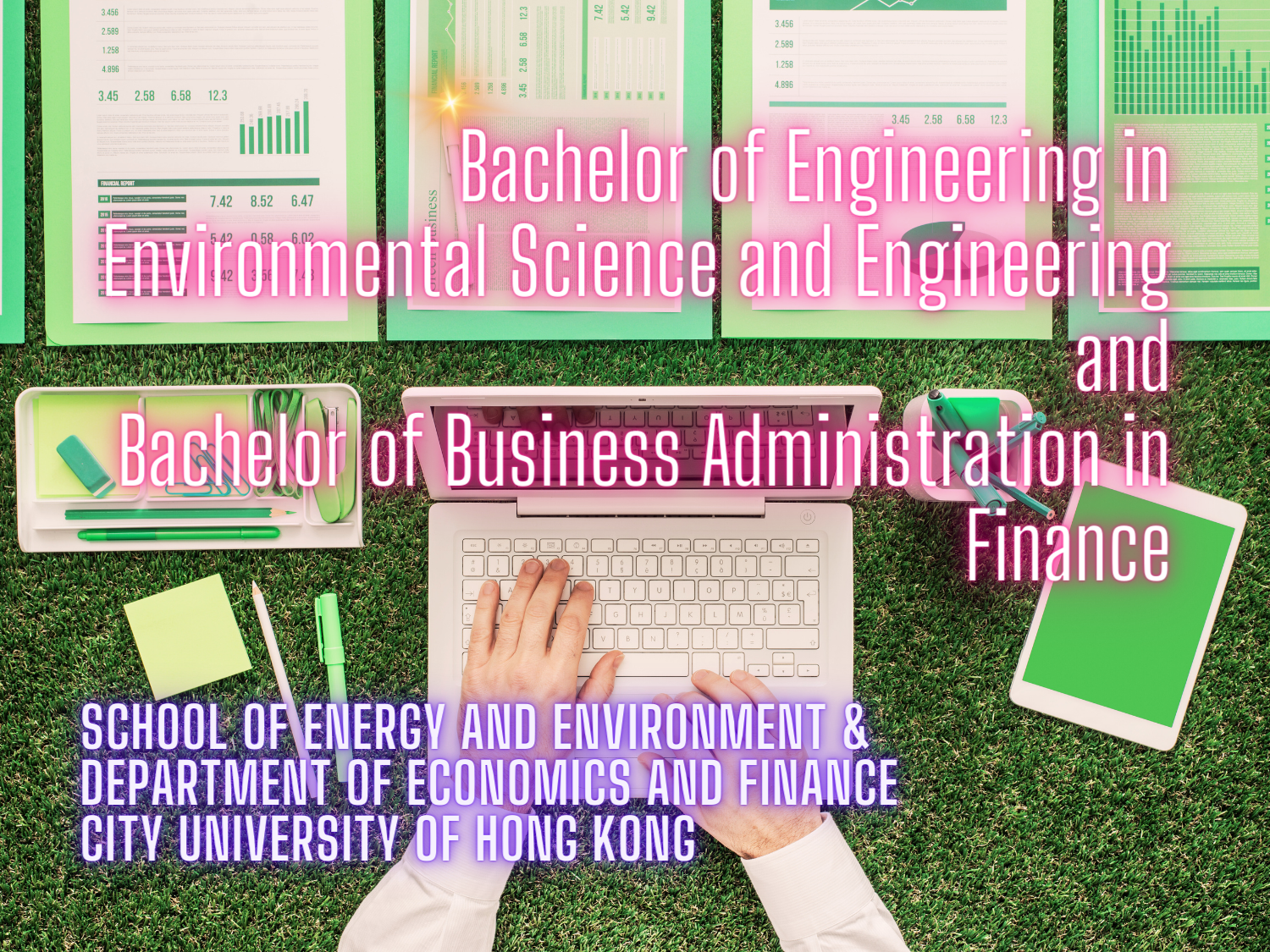
BEng Environmental Science and Engineering and BBA Finance (Double Degree; Features: Environmental, Social & Governance (ESG) / Green Finance / Environmental Technology / Interdisciplinary Education)

Subtitle
工學士(環境科學及工程學)與工商管理學士(金融)[雙學位;特點:環境、社會和管治 / 綠色金融 / 環保技術 / 跨學科教育]
Thumbnail
Image
Double Degree Programme - Bachelor of Engineering in Environmental Science and Engineering and Bachelor of Business Administration in Finance
Academic Year of Entry
Admission Code

1052 (JS1052)

Indicative Intake Target

Local Places:

10 (For First-Year Entry)*

Non-Local Places  
(All CityUHK programmes except Chinese Mainland Gaokao):

Around 500

Normal Duration of Programme
5 Years
Programme Leader and Admissions Tutor
Prof. Jason LAM
Remarks

* for JUPAS and non-JUPAS admissions

Why BEng in Environmental Science and Engineering and BBA in Finance?

As the demand for professionals with expertise in environmental engineering, green finance, and Environment Social Governance (ESG) continues to rise, it has become increasingly apparent that there is a shortage of local financial professionals with expertise in ESG, as noted in the Chief Executive’s 2022 Policy Address.  Given Hong Kong’s strength as an international financial centre, it is imperative to further establish its status as a preferred ESG investment hub. Investors will likely shift their priority to companies with high ESG performance and commitment towards the carbon neutrality target. Moreover, areas like green finance and carbon emission trading are gaining importance in the financial field.

In response to the aforesaid developments, the School of Energy and Environment is proud to offer, in collaboration with the Department of Economics and Finance, a new double degree programme, the Bachelor of Engineering in Environmental Science and Engineering and Bachelor of Business Administration in Finance.

Through this double degree programme, students will receive a rigorous and comprehensive education in both environmental engineering and finance.  They will acquire the necessary skills and knowledge to address the challenges of sustainable finance, not just in Hong Kong but also in the global context.  By bridging the gap between these two fields, graduates of this programme will be well-prepared to tackle complex sustainability issues from a multidisciplinary perspective.

Entrance Requirements
JUPAS Applicants

JUPAS Entrance Requirements

JS1052 BEng Environmental Science and Engineering and BBA Finance (Double Degree; Features: Environmental, Social & Governance (ESG) / Green Finance / Environmental Technology / Interdisciplinary Education)
HKDSE SubjectMinimum Level Required
English LanguageLevel 3
Chinese LanguageLevel 3
MathematicsLevel 3
Citizenship and Social DevelopmentAttained
Elective 1Level 3 in one elective subject from: 
- Biology 
- Chemistry 
- Physics
Elective 2Level 3

Notes:  
- Besides Category A elective subjects, Mathematics extended modules (M1/M2) and “other languages” can also be used to meet the elective requirement. If students take both M1 and M2, they are counted as one subject only.  
- Applied Learning subjects are not counted as elective subjects.  
- For details of the alternative Chinese Language qualifications acceptable by the University for Non-Chinese Speaking (NCS) students, please click here.

Direct/Non-JUPAS Applicants

Direct/ Non-JUPAS Applicants Entrance Requirements

In addition to meeting the General Entrance Requirements as stipulated by the University, as a guide for applications, direct / non-JUPAS applicants are expected to have studied Mathematics and subjects related to Chemistry/Physics at a high school or post-secondary institution.

Curriculum Structure

The programme adopts an integrated curriculum combining the essence of the two degrees.  Students will enroll in courses primarily offered by SEE and EF to complete a minimum requirement of 154 credit units in five years.

For details, please refer to the page at the following link: 
https://www.cityu.edu.hk/see/programmes/undergraduate-programmes/BEngEVEBBAFIN 

What You Will Be Studying

The programme is designed to meet the unique needs of Hong Kong’s environmental and business landscape, and to prepare students for Environmental, Social, and Governance (ESG)-related careers in the region.  The programme objectives are:

  1. To provide students with a solid foundation in environmental engineering, economics, and finance, and to develop their knowledge and skills in climate change, social responsibility, and sustainable development;

  2. To equip students with the technical and analytical skills to assess environmental risks and opportunities, conduct ESG audits, and design and implement ESG strategies in various industries and sectors, such as energy, manufacturing, finance, and consulting;

  3. To develop students’ leadership and communication skills, enabling them to engage stakeholders and communicate effectively about sustainability issues, and to work collaboratively with multidisciplinary teams to achieve Carbon Neutrality goals;

  4. To foster students’ ethical and professional values, including integrity, transparency, and accountability, and to prepare them to address the complex ethical dilemmas and conflicts that arise in ESG-related work;

  5. To promote students’ global awareness and cultural competence, encouraging them to engage in international sustainable finance and environmental engineering initiatives and to work across borders and cultures to promote sustainability and social justice; and

  6. To prepare students for lifelong learning and professional development, providing them with the tools and resources to stay up-to-date with the latest ESG trends, innovations, and best practices, and to pursue further education or professional certifications as needed.

Integrated Enrichment Programme

Integrated Enrichment Programme comprises a wide range of co-curricular activities and training that are tailored for SEE undergraduate students. Through the Programme, students will be exposed to not only summer programme and regular student exchange, but also industry-ready internship, professional training in leadership, presentation skills, business etiquette, business communication, and so on. The series of co-curricular activities organized by SEE every year aims to equip our students to be all-round professionals who possess skillsets highly sought after by the job market.

For details, please visit our page at:  
https://www.cityu.edu.hk/see/student-life-and-learning/integrated-enrichment-programme

Start Your Career Here

Our graduates enjoy a wide range of career opportunities, including but not limited to, in various units such as government departments, NGOs, and private companies.

  • Carbon Neutrality and Management

  • Consultants in Engineering and Professional Firms (e.g., Big-4)

  • ESG Reporting for Compliance (Multinational Corporations and Listed Companies)

  • Green Finance and ESG Investing

  • In-house Sustainability Officers

  • Sustainability Taskforce of Government Departments

SEE Corporate Video
Programme Video
SEE Programme Leaflet
Contact Type
Email
Contact Value

Ms LAU M Y, Man

j.man.yee@cityu.edu.hk

Admission Year
Programe A-Z
Description (For Search Result Only)

工學士(環境科學及工程學)與工商管理學士(金融)[雙學位;特點:環境、社會和管治 / 綠色金融 / 環保技術 / 跨學科教育]

Title (For sorting)
273
Programme Calculation Method
Best 5 Subjects
Non-JUPAS Year 1 Admission
Non-JUPAS Senior Year Admission
International Admission
Mainland Non-Gaokao Admission
Deadline applicable to all types of Admission
Included Subjects for calculation first
Included Subjects for calculation first (One of)
Historical Data
Interview Arrangement - Direct Yr1

When necessary

Interview Arrangement - JUPAS

On a selective basis  
- Early to mid-July 2027
- Group interview  
- English

Late Application (Deadline applicable to all types)
Off
Late Application (International Admission)
Off
Late Application (Mainland Non-Gaokao Admission)
Off
Late Application (Non-JUPAS Senior Year Admission)
Off
Late Application (Non-JUPAS Year 1 Admission)
Off
Maths Core / M1 / M2 Calculation as one Subject
Off
Minimum Entrance Requirement (Core)
Historical Data Display
On
Reduce the font size?
On

BSocSc Social Work (Features: Social Engagement and Concern for People’s Health and Well-Being / Human Diversities and Sustainability / People-in-Environment Interventions)

Subtitle
社會科學學士(社會工作) (特點: 社會參與及人文關懷–健康與福祉 / 社會多元與持續 / 人在環境的專業介入)
Thumbnail
Image
JS1113_1303A_20250331
Academic Year of Entry
Admission Code

1113 (JS1113)

Indicative Intake Target

Local Places:

54 (For First-Year and Advanced Standing I Entries)*


Non-Local Places  
(All CityUHK programmes except Chinese Mainland Gaokao):

Around 500

Normal Duration of Programme
4 years
Major Leader
Prof. YEUNG Wai Keung Jerf
Remarks

* for JUPAS and non-JUPAS admissions

Why BSocSc Social Work?

The Bachelor of Social Sciences in Social Work (BSSSW) programme is a helping professional degree that is accredited by the Social Workers Registration Board (SWRB) to promote human and community well-being, with a commitment to upholding human dignity, social equality, and diversity. The programme aims to enable students to evaluate and align personal values with the value base of the social work profession, and acquire knowledge, skills, understanding, and practice competence in the profession. Throughout the course of study, students will receive a solid foundation of training in social sciences and social work related to their professional practice. Prior to integrating classroom learning into real-life practice through two fieldwork placements, students will undergo rigorous theoretical and laboratory training in the classroom. With elective courses concentrated on specific target groups and different working approaches, students can develop specializations in specific areas. To enable students with a breadth of knowledge to successfully navigate the challenges of the 21st century, they will also be exposed to multiple disciplines through gateway education (GE) and college-specified courses offered by the university. To cultivate students as ideal graduates who are globally-minded, critical and innovative, and civically-oriented with effective communication skills, this programme encourages students to work alongside faculty members in research and action learning projects, both locally and overseas.

Uniqueness of the programme
The programme integrates a liberal arts perspective to enrich students’ understanding of the person-in-environment context of professional practice, with a critical analysis and assessment of interpersonal, bio-psycho-social, cultural, and environmental factors. By explaining the use of comparative theories to work with individuals, families, groups, organizations, and communities and applying the knowledge and skills of generalist social work practice with systems of all sizes, students can become competent, reflective, and ethical social work practitioners, capable of carrying out well-prepared professional practice for diverse clients and social groups. Upon completing the BSSSW programme, students are qualified to become registered social workers. 

Entrance Requirements
JUPAS Applicants

JUPAS Entrance Requirements

JS1113 BSocSc Social Work
HKDSE SubjectMinimum Level Required
English LanguageLevel 3
Chinese LanguageLevel 3
MathematicsLevel 2
Citizenship and Social DevelopmentAttained
Elective 1Level 3
Elective 2Level 3

Notes:  
- Besides Category A elective subjects, Mathematics extended modules (M1/M2) and “other languages” (at grade E or above) can also be used to meet the elective requirement. If students take both M1 and M2, they are counted as one subject only.  
- Applied Learning subjects are not counted as elective subjects.  
- For details of the alternative Chinese Language qualifications acceptable by the University for Non-Chinese Speaking (NCS) students, please click here.

Admission Interview:
An admission interview is required for applicants to the Social Work major. Interview priority will be given to applicants who have exhibited promising performance in public examinations and/or extracurricular activities. Strong evidence of your personal qualities, community participation, and sustained involvement in extracurricular and co-curricular activities is desirable to support your application.

Direct / Non-JUPAS Applicants

Direct/Non-JUPAS Applicants Entrance Requirements

To be considered for admission, you must satisfy the General Entrance Requirements.

Admission Interview:
An admission interview is required for applicants to the Social Work major. Interview priority will be given to applicants who have exhibited promising performance in public examinations and/or extracurricular activities.  Strong evidence of your personal qualities, community participation and sustained involvement in extracurricular and co-curricular activities is desirable to support your application.

Curriculum Structure

During their first year, students will study a broad range of Gateway Education (GE), College core and Departmental requirement courses. 

Curriculum structure of the normative 4-year degree:

Degree Requirements

No. of Credit Units

Gateway Education Requirement

31 credit units

College / School Requirement

6 credit units

Major Requirement

Foundation-year courses: 9 credit units

Major core courses: 66 credit units

Elective courses: 6 credit units

Free Electives / Minor (if applicable)

3 credit units

Minimum Number of Credit Units Required

121 credit units

For details of the programme’s curriculum structure, please visit the Undergraduate Catalogue - Social Work.

What You Will Be Studying

This major enables students to evaluate and align their personal values with the value base of the social work profession, and to acquire knowledge, skills, understanding and competence in reflective professional practice. Upon successful completion of this major, students should be able to:

  • evaluate and align their personal values with the value base of the profession and its ethical standards and principles, and practice accordingly;
  • integrate the liberal arts perspective that enriches understanding of the person-in-environment context of professional practice with critical analysis and assessment of interpersonal, bio-psycho-social, cultural and environmental factors;
  • explain the use of comparative theories of working with individuals and families, groups, organizations and communities;
  • use communication skills differentially and creatively across client populations, colleagues and communities;
  • apply the knowledge and skills of generalist social work practice with systems of all sizes and integrate new ideas into practice;
  • demonstrate the skills to practice without discrimination, with respect and knowledge of clients’ characteristics, cultural beliefs and contexts;
  • apply critical thinking skills within the context of professional social work practice;
  • describe the forms and mechanisms of oppression and discrimination and apply advocacy and social change strategies that advance social and economic justice;
  • conduct research studies and evaluate and apply research findings to provide creative solutions to practice within the community, with an aim to engage in evidence-based practice; and
  • demonstrate knowledge, understanding and competence in practice through reflection to accomplish discovery and innovation in social work practice.

Based on its learning objectives, this major has the following main components:

  • College Core Courses
  • SS Foundation Courses
  • Social Work Core Courses
  • Social Work Elective Courses
  • Concurrent Practicum

Please refer to the Undergraduate Catalogue - Social Work for further details on these courses.

Start Your Career Here

Upon graduation, you will have the competence to practice as a professionally qualified social worker in a variety of settings through which human services are delivered (e.g., social services agencies, schools, and health care institutions); work in the field of human resources (e.g., customer service and staff training); or pursue further studies in social work or related fields (e.g., psychology and education). You will also be eligible to apply for social work positions as a Registered Social Worker (RSW) in government and non-government organizations.

Professional Recognition

Graduates are qualified to register with the Social Workers Registration Board as Registered Social Workers (RSW).  The qualification is recognised by the majority of societies throughout the world.

Bonus Features
  • 10 full-time undergraduate social work students are awarded HKD 25,000 each under the HSBC Social Work Scholarship Scheme every year.
  • Students with outstanding academic performance can apply for non-local fieldwork placement at other countries/cities, such as United States, Canada, Australia, Singapore, etc.
  • Access to a rich array of co-curricular activities, such as student exchanges, summer internships, study tours, volunteer services and other whole person development activities, and the like.
  • Opportunities to work alongside teachers in research and action learning projects locally or overseas.
  • Minor studies in Applied Psychology, Psychology, Applied Sociology, Criminology and Forensic Studies are offered to students within the Department. Students are also welcome to declare minor studies in disciplines outside the Department.
Programme Video
Programme Brochure
Contact Type
Email
Contact Value
Admission Year
Programe A-Z
Title (For sorting)
525
Subject Weighting
Programme Calculation Method
Best 4 Subjects
Non-JUPAS Year 1 Admission
Non-JUPAS Senior Year Admission
International Admission
Mainland Non-Gaokao Admission
Deadline applicable to all types of Admission
Included Subjects for calculation first
Historical Data
Interview Arrangement - Direct Yr1

On a selective basis 
- February to early March 2027
- Group interview (1 hour)
- English and Chinese

Interview Arrangement - JUPAS

On a selective basis 
- Late July to early August 2027
- Group interview
- English and Chinese

Late Application (Deadline applicable to all types)
Off
Late Application (International Admission)
Off
Late Application (Mainland Non-Gaokao Admission)
Off
Late Application (Non-JUPAS Senior Year Admission)
Off
Late Application (Non-JUPAS Year 1 Admission)
Off
Maths Core / M1 / M2 Calculation as one Subject
Off
Minimum Entrance Requirement (Core)
Historical Data Display
On
Reduce the font size?
On

BSocSc Psychology (Streams: Health and Development / Mind and Brain)

Subtitle
社會科學學士(心理學) (專修: 健康與人類發展 / 大腦與認知)
Thumbnail
Image
JS1112_1298A_20250331
Academic Year of Entry
Admission Code

1112 (JS1112)

Indicative Intake Target

Local Places:

25 (For First-Year and Advanced Standing I Entries)*


Non-Local Places  
(All CityUHK programmes except Chinese Mainland Gaokao):

Around 500

Normal Duration of Programme
4 years
Programme Leader
Prof. WONG, Mark Lawrence
Remarks

* for JUPAS and non-JUPAS admissions

Why BSocSc Psychology?

The Psychology major provides students with comprehensive training in psychology with an emphasis on experimental and research competencies, and prepares students for professional development in human service careers and advanced training in professional psychology and related fields.

Our Programme Provides:

  • Strong theoretical & scientific training in psychological studies to equip all graduates with essential skills and knowledge to conduct research and to apply learning to daily life
  • Individual research project in the final year to work with a faculty
  • Lab-based training in eye-tracking system, EEG system, tDCS and TMS system
  • Opportunities to work on empirical research under academic staff (e.g., voluntary research schemes)
  • Options for either stream of specialization in Health & Development or Mind & Brain   

Key Features:

  • Joint Bachelor's Degree Programme with Columbia University
  • Overseas Experience
  • Psychology Internship
  • Individualized Research Project Supervision

After graduation, students are eligible: 

  • To apply for graduate membership of professional associations in Hong Kong Psychological Society (HKPS), British Psychological Society (BPS), and American Psychological Association (APA)
  • To pursue advanced training in Master’s or Doctoral level degrees in research & applied psychology, Clinical Psychology, Educational Psychology, Counselling Psychology, and Industrial & Organizational Psychology in local and overseas universities.
Entrance Requirements
JUPAS Applicants

JUPAS Entrance Requirements

JS1112 BSocSc Psychology
HKDSE SubjectMinimum Level Required
English LanguageLevel 3
Chinese LanguageLevel 3
MathematicsLevel 2
Citizenship and Social DevelopmentAttained
Elective 1Level 3
Elective 2Level 3

Notes:  
- Besides Category A elective subjects, Mathematics extended modules (M1/M2) and “other languages” (at grade E or above) can also be used to meet the elective requirement. If students take both M1 and M2, they are counted as one subject only.  
- Applied Learning subjects are not counted as elective subjects.  
- For details of the alternative Chinese Language qualifications acceptable by the University for Non-Chinese Speaking (NCS) students, please click here.

Direct / Non-JUPAS Applicants

Direct/Non-JUPAS Applicants Entrance Requirements

To be considered for admission, you must satisfy the General Entrance Requirements.

Curriculum Structure

During their first year, students will study a broad range of Gateway Education (GE), College core and Departmental requirement courses. 

Curriculum structure of the normative 4-year degree:

Degree Requirements

No. of Credit Units

Gateway Education Requirement

31 credit units

College / School Requirement

6 credit units

Major Requirement

Foundation-year courses: 9 credit units

Major core courses: 36 credit units

Elective courses: 18 credit units

Free Electives / Minor (if applicable)

21 credit units

Minimum Number of Credit Units Required

121 credit units

For details of the programme’s curriculum structure, please visit the Undergraduate Catalogue - Psychology.

What You Will Be Studying

SS Foundation Courses:

• Social Welfare Services and Issues
• Basic Psychology 
• Social Issues and Problems

Core Courses:

• Basic Psychology II 
• Research Methods for Behavioural Sciences 
• Developmental Psychology 
• Personality and Individual Differences 
• Design and Analysis for Psychological Research I 
• Design and Analysis for Psychological Research II 
• Biological Psychology 
• Cognitive Psychology 
• Learning and Behaviour 
• Social Psychology 
• Research Project in Psychology

Electives:

• Psychology of Interpersonal Relations 
• Psychological Testing
• Enhancing Cultural Competence in Overseas Study and Work
• Psychology of Childhood and Adolescence 
• Cultural Psychology
• Psychological Aspects of Crime
• Neuropsychology 
• Introduction to psychopathology
• Psychology of Ageing 
• Psychology of Language 
• Positive Psychology 
• Cognitive Neuroscience 
• Designing Experiments in Psychology 
• Supervised Independent Study and Research
• Clinical Psychological Science
• Introduction to Health Psychology 
• Introduction to Educational Psychology 
• Introduction to Industrial and Organizational Psychology 
• Psychology Internship
• Start-up Technology Entrepreneur Programme*

*Offered by Academy of Innovation
(Note: The list of elective courses offered may vary from year to year.)

Joint Bachelor's Degree Programme

BSocSc Psychology students are also eligible to apply for the Joint Bachelor’s Degree Program between City University of Hong Kong and Columbia University. Students study at CityUHK in year 1 and 2, and at Columbia University, New York, USA in year 3 and 4. Two bachelor’s degrees certificates will be awarded, one awarded by CityUHK and one awarded by Columbia University. 

Start Your Career Here

Our graduates are particularly suited for people-oriented jobs, such as human resources, public relations, customer services, children and youth services, education and training, counselling and guidance, health-related services, family and community work, etc. Students are also well-prepared for jobs that require strong research skills and competence, critical analysis and communication abilities, such as scientific or applied research, research and development, project management and so on. Students who aspire to practice as professional psychologists will be able to pursue advanced education at the Master's or doctoral level in Hong Kong or overseas with training in pursuing scientific research or applied psychological training such as health, forensic, clinical, educational, counselling and occupational psychology.

Professional Recognition

Graduates who satisfy the requirements stipulated by the Hong Kong Psychological Society (HKPS) can apply for Graduate Membership of the Society (Note: Graduate Membership of the HKPS is normally regarded as an entrance requirement for advanced training in professional psychology).

Direct Admission to Joint Bachelor’s Degree Programme with Columbia University

Starting in 2026/27, high school applicants can directly apply for Year 1 entry to the prestigious Joint Bachelor’s Degree Programme offered by CityUHK and Columbia University. Graduates will earn degrees from both institutions. For JUPAS applicants, a separate application to Columbia University is required after submitting the JUPAS application.

Programme Video
Programme Brochure
Contact Type
Email
Contact Value
Admission Year
Programe A-Z
Title (For sorting)
522
Subject Weighting
Programme Calculation Method
Best 4 Subjects
Non-JUPAS Year 1 Admission
Non-JUPAS Senior Year Admission
International Admission
Mainland Non-Gaokao Admission
Deadline applicable to all types of Admission
Included Subjects for calculation first
Historical Data
Interview Arrangement - Direct Yr1

Not required

Interview Arrangement - JUPAS

Not required

Late Application (Deadline applicable to all types)
Off
Late Application (International Admission)
Off
Late Application (Mainland Non-Gaokao Admission)
Off
Late Application (Non-JUPAS Senior Year Admission)
Off
Late Application (Non-JUPAS Year 1 Admission)
Off
Maths Core / M1 / M2 Calculation as one Subject
Off
Minimum Entrance Requirement (Core)
Historical Data Display
On
Reduce the font size?
Off

BSocSc Crime Science (Features: Crime Prevention / Security Practice / Global Policing / Crime Analytics / Cyber and Future Crimes)

Subtitle
社會科學學士 (犯罪科學) (特點: 犯罪預防 / 安保實務 / 全球警政 / 犯罪分析 / 科網與未來犯罪)
Thumbnail
Image
JS1111_20250331
Academic Year of Entry
Admission Code

1111 (JS1111)

Indicative Intake Target

Local Places:

20 (For First-Year and Advanced Standing I Entries)*


Non-Local Places  
(All CityUHK programmes except Chinese Mainland Gaokao):

Around 500

Normal Duration of Programme
4 years
Programme Leader
Prof. HO Wing Chung

Remarks

* for JUPAS and non-JUPAS admissions

Why BSocSc Crime Science?

Crime Science is an interdisciplinary approach for developing practical solutions to real world crime problems. This programme aims to equip students with a comprehensive understanding of this approach, including the use of scientific theories, methods and strategies for preventing crime. With a specific focus on safeguarding the public and upholding Hong Kong's reputation as one of the safest cities globally, this programme offers students the opportunity to contribute to societal progress through innovative approaches. The programme considers the prevention of many forms of both small-scale and transnational organised criminal activity – ranging from residential burglaries to cybercrime. It is ideally suited for practical-minded students with a passion for discovery and a commitment to utilizing scientific analytical methods to benefit society and promote social development. 

This is the only UGC-funded undergraduate programme in Hong Kong to provide comprehensive training in the discipline of Crime Science.

Entrance Requirements
JUPAS Applicants

JUPAS Entrance Requirements

JS1111 BSocSc Crime Science
HKDSE SubjectMinimum Level Required
English LanguageLevel 3
Chinese LanguageLevel 3
MathematicsLevel 2
Citizenship and Social DevelopmentAttained
Elective 1Level 3
Elective 2Level 3

Notes:  

  • Besides Category A elective subjects, Mathematics extended modules (M1/M2) and “other languages” (at grade E or above) can also be used to meet the elective requirement. If students take both M1 and M2, they are counted as one subject only.  
  • Applied Learning subjects are not counted as elective subjects.  
  • For details of the alternative Chinese Language qualifications acceptable by the University for Non-Chinese Speaking (NCS) students, please click here.
Direct / Non-JUPAS Applicants

Direct/Non-JUPAS Applicants Entrance Requirements

To be considered for admission, you must satisfy the General Entrance Requirements.

Curriculum Structure

During their first year, students will study a broad range of Gateway Education (GE), College core and Departmental requirement courses.  

Curriculum structure of the normative 4-year degree:

Degree RequirementsNo. of Credit Units
Gateway Education Requirement31 credit units
College / School Requirement6 credit units
Major Requirement

Foundation-year courses: 9 credit units

Major core courses: 39 credit units

Elective courses: 9 credit units

Free Electives / Minor (if applicable)27 credit units
Minimum Number of Credit Units Required121 credit units

For details of the programme’s curriculum structure, please visit the Undergraduate Catalogue - Crime Science. 


What You Will Be Studying

Upon successful completion of this programme, students should be able to:        

  • describe a range of key concepts, theories and professional values in Crime Science and understand how it differs from traditional criminology;
  • identify and critique the underlying assumptions of and devise interventions against criminal issues with a particular interest in different types of informal and formal problem-solving strategies in society;
  • apply qualitative and quantitative research methods and use different scientific perspectives for explaining crimes in society;
  • evaluate the applicability of crime-scientific theories in practice and develop innovative ideas for preventing crimes and creative ways of reducing re-offending in society with a focus on the local context;
  • evaluate the function and operation of social institutions and law enforcement agencies in the criminal justice system;
  • conduct scientific research independently; analyse the impacts of social, technological, and environmental changes on individuals and society; present research findings clearly and systematically to the public; and provide creative suggestions and/or solutions for preventing crimes in society; and
  • design programmes, generate alternatives, invent ideas, and construct cost-effective means for sustaining social order and safety.
Start Your Career Here

Students will have a broadened exposure to theories and analytical skills training in Crime Science – which specifically engages with devising practical approaches for solving real-world problems. This broad and practical knowledge base will strengthen the employability of graduates. Sample areas of employment for our graduates include positions in law enforcement agencies (e.g. Hong Kong Police Force, Correctional Services Department, Customs and Excise Department, Immigration Department, and Fire Services), schools and universities, non-governmental organisations, security or risk management departments in private companies, research institutes and marketing research firms, media industries, and public relations firms.

Programme Video
Programme Brochure
Contact Type
Email
Contact Value
Admission Year
Programe A-Z
Title (For sorting)
519
Subject Weighting
Programme Calculation Method
Best 4 Subjects
Non-JUPAS Year 1 Admission
Non-JUPAS Senior Year Admission
International Admission
Mainland Non-Gaokao Admission
Deadline applicable to all types of Admission
Included Subjects for calculation first
Historical Data
Interview Arrangement - Direct Yr1

Not required

Interview Arrangement - JUPAS

Not required

Late Application (Deadline applicable to all types)
Off
Late Application (International Admission)
Off
Late Application (Mainland Non-Gaokao Admission)
Off
Late Application (Non-JUPAS Senior Year Admission)
Off
Late Application (Non-JUPAS Year 1 Admission)
Off
Maths Core / M1 / M2 Calculation as one Subject
Off
Minimum Entrance Requirement (Core)
Historical Data Display
On
Reduce the font size?
On

BA Linguistics and Language Applications (Features: General Linguistics / Computational Linguistics / Corpus Linguistics / Experimental Linguistics / Language Technology and Applications)

Subtitle
文學士(語言學及語言應用) (特點: 普通語言學 / 計算語言學 / 語料庫語言學 / 實驗語言學 / 語言技術及應用)
Thumbnail
Image
BA Linguistics and Language Applications
Academic Year of Entry
Admission Code

1109 (JS1109)

Indicative Intake Target

Local Places:

24 (For First-Year and Advanced Standing I Entries)*


Non-Local Places 
(All CityUHK programmes except Chinese Mainland Gaokao):

Around 500

Normal Duration of Programme
4 years
Major Leader of BALLA
Prof. John S.Y. LEE

Associate Professor, Department of Linguistics and Translation

Admission Tutor of BALLA
Prof. Vanti W.S. LEE

Associate Professor, Department of Linguistics and Translation

* For JUPAS and non-JUPAS admissions

Why BA Linguistics and Language Applications (LLA)?

Language is a defining aspect of humanity, shaping how we communicate, think, and connect. The Major in Linguistics and Language Applications (BALLA) explores the science of language, from constructing sentences and words to understanding how our brains process language, how languages change over time, and how they reflect social and cultural identities. It also examines how adults, children, and even computers learn languages.

Studying linguistics offers practical applications with societal impact. Linguistics contributes to language education policies, addressing language-related social issues, developing AI-driven language technologies, and providing support to those with speech or communication challenges. The Major in BALLA aims to educate students so that they will become language professionals who are familiar with linguistics and language-related applications. Along the way, students will develop an analytical, critical and creative mind and foster an open attitude towards people from different cultures. Students will also improve their communication and writing skills, making language learning more efficient and everyday interactions more effective.


Entrance Requirements
JUPAS Applicants

JUPAS Entrance Requirements

JS1109 BA Linguistics and Language Applications
HKDSE SubjectMinimum Level Required
English LanguageLevel 3
Chinese LanguageLevel 3
MathematicsLevel 2
Citizenship and Social DevelopmentAttained
Elective 1Level 3
Elective 2Level 3

Notes:  
- Besides Category A elective subjects, Mathematics extended modules (M1/M2) and “other languages” (at grade E or above) can also be used to meet the elective requirement. If students take both M1 and M2, they are counted as one subject only.  
- Applied Learning subjects are not counted as elective subjects.  
- For details of the alternative Chinese Language qualifications acceptable by the University for Non-Chinese Speaking (NCS) students, please click here.


Direct/Non-JUPAS Applicants

To be considered for admission, you must satisfy the General Entrance Requirements.

What You Will Be Studying?

There are two main subject areas: Linguistics and Language Applications.

  • Core courses in Linguistics include: Fundamentals of Linguistics, Introduction to Linguistic Research, Language in Society, Language and Mind, Phonetics, Phonology, Morphology and Syntax, and Semantics and Pragmatics.
  • Core courses in Language Applications include: Introduction to Language Technology, Computational Linguistics, and Project I.

At a more advanced level, students may choose from among courses such as Computational Lexicography, Computer-Assisted Language Learning, Conversation Analysis, Corpus Linguistics, Experimental Phonetics, First/Second Language Acquisition, Psycholinguistics, Sociolinguistics, and Project II.

Curriculum Structure

To find more details about the Programme Curriculum, please refer to the Programme Structure.

Bonus Features

1. Participating in internships and other co-curricular activities offered provides students valuable job experience in fields that require knowledge of languages, linguistics, and language applications.

2. Exchange programmes provide students with opportunities to gain experience of studying and living abroad for a semester, by paying the local tuition fees.

3. The Department of Linguistics and Translation (LT) offers two Joint Bachelor's Degree Programmes with National Taiwan University and Columbia University. 

  • Students can get 2 degrees by studying two years in LT and two years at a partner university. (For detailed information, please click this link.)

4. Students may opt for double majors within CityUHK and major plus minor programme or CityU Talents Programme (HK TECH Tiger).

Start Your Career Here

The Major in BALLA provides students with a solid foundation in the scientific study of language. Students will be prepared for careers that require both language skills and linguistics-related computer skills and other skills in language applications. In addition to opportunities in research and development, graduates will have employment prospects in administrative and executive positions in various public and private sectors. They will have an important role to play in language and information service sectors of Hong Kong, Greater China, and the world. Moreover, this Major is recognized by the Education Bureau as an English language major degree for the purpose of teaching in Hong Kong.

Did You Know?

With the growing popularity of the web and apps as information resources and means of interaction, the field of language applications is advancing. Both of the academic institutions and industry partners work together to realise the growing potential of linguistically sophisticated applications.

Language professionals are needed not just for language teaching jobs at all levels, but also for vacancies in the private sector such as editors, technical writers, translators, reporters, journalists, anchor persons, PR personnel, etc.

According to the QS (Quacquarelli Symonds) World University Rankings by Subject (2026), Linguistics at City University of Hong Kong is ranked 36th in the world.

Student/Alumni Sharing

Student/Alumni sharing is available at https://lt.cityu.edu.hk/People/alumni/.

Several dozens of alumni have already expressed their sincere wish to help with our LT Senior Mentor Programme enthusiastically. This is a great opportunity for senior students or fresh graduates to communicate with their predecessors 校友學長 about some of the possible puzzles in job hunting, workplace etiquette, work attitude and job prospects, and further studies in various continents.

Direct Admission to Joint Bachelor’s Degree Programme with Columbia University

Starting in 2026/27, high school applicants can directly apply for Year 1 entry to the prestigious Joint Bachelor’s Degree Programme offered by CityUHK and Columbia University. Graduates will earn degrees from both institutions. For JUPAS applicants, a separate application to Columbia University is required after submitting the JUPAS application.

Programme Video
About our Alumni
Programme Brochure
Contact Type
Phone
Contact Value

+852 3442 8705

Contact Type
Fax
Contact Value

+852 3442 0359

Contact Type
Email
Contact Value
Admission Year
Programe A-Z
Description (For Search Result Only)
BA Linguistics and Language Applications
Title (For sorting)
516
Programme Calculation Method
3 Core + 2 Elective Subjects
Non-JUPAS Year 1 Admission
Non-JUPAS Senior Year Admission
International Admission
Mainland Non-Gaokao Admission
Deadline applicable to all types of Admission
Historical Data
Interview Arrangement - Direct Yr1

Not required.

Interview Arrangement - JUPAS

Not required.

Interview Arrangement - Direct SY

Not required.

Late Application (Deadline applicable to all types)
Off
Late Application (International Admission)
Off
Late Application (Mainland Non-Gaokao Admission)
Off
Late Application (Non-JUPAS Senior Year Admission)
Off
Late Application (Non-JUPAS Year 1 Admission)
Off
Maths Core / M1 / M2 Calculation as one Subject
Off
Minimum Entrance Requirement (Core)
Historical Data Display
On
Reduce the font size?
On