BEng Innovation and Enterprise Engineering

College/School
Subtitle
工學士(創新與企業工程)
Thumbnail
Image
BENG ITME
Academic Year of Entry
Admission Code

1709A

Indicative Intake Target

Local Places:

16 (For First-Year Entry)*


Non-Local Places 
(All CityUHK programmes except Chinese Mainland Gaokao):

Around 500

Normal Duration of Programme
3 years (For Advanced Standing I Entry)
Programme Leader
Prof. Andy CHOW

BEng(HKUST), PhD(UCL)

+852 3442 2155

Admissions Tutor
Dr. Sherman NGAN

BSc(California), MSc(Minnesota), PhD(Minnesota)

+852 3442 8400

Remarks

* for JUPAS and non-JUPAS admissions

Why BEng Innovation and Enterprise Engineering?

This programme is an unique undergraduate programme in Hong Kong which covers elements of systems design and process, engineering innovation and entrepreneurship. The programme prepares our students for successful careers in engineering innovation and enterprise which are identified as a key component for Hong Kong’s future planning and growth.  Our curriculum allows students to further specialize in different areas of expertise including industrial Internet-of-Things, smart city, logistics and supply chain, robotics and automation. Our programme also has a placement component that allows students to gain real world experience, which will provide a significant edge when students look for employment after graduation.

Entrance Requirements
Direct/Non-JUPAS Applicants

Direct/ Non-JUPAS Applicants Entrance Requirements

To be considered for admission, you must satisfy the General Entrance Requirements and have studied a science- or mathematics-based subject at a high school or post-secondary institution.

Curriculum Structure

For details of the programme’s curriculum structure, please visit the ‘Undergraduate Catalogue’.

Department of Systems Engineering

The Department of Systems Engineering (SYE) offers the BEng in Innovation and Enterprise Engineering. The proposed programme consists of a two-year block delivered by the College of Engineering and College of Science, leveraging our strength and industrial connections. This programme will cover the following components over the first two-year span:

•    Understanding of the scientific principles and applications of innovation and enterprise engineering.
•    A solid foundation in science subjects for the preparation of engineering exploration.
•    Basic knowledge in relevant areas, including engineering enterprise, logistics and supply chain management, management science, technology innovation, optimisation, statistics and reliability.
•    Ability to formulate and solve real intelligent system and enterprise engineering problems and provide high-quality solutions.
•    Work-related experience and effective communication skills.

Upon completing the initial two-year period, students have the option to complete the remaining required courses in the programme or select other BEng programmes or obtain double major degrees in the College of Engineering if the student wishes to specialise in other engineering disciplines.
 

Our Target

The proposed BEng in Innovation and Enterprise Engineering (IEEG) programme is to nurture a new generation of engineers with a mindset of innovation and entrepreneurship, facilitate opportunities for tech start-ups for young entrepreneurs, and promote university-industry collaboration.

What You Will Be Studying

This programme will cover the following components over the first two-year span:

  • Understanding of the scientific principles and applications of innovation and enterprise engineering.
  • A solid foundation in science subjects for the preparation of engineering exploration. 
  • Basic knowledge in relevant areas, including engineering enterprise, logistics and supply chain management, management science, technology innovation, optimisation, statistics and reliability.
  • Ability to formulate and solve real intelligent system and enterprise engineering problems and provide high-quality solutions.
  • Work-related experience and effective communication skills.

Upon completing the initial two-year period, students have the option to pursue one of the following paths:

  1. to complete the remaining required courses of the IEEG, offered by SYE and other departments in the College of Engineering (CENG) and graduate with a Bachelor of Engineering degree in IEEG
  2. to select other BEng programmes or obtain double major degrees in the College of Engineering if the student wishes to specialise in other engineering disciplines.

There will be an academic advisor mentoring each student in the programme on selecting required elective courses for achieving their goals upon completion of the programme. 
 

Student Exchange / Internship

International Academic Exchange Programmes

For students to broaden their educational horizons, gain language experience and enhance their awareness of different cultures, the Department, College and University offer over 110 credit-bearing exchange programmes with various partner institutions around the world including universities in Australia, Canada, Europe, the US and the Asia-Pacific region.

Please visit the University's website and the Department's website for details of our outbound exchange programmes.

Industrial Placements

The College of Engineering and the Department offer work placement opportunities through various internship schemes that provide students with full-time job attachments in firms not only in Hong Kong, but also in the Pearl River Delta region and overseas. Through such placements, students will:

  • gain valuable experience in a real world work environment;
  • develop problem-solving abilities and interpersonal skills;
  • learn the right attitudes towards work and professionalism; and
  • enhance their employability.

For details, please visit the website.

Career Placements

Our graduates are actively engaged in improving the operations of various enterprises in Hong Kong. Among their roles are:

  • manufacturing and engineering in major corporations (e.g. assistant/senior engineers, quality assurance engineers);
  • management/technology consulting/entrepreneurship in Big-4 and other major management consulting firms;
  • operations management/business analysis in business enterprises (e.g. management trainees, business associates, business operation trainees)
  • data science and business process automation in major corporations.

View Career Profiles of our recent graduates.

Did You Know?
  • Every year, over 90% of our graduates find jobs within six months of graduation.
  • Department graduates are versatile and well sought-after, with about 50% finding their first jobs in the Engineering/Technical sectors and the rest in a variety of disciplines.
  • Both industrial and non-industrial enterprises in Hong Kong and manufacturing companies in the Pearl River Delta region are very enthusiastic about offering jobs to our graduates.
Programme Brochure
Programme Video
Contact Type
Phone
Contact Value

+852 3442 9321

Contact Type
Fax
Contact Value

+852 3442 0173

Contact Type
Email
Contact Value
Programe A-Z
author_college
Title (For sorting)
419
Non-JUPAS Year 1 Admission
Non-JUPAS Senior Year Admission
International Admission
Mainland Non-Gaokao Admission
Deadline applicable to all types of Admission
Included Subjects for calculation first
Historical Data
Interview Arrangement - Direct Yr1

When necessary
- Group or individual interviews
- English 

Late Application (Deadline applicable to all types)
Off
Late Application (International Admission)
Off
Late Application (Mainland Non-Gaokao Admission)
Off
Late Application (Non-JUPAS Senior Year Admission)
Off
Late Application (Non-JUPAS Year 1 Admission)
Off
Maths Core / M1 / M2 Calculation as one Subject
Off
Minimum Entrance Requirement (Core)
Historical Data Display
On
Reduce the font size?
On

Social and Arts Global Excellence (SAGE) [Features: Any major in the College of Liberal Arts and Social Sciences (except for BSocSc Social Work) / Non-local experience / Interdisciplinary]#

Subtitle
卓越全球人文社科課程 [特點: 自由選擇學院內任何一個主修科(社會科學學士(社會工作)除外) / 海外體驗 / 跨領域學習]#
Thumbnail
Image
Default image_flagship
Academic Year of Entry
Admission Code

1120 (JS1120)

Indicative Intake Target

Local Places:

10 (For First-Year Entry)*

Normal Duration of Programme
4 years
Admissions Tutor
Professor CHING May Bo
Remarks

* for JUPAS and non-JUPAS local admissions

#Programme subject to the University's approval

Why Social and Arts Global Excellence (SAGE)?

The Social and Arts Global Excellence (SAGE) stream aims to recruit high-calibre applicants who want to explore their academic interests and make informed decision about their future. Distinguished features of the stream are as follows: 

  • Free choice of major: Students admitted through the SAGE stream are free to choose a major in the College of Liberal Arts and Social Sciences (CLASS) at the beginning of Year 1 (except for BSocSc Social Work).
     
  • Service Learning courses: Students of the SAGE stream are required to satisfactorily complete two Service Learning courses under the SAGE stream, namely PIA2268 Cross-Sectoral Innovation and Leadership (3 credit units) and SS2300 Leading Public and Social Sector Organizations: Service Learning in Practice (3 credit units), which integrate community service with academic learning. This hands-on experience not only enriches students' education but also enhances their understanding of societal issues, fostering personal growth and civic responsibility.
     
  • Cross-sectoral modules: Students of the SAGE stream will be given the opportunity to widen their horizons by attending different modules of seminars (non-credit bearing) conducted by experts in their respective industries.
     
  • Non-local academic/research exchanges: Upon fulfilling conditions, eligible students of the SAGE stream will be provided with an opportunity to participate in non-local academic/research exchanges in top-ranked universities or prestigious organisations to leverage the diverse disciplines within CLASS.
     
  • One-to-one mentorship: Each student will be paired with a faculty member to meet regularly for academic advising and career planning.
     
Entrance Requirements
JUPAS Applicants

JUPAS Entrance Requirements

JS1120 Social and Arts Global Excellence (SAGE) [Features: Any major in the College of Liberal Arts and Social Sciences (except BSocSc Social Work) / Non-local experience / Interdisciplinary]
HKDSE SubjectMinimum Level Required
English LanguageLevel 3
Chinese LanguageLevel 3
MathematicsLevel 2
Citizenship and Social DevelopmentAttained
Elective 1Level 3 
Elective 2Level 3 

Notes:  

  • Unspecified electives may include Category A elective subjects, Mathematics extended modules (M1 / M2) and Category C other language subjects. If students take both M1 and M2, they are counted as one subject only.
  • Applied learning (ApL) subjects are not counted as elective subjects.
  • Past results of HKDSE Liberal Studies (Level 2 or above) are accepted for meeting the subject requirement of HKDSE Citizenship and Social Development in the General Entrance Requirements. However, results obtained in HKDSE Liberal Studies or HKDSE Citizenship and Social Development are not counted in the admission score.
  • For details of the entrance requirements, please visit the website of the Admissions Office.
     
Direct / Non-JUPAS Applicants

Direct/ Non-JUPAS Applicants Entrance Requirements

To be considered for admission (programme code: 1120), you must satisfy the General Entrance Requirements and possess the International Baccalaureate (IB) Diploma or GCE A-level (or International A-level) qualifications.

Admissions Arrangements

Students admitted through the Social and Arts Global Excellence (SAGE) stream are free to choose a major in the College of Liberal Arts and Social Sciences (CLASS) at the beginning of Year 1 (except for BSocSc Social Work). The major options are:

Department of Chinese and History
- BA Chinese and History (SAGE stream)

Department of English
- BA English (SAGE stream)

Department of Linguistics and Translation
- BA Linguistics and Language Applications (SAGE stream)

Department of Media and Communication
- BA Digital Television and Broadcasting (SAGE stream)
- BA Media and Communication (SAGE stream)

Department of Public and International Affairs
- BSocSc International Relations and Global Affairs (SAGE stream)
- BSocSc Public Affairs and Management (SAGE stream)

Department of Social and Behavioural Sciences
- BSocSc Crime Science (SAGE stream)
- BSocSc Psychology (SAGE stream)
 

Curriculum Structure

For details of the programme's curriculum structure, please visit the Undergraduate Catalogue.

What You Will be Studying

On top of the existing requirements of the respective majors in the College of Liberal Arts and Social Sciences (CLASS), students of the Social and Arts Global Excellence (SAGE) stream are required to satisfactorily complete two Service Learning courses under the SAGE stream, namely PIA2268 Cross-Sectoral Innovation and Leadership (3 credit units) and SS2300 Leading Public and Social Sector Organizations: Service Learning in Practice (3 credit units), which integrate community service with academic learning. This hands-on experience not only enriches students' education but also enhances their understanding of societal issues, fostering personal growth and civic responsibility.

Under normal circumstances, students of the SAGE stream are expected to complete PIA2268 within their first year of study and SS2300 in their second year.

Start Your Career Here

The Social and Arts Global Excellence (SAGE) stream is designed to cultivate global-minded leaders and nurture graduates with a distinct competitive edge across corporate, public and social sectors. Through combining an academic specialization offered by the College of Liberal Arts and Social Sciences (CLASS) with comprehensive cross-sectoral leadership training and non-local academic/research exchange opportunities, the SAGE stream empowers graduates to excel as management trainees, policy analysts, media strategists, consultants of Environment, Social and Governance (ESG), humanities education, and social innovators.

Flagship Programme

This is one of the CityUHK’s Flagship Programmes, which equip students with essential knowledge and skills, cultivate their global leadership abilities, and connect them with leading professionals. The Flagship Scholarships, which cover tuition and hall fees, a guaranteed berth, and a one-off exchange sponsorship of up to HK$500,000, will be awarded to local JUPAS talents who meet the criteria.

Contact Type
Email
Contact Value
Admission Year
Programe A-Z
Description (For Search Result Only)

Title (For sorting)
104
Minimum Entrance Requirement (Elective)
Programme Calculation Method
3 Core + 2 Elective Subjects
Non-JUPAS Year 1 Admission
Non-JUPAS Senior Year Admission
International Admission
Mainland Non-Gaokao Admission
Deadline applicable to all types of Admission
Historical Data
Interview Arrangement - Direct Yr1

When necessary

Interview Arrangement - JUPAS

When necessary

Late Application (Deadline applicable to all types)
Off
Late Application (International Admission)
Off
Late Application (Mainland Non-Gaokao Admission)
Off
Late Application (Non-JUPAS Senior Year Admission)
Off
Late Application (Non-JUPAS Year 1 Admission)
Off
Maths Core / M1 / M2 Calculation as one Subject
Off
Minimum Entrance Requirement (Core)
Historical Data Display
On
Reduce the font size?
On

BSc Cybersecurity

College/School
Subtitle
理學士 (網絡安全)
Thumbnail
Image
programme default img
Academic Year of Entry
Admission Code

1720A

Indicative Intake Target

Local Places:

29 (For First Year and Advanced Standing I Entries)*  and  
5 (For Senior Year Entry)


Non-Local Places 
(All CityUHK programmes except Chinese Mainland Gaokao):

Around 500

Normal Duration of Programme
3 Years (For Advanced Standing I Entry)
2 Years (For Senior Year Entry)
Major Leader
Prof Gerhard Petrus HANCKE

BEng (Pretoria), MEng (Pretoria), PhD (Cambridge), LLB (UNISA), FIEEE CEng

Remarks

* for JUPAS and non-JUPAS admissions

Why BSc Cybersecurity?

The rapid and unprecedented evolution of the digital landscape is being driven by transformative technologies like AI, Big Data, and FinTech, revolutionizing industries across the globe.  Nevertheless, these advancements introduce novel vulnerabilities and threats, underscoring the critical imperative for cybersecurity professionals.  The pervasive shortage of skilled cybersecurity experts continues to persist within numerous businesses worldwide, resulting in a substantial and escalating demand for qualified cybersecurity professionals. 

Entrance Requirements for Direct/Non-JUPAS Applicants

To be considered for admission, you must satisfy the General Entrance Requirements or have obtained an Associate Degree or Higher Diploma in a computing-related discipline, or an equivalent qualification.

For senior-year (Advanced standing II) admission, applicants are normally expected to have completed an Associate Degree/Higher Diploma with a cumulative grade point average (CGPA) of ≥3.4 or an equivalent overall mark, and a credit award in Engineering or a related discipline.

Curriculum Structure

For details of the programme’s curriculum structure, please visit the ‘Undergraduate Catalogue’.

Department of Computer Science

The Department of Computer Science was established in 1984, and has evolved from a teaching-oriented department into one that excels in both teaching and research.

The Department launched its first BSc in Computer Studies in 1987 (renamed and restructured as the BSc Computer Science in 2000), followed by the MSc in Computer Science in 1991. The Department also produced its first PhD graduate in 1994.

In addition to offering traditional courses such as foundations of computer science, computer architecture and software engineering, our curriculum exposes students to the latest advances in cloud computing, machine learning, and bioinformatics. Students have the opportunity to undertake a major design and development project in areas such as electronic commerce, virtual reality, multimedia, computer vision, cloud computing, and cybersecurity.

All teaching within the Department is subject to stringent quality assurance procedures. The Department maintains state-of-the-art computing facilities, including a private cloud infrastructure for teaching activities support and a high-throughput computing cluster for computationally intensive tasks involved in various research activities.

The Department's research foci include bioinformatics, cloud computing, data science, evolutionary computation and metaheuristic, information security, machine learning, mobile computing, multimedia computing, software engineering, vision and graphics. Our staff have contributed intellectually and professionally to the advancement of these fields.
 

Our Target

We provide a comprehensive undergraduate education with a balanced emphasis on both foundational computer science and systematic cybersecurity training.  Ensure that students gain a solid understanding of the cybersecurity principles, practical skills in various security domains, and the managerial knowledge required to oversee or contribute to a cybersecurity team, all built upon a solid foundation of computer science education.

Industrial Training and International Exchange

After completing the first two years of full-time study, CS students will take a 9-month IT Professional Internship (ITPP) course in the third year. This structured placement/internship programme enables our students to integrate and apply what they have learnt in class in a real-world environment. Students perform IT-related projects/developments, and learn how to work as a team member in business or government organizations. In the past, we had students who work at international computer vendors, such as Siemens Ltd., Huawei Tech. Investment Co., Limited; at banks such as HSBC and the Bank of East Asia; at the Hong Kong SAR government and related organisations such as the Office of the Government Chief Information Officer, the Hospital Authority, the Housing Authority and other enterprises such as Hongkong Electric, Deloitte China and Hong Kong Exchanges and Clearing Limited. During the placement year, students will take one day off weekly from work to study a number of courses. For more information, please visit the ITPP website.

If time permits, students may in addition opt for additional short-term overseas internships between the ITPP and semester start. For more information, please visit the University’s Career and Leadership Centre website.

Furthermore, for students to broaden their educational horizons, gain language experience and enhance their awareness of different cultures, the Department, College and University offer over 110 credit-bearing exchange programmes with various partner institutions around the world including universities in Australia, Canada, Europe, the US and the Asia-Pacific region.  For details on Outgoing Exchange opportunities, please visit the University's Global Engagement Office website.

Programme Brochure
Contact Type
Phone
Contact Value

+852 3442 8580

Contact Type
Fax
Contact Value

+852 3442 0503

Contact Type
Email
Contact Value
Programe A-Z
author_college
Title (For sorting)
320
Non-JUPAS Year 1 Admission
Non-JUPAS Senior Year Admission
International Admission
Mainland Non-Gaokao Admission
Deadline applicable to all types of Admission
Interview Arrangement - Direct SY

On a selective basis
- November 2026 to June 2027
- Group interview
- English

Late Application (Deadline applicable to all types)
Off
Late Application (International Admission)
Off
Late Application (Mainland Non-Gaokao Admission)
Off
Late Application (Non-JUPAS Senior Year Admission)
Off
Late Application (Non-JUPAS Year 1 Admission)
Off
Maths Core / M1 / M2 Calculation as one Subject
Off
Historical Data Display
Off
Reduce the font size?
On

Integrative Bioscience & Bioengineering Programme (Bio3) (Features: Free Choice of Major / Overseas Research Opportunities / Interdisciplinary)

College/School
Subtitle
綜合生物科學與生物工程課程 (特點: 自主選擇主修學科 / 海外頂尖院校研究機會 / 跨學科)
Thumbnail
Image
CBM Bio3
Academic Year of Entry
Admission Code

1300 (JS1300)

Indicative Intake Target

Local Places:

10 (For First-Year Entry)*

Normal Duration of Programme
4 years
Admissions Tutor
Prof. Gigi LO
Remarks

* for JUPAS and non-JUPAS admissions

Why Integrative Bioscience & Bioengineering Programme (Bio3)?

Explore, Innovate, and Connect: A Gateway to Biological Sciences, Biomedical Sciences, and Biomedical Engineering

Integrative Bioscience & Bioengineering Programme (Bio³) aims to provide exemplary students with a comprehensive and globally-oriented education in biomedicine and biomedical engineering. Building on the strengths of the Biological Sciences (BISI), Biomedical Sciences (BMS), and Biomedical Engineering (BME) programmes, Bio³ integrates enhanced overseas study experiences, research opportunities, and mentorship support. Students will benefit from the specialized curriculum in biomedicine and biomedical engineering, along with extensive training in global perspectives, innovative mindset, and research.

Key Features

1. Free Choice of Major

Students admitted to the Bio³ programme are free to choose their majors among (i) Biomedical Engineering [BME], (ii) Biological Sciences [BISI], (iii) Biomedical Sciences [BMS], upon offer acceptance. They will be enrolled in the major in their first year of study.

2. Overseas Research Internship

Students will have the unique opportunity to collaborate with eminent researchers in their specialized fields at a renowned international university. This hands-on experience in cutting-edge research will not only cultivate their skills in data analysis, experimental design, and scientific communication but also provide invaluable insights and mentorship for their academic and professional growth.

3. Overseas Exchange Study

Students will immerse themselves in a diverse academic environment at a prestigious international university. This experience will broaden their perspectives, enhance cultural awareness, and foster global connections. Engaging with new educational systems and peers from around the world, students will not only enrich their academic knowledge but also develop a deeper understanding of global issues and different perspectives.

4. Professional Mentorship

Students will participate in a mentorship programme that connects them with experienced professionals, offering guidance and industry insights to support their personal and professional development.

5. Flagship Scholarships (for Local Students)

Local students admitted to the Flagship Programme with outstanding academic performance shall be automatically considered for the Flagship Scholarships.

Entrance Requirements
JUPAS Applicants

JUPAS Entrance Requirements

JS1300 Integrative Bioscience & Bioengineering Programme (Bio3) (Features: Free Choice of Major / Overseas Research Opportunities / Interdisciplinary)
HKDSE SubjectMinimum Level Required
English LanguageLevel 3
Chinese LanguageLevel 3
MathematicsLevel 3
Citizenship and Social DevelopmentAttained
Elective 1Level 3 in one elective subject from: 
- Biology 
- Chemistry 
- Physics
Elective 2Level 3 in any elective subjects
[may include Attained with Distinction II in the ApL subject - Medical Laboratory Science]

Notes:  
- Unspecified elective subject exclude Category C other language subjects.  
- Besides Category A elective subjects, Mathematics extended modules (M1/M2) and “other languages” can also be used to meet the elective requirement. If students take both M1 and M2, they are counted as one subject only.  
- For details of the alternative Chinese Language qualifications acceptable by the University for Non-Chinese Speaking (NCS) students, please click here.
- "Attained with Distinction II" in the Applied Learning subject - Medical Laboratory Science may be accepted as one elective subject for JS1300.

Direct / Non-JUPAS Applicants

Direct/ Non-JUPAS Applicants Entrance Requirements

To be considered for admission (programme code: 1300), you must satisfy the General Entrance Requirements and possess the International Baccalaureate (IB) Diploma or GCE A-level (or International A-level) qualifications.

Admissions Arrangements

Applicants to this programme will have a free choice of majors offered by the Department of Biomedical Engineering and the Department of Biomedical Sciences. The major options are:

  • BEng Biomedical Engineering (Bio3 stream)
  • BSc Biological Sciences (Bio3 stream)
  • BSc Biomedical Sciences (Bio3 stream)
Curriculum Structure

For details of the programme's curriculum structure, please visit the Undergraduate Catalogue.

What You Will be Studying

Integrative Bioscience & Bioengineering Programme (Bio3) is designed to equip students with a strong theoretical background and extensive practical experience. The programmes will offer you a solid foundation in the following areas.

BEng Biomedical Engineering (Bio3 stream):

  • Medical Technology
  • Bioinstrumentation
  • Cell and Tissue Engineering
  • Biomedical Robotics

BSc Biological Sciences (Bio3 stream):

  • Bioinformatics
  • Biochemistry
  • Genetics
  • Cellular & Molecular Biology
  • Immunology

BSc Biomedical Sciences (Bio3 stream):

  • Clinical Chemistry
  • Hematology
  • Medical Microbiology
  • Cellular Pathology
Start Your Career Here

BEng Biomedical Engineering (Bio3 stream):

  • Medical device industry
  • Engineering services in hospitals
  • Consultation for public health
  • Regulation and management in government departments and laboratories
  • Research and development in commercial and educational sectors
  • Postgraduate studies locally or overseas

BSc Biological Sciences (Bio3 stream) / BSc Biomedical Sciences (Bio3 stream):

  • Medical and health services
  • Research and development in the pharmaceutical and biotechnology industries
  • Laboratory management and consultancy
  • Government
  • Postgraduate studies locally or overseas
Flagship Programme

This is one of the CityUHK’s Flagship Programmes, which equip students with essential knowledge and skills, cultivate their global leadership abilities, and connect them with leading professionals. The Flagship Scholarships, which cover tuition and hall fees, a guaranteed berth, and a one-off exchange sponsorship of up to HK$500,000, will be awarded to local JUPAS talents who meet the criteria.

Programme Leaflet
Contact Type
Phone
Contact Value

+852 3442 8207

Contact Type
Email
Contact Value
Admission Year
Programe A-Z
author_college
Title (For sorting)
104
Minimum Entrance Requirement (Elective)
Programme Calculation Method
3 Core + 2 Elective Subjects
Non-JUPAS Year 1 Admission
Non-JUPAS Senior Year Admission
International Admission
Mainland Non-Gaokao Admission
Deadline applicable to all types of Admission
Historical Data
Interview Arrangement - Direct Yr1

Not Required

Interview Arrangement - JUPAS

Not Required

Late Application (Deadline applicable to all types)
Off
Late Application (International Admission)
Off
Late Application (Mainland Non-Gaokao Admission)
Off
Late Application (Non-JUPAS Senior Year Admission)
Off
Late Application (Non-JUPAS Year 1 Admission)
Off
Maths Core / M1 / M2 Calculation as one Subject
Off
Minimum Entrance Requirement (Core)
Historical Data Display
On
Reduce the font size?
On

BSc Computer Science and BSc Computational Finance and Financial Technology (Double Degree; Features: Corporate Accounting & Economics / Computational Finance / Advanced Statistics / Modeling & Algorithms / Financial Technologies Software Engineering)

Subtitle
理學士(計算機科學)與理學士(計算金融及金融科技) (雙學位; 特點: 企業會計與經濟 / 計算金融 / 高階統計 / 建模與演算法 / 金融科技軟件工程)
Thumbnail
Image
programme default img
Academic Year of Entry
Admission Code

JS1221

Indicative Intake Target

Local Places:

10 (For First Year Entry)

Normal Duration of Programme
5 years
Programme Leader
Prof KEUNG, Wai Jacky (Department of Computer Science)

BSc Sydney, PhD New South Wales

Admission Scheme
Why Bachelor of Science in Computer Science and Bachelor of Science in Computational Finance and Financial Technology?

Leveraging Technology in Finance to Transform and Go Beyond

Jointly offered by the Department of Computer Science and the College of Business, the programme aims to educate a new generation of professionals with a unique combination of expertise from the important areas of computer science, computational finance, and financial technology. Finance is one of the pillars supporting the economy of Hong Kong, and the use of computational technologies has become pervasive in different business sectors. With recent significant advances in artificial intelligence (AI) and blockchain technologies and their increasing applications in every aspect of the financial industry, the new programme, which comprises a broad set of courses from the Department of Computer Science and College of Business, will train students with a distinctive and interdisciplinary blend of knowledge across the complete spectrum of computer science/computational finance/financial technology areas, from AI, big data analytics, derivatives pricing, financial econometrics, portfolio management to software engineering.


Career Prospects

The interdisciplinary nature of the programme allows students to enter traditional financial careers, and simultaneously equip students with finance domain knowledge and technology background for opportunities in the emerging fintech industry. Employment opportunities available for graduates include:

  • Quantitative/Finance/Business Analyst
  • Cybersecurity Analyst
  • Artificial Intelligence & Machine Learning Specialist
  • Data Scientist
  • Risk & Compliance Specialist
  • Blockchain Developer

After a few years in the field, graduates can take up a specialist role in any one of the above careers or switch among them. Management role, product/service director and entrepreneurship are advanced available options.


Entrance Requirements

JUPAS Entrance Requirements

JS1221 BSc Computer Science and BSc Computational Finance and Financial Technology 
HKDSE SubjectMinimum Level Required
English LanguageLevel 3
Chinese LanguageLevel 3
MathematicsLevel 4
Citizenship and Social DevelopmentAttained
Elective 1Level 3 in one elective subject from: 
- Biology 
- Chemistry 
- Information and Communication Technology 
- M1/M2 
- Physics
Elective 2Level 3

Notes:  
- Besides Category A elective subjects, Mathematics extended modules (M1/M2) and “other languages” (at grade E or above) can also be used to meet the elective requirement. If students take both M1 and M2, they are counted as one subject only.  
- Applied Learning subjects are not counted as elective subjects.  
- For details of the alternative Chinese Language qualifications acceptable by the University for Non-Chinese Speaking (NCS) students, please click here.

Curriculum Structure

Curriculum Structure for Bachelor of Science in Computer Science and Bachelor of Science in Computational Finance and Financial Technology

Degree RequirementsCredit       
Units 
BSc in Computer ScienceBSc in Computational Finance and Financial Technology
University Requirements  and Distributional Requirements22
  • GE1401 University English (3 credit units)
  • Discipline-specific GE English (3 credit units)

GE2410 English for Engineering or GE2402 English for Business Communication

  • GE1501 Chinese Civilisation - History and Philosophy  (3 credit units)
  • GE1601 Whole-Person Development (1 credit unit)
  • Distributional areas (12 credit units)
College-specified courses18College-specified courses of CENG          
(9 credit units):          
(MA1200/ MA1300) + (MA1201/ MA1301) + JC2066
College-specified courses of CB          
(9 credit units):          
CS2204 (in lieu of CB2240) + CS3334 + MA3525
College/School Requirement12
  • CS1302A        
    (3 credit units)
  • Take CB2400 to fulfill the 3 credit units of CC College Requirement
  • CB2100         
    (3 credit units)
  • CB2400         
    (3 credit units)
  • CB3410         
    (3 credit units)
Major Required Courses10028 or 19 credit units 
(CS core courses)
30 credit units 
(CFFT core courses)
33 credit units         
(Required Core Courses or Electives for both Majors)
9 or 18 credit units 
(CS Elective)
Minimum number of credit units for the Double Degree award152


College of Business

The College of Business is one of the premier business schools in Asia, offering a full suite of programmes from BBA, BSc, MBA, MSc, EMBA, DBA to PhD level, as well as specialist executive education courses. We are a culturally diverse faculty with over 200 core members of some 17 nationalities, and teach over 5,000 students each year. We are passionate about teaching and research and are currently ranked #39 worldwide for research. We are continuously expanding our work horizons.

Department of Computer Science

The Department of Computer Science has received worldwide recognition for its outstanding research and pedagogical development.

On the education front, our programmes are designed to meet the most pressing information and communication technology needs of business and industry in Hong Kong. The programme provides a solid foundation in computer science knowledge and introduces students to a wide range of modern technologies, design and development processes, and IT professionalism. Students have the opportunity to undertake a major design and development project in an area such as data science, virtual reality, multimedia, computer vision, cloud computing and information security.

Along with exposure to cutting-edge teaching and learning practices, these experiences are shaping a new generation of professionals capable of developing innovative solutions to challenges in new fields in computer science.

To strive for research excellence, the Department conducts world-class fundamental and applied research. With more than 200 projects in progress, the vital areas covered include artificial intelligence, big data analytics, cloud computing, multimedia computing, computer systems, cyber security, and bioinformatics. Two applied research centres of note are the Centre for Decentralized Trust Computing, and the TFI Applied Research Centre for Advanced Digital Media Technology.  A number of laboratories also conduct a wide range of research projects.

The Department maintains state-of-the-art computing facilities, including a private cloud infrastructure to support teaching activities and a high-throughput computing cluster for computationally intensive tasks involved in various research activities.

The Department’s research foci include artificial intelligence, bioinformatics, cloud computing, data science, evolutionary computation and metaheuristics, information security, machine learning, mobile computing, multimedia computing, software engineering, computer vision and graphics. Our staff members have contributed intellectually and professionally to the advancement of these fields.

Our Target

The programme aims to educate a new generation of professionals with a unique combination of expertise from the important areas of computer science, computational finance, and financial technology.  Finance is one of the pillars supporting the economy of Hong Kong, and the use of computational technologies has become pervasive in different business sectors.  With recent significant advances in artificial intelligence (AI) and blockchain technologies and their increasing applications in every aspect of the financial industry, the programme, which comprises a broad set of courses from the Department of Computer Science and College of Business, will train students with a distinctive and interdisciplinary blend of knowledge across the complete spectrum of computer science/computational finance/financial technology areas, from AI, big data analytics, derivatives pricing, financial econometrics, portfolio management to software engineering.

Programme Video
Programme Brochure
Contact Type
Phone
Contact Value

+852 3442 8580

Contact Type
Fax
Contact Value

+852 3442 0503

Contact Type
Email
Contact Value
Admission Year
Programe A-Z
author_college
Title (For sorting)
267
Programme Calculation Method
Best 5 Subjects
Non-JUPAS Year 1 Admission
Non-JUPAS Senior Year Admission
International Admission
Mainland Non-Gaokao Admission
Deadline applicable to all types of Admission
Historical Data
Interview Arrangement - JUPAS

When necessary

Late Application (Deadline applicable to all types)
Off
Late Application (International Admission)
Off
Late Application (Mainland Non-Gaokao Admission)
Off
Late Application (Non-JUPAS Senior Year Admission)
Off
Late Application (Non-JUPAS Year 1 Admission)
Off
Maths Core / M1 / M2 Calculation as one Subject
Off
Minimum Entrance Requirement (Core)
Historical Data Display
On
Reduce the font size?
On

BSc Architecture and Surveying

College/School
Subtitle
理學士(建築學及測量學)
Thumbnail
Image
programme default img
Academic Year of Entry
Admission Code

1707A

Indicative Intake Target

Local Places:
87(For First Year and Advanced Standing I Entries)*

14 (For Senior Year Entry)


Non-Local Places
(All CityUHK programmes except Chinese Mainland Gaokao):

Around 500

Normal Duration of Programme
3 years (For Advanced Standing I Entry)
2 years (For Advanced Standing II Entry)
Remarks

* for JUPAS and non-JUPAS admissions

Why BSc Architecture and Surveying?

Bachelor of Science in Architecture and Surveying (with 2 streams in Architecture / Surveying and Urban Informatics)
Architecture Stream
The Architecture stream nurtures students' intellectual, analytical, and creative abilities, preparing them to become thoughtful and skilled professionals in the field of architecture. Through a curriculum grounded in design thinking, technical knowledge, and critical inquiry, students develop strong communication and design skills. 


Surveying and Urban Informatics Stream
The Surveying and Urban Informatics stream is designed to develop students into competent and reflective professionals in the surveying field. Emphasizing both theoretical knowledge and practical skills, the program enables students to approach complex spatial and land-related challenges with analytical precision and collaborative problem-solving. 
 

Both Architecture and Surveying nurtures professionals to become the gatekeepers of built facilities.

Architects are professionals to support Hong Kong's move to a knowledge-based economy and ensure its built environment quality befits its world-class city status. The stream curriculum aims to offer well-balanced teaching and learning with an emphasis on the technological aspects of architectural design and construction. It is designed to equip participants with the concept of full integration between architectural studies with other disciplines that produce the built environment, including building services and civil engineering, property development, surveying, property management, landscape architecture and urban planning.

Themes of Study

  • Architecture studio/ project
  • Technology – Technical and Environmental
  • Communication
  • Architecture History and Societal
  • Professional Practice

Surveyors are always regarded by the general public as building economists, contract advisors, doctors and managers. The duties of quantity surveyors are to ensure a construction project is within budget and free of unnecessary contractual risks. As for the building surveyors, they uphold the standards of the building regulations by inspecting and approving the building design, examine the safety performance of existing buildings, etc. Surveyors’ legal, economic and technical knowledge in construction make them very sought after for managing a project.

Themes of Study

  • Construction law and dispute resolution
  • Construction economics
  • Project management
  • Construction technology
  • Building regulations and control
  • Building inspection

     
Entrance Requirements for Direct/Non-JUPAS Applicants

Entrance Requirements for Direct/Non-JUPAS Applicants

To be considered for admission, you must satisfy the General Entrance Requirements and the following major-specific entrance requirements:

  • level 3 or above in HKDSE Mathematics;
  • grade C or above in GCE A Level Mathematics;
  • subject score of 4 or above in the IB Mathematics subject group; OR
  • other qualifications equivalent to any one of the above and approved by the University.
Curriculum Structure

For details of the programme’s curriculum structure, please visit the ‘Undergraduate Catalogue’.

Our Target

Architecture Stream: We aim to provide a basis for continuing professional development and encourage professional specialization and higher academic study. This major is designed to prepare graduates for a multidisciplinary professional architectural practice by equipping them with a deep understanding of diverse architectural knowledge and a command of technology and integration that will enable them to serve the building industry as architects or other professionals. Graduates will become the driving force behind innovative and creative architectural designs that reflect a balance and integration of design and technology.

Surveying and Urban Informatics Stream: We aim to provide students with the necessary skills and knowledge to i) participate in real estate and infrastructure developments, ii) analyse building development proposals, iii) appraise contemporary building science and engineering techniques, iv) advise on appropriate means of procurement, v) pursue financial control of construction projects and vi) apply a multi-disciplinary approach to the management of construction processes.

Start Your Career Here

The construction industry has been one of the major drivers of the economies of Hong Kong and Chinese Mainland. This trend is expected to continue in view of recent major infrastructure developments in Hong Kong.

Architecture Stream: This major aims to provide students with a sound professional and technological foundation to pursue higher professional degree studies. Given the fast pace of urbanization in the Chinese mainland and the rest of Asia, millions of people will move to cities in the coming decades. Constructing new towns and restoring old towns is an immense task. The number of architectural professionals in the Chinese mainland and throughout Asia is far from sufficient to meet the increasing social demand and expected growth as the economy improves and the property market recovers.

Surveying and Urban Informatics Stream: Surveyors will find career opportunities in many areas including real-estate development, construction, building economics, law, contracts, design, maintenance, project and facilities management and finance.

Graduates of both Surveying and Architecture streams are expected to be in high demand.

What You Will Be Studying

Architecture Stream:

The courses in the curriculum are built around five themes:

  • Architecture Studio/ Project
  • Technology – Technical and Environmental
  • Communication
  • Architecture History and Societal
  • Professional Practice

The curriculum is structured around the Architectural Design studio sequence and supplemented by a broad spectrum of courses covering the subject areas.

The first two Architectural Design studios seek to strengthen your overall grasp of the understanding of space design and site responses. The next two seek to allow students to explore an integrated design for a building typology and responses of architecture to urbanism, respectively.  The final year comprises a Final Year Design Research Project, which enables students to integrate their knowledge and skills acquired so far, into exploring a topic of interest selected by themselves, resulting in a related architectural proposition. This takes place under the supervision of an academic staff member.

Surveying and Urban Informatics Stream:

  • Technology: Construction Methods, Building Design and Appraisal, Building Science and Engineering, Materials and Products, Energy Utilisation, Fire Safety, Building Services, Building Structures and Maintenance Technology.
  • Communications: Information Systems, Professional Practice and Language.
  • Economics: Tendering Strategies, Life Cycle Costing, Budgets, Development Appraisal, Measurement and Valuation of Construction Work.
  • Law: Hong Kong Legal System, Law of Contract, Tort and Property, Construction Contracts, Building and Planning Control.
  • Management: Principles of Management, Supervision, Organisation, Planning, Decision-Making, Property and Project Management and Computer Applications.
Industrial Training and International Exchange

The College of Engineering and the Department offer work placement opportunities through internship schemes that provide students with full-time job attachments to firms not only in Hong Kong, but also in the PRC and overseas. Through such placements, students will:

  • gain solid experience in a real-life work environment;
  • develop problem-solving abilities and interpersonal skills;
  • learn the right attitudes towards work and professionalism; and
  • broaden their experience and enhance their employability.

For details, please visit the College’s Co-operative Education website.

Furthermore, to help students to broaden their educational horizons, gain language experience and enhance their awareness of different cultures, the Department, College and University offer a number of credit-bearing exchange programmes with various partner institutions around the world including universities in Australia, Canada, Europe, the US and the Asia-Pacific region.

For details, please visit the University’s outbound exchange programme website.

Professional Recognition

The Architecture Stream will seek accreditation by the Hong Kong Institute of Architects and Architects Registration Board in 2027. The former architecture programme - Bachelor of Science in Architectural Studies was accredited since 2014.

Surveying and Urban Informatics Stream:

1. This Major (Surveying and Urban Informatics Stream) is accredited by:

  • The Royal Institution of Chartered Surveyors (RICS) in the form of partnership
  • The Hong Kong Institute of Surveyors (HKIS)

2. Graduates who are going to apply for entry to the APC scheme of Building Surveying Division (BSD) and Quantity Surveying Division (QSD) of The Hong Kong Institute of Surveyors (HKIS) have to complete the following courses:

The HKIS QSD:

  • CA2126 Measurement of Building Works
  • CA3214 Construction Economics
  • CA4229 Land Use Planning & Applied Valuation
  • CA4320 Cost Management of Building and Engineering Works

The HKIS BSD:

  • CA4229 Land Use Planning & Applied Valuation (for 2017 intake onward)
  • CA4623 Maintenance Technology and Management
Did You Know?
  • 100% of our graduates find jobs in related professional fields within three months of graduation.
  • This major participants in an Industrial Attachment Scheme that offers students the opportunity to gain practical industrial experience.
  • Under the Industrial Mentoring Scheme (Surveying), students have the opportunity to obtain advice from industrial mentors during their final two years of study.
Programme Brochure
Contact Type
Phone
Contact Value

+852 3442 7609

Contact Type
Email
Contact Value
Programe A-Z
author_college
Title (For sorting)
455
Non-JUPAS Year 1 Admission
Non-JUPAS Senior Year Admission
International Admission
Mainland Non-Gaokao Admission
Deadline applicable to all types of Admission
Interview Arrangement - Direct SY

On a selective basis
- November 2026 to July 2027
- Group and/or individual interviews
- English

Late Application (Deadline applicable to all types)
Off
Late Application (International Admission)
Off
Late Application (Mainland Non-Gaokao Admission)
Off
Late Application (Non-JUPAS Senior Year Admission)
Off
Late Application (Non-JUPAS Year 1 Admission)
Off
Maths Core / M1 / M2 Calculation as one Subject
Off
Historical Data Display
Off
Reduce the font size?
Off

BEng Intelligent Manufacturing Engineering

College/School
Subtitle
工學士 (智能製造工程學)
Thumbnail
Image
BENG ITME
Academic Year of Entry
Admission Code

1706A

Indicative Intake Target

Local Places:

24 (For First Year and Advanced Standing I Entries)*

17 (For Senior Year Entry)


Non-Local Places  
(All CityUHK programmes except Chinese Mainland Gaokao):

Around 500

Normal Duration of Programme
3 years (For Advanced Standing I Entry)
2 years (For Advanced Standing II Entry)
Programme Leader
Prof. Xiaohan DU

BEng(HKUST), BBA(HKUST), PhD(Princeton)

+852 3442 0173

Admissions Tutor
Dr. Sherman NGAN

BSc(California), MSc(Minnesota), PhD(Minnesota)
+852 3442 8400

Remarks

* for JUPAS and non-JUPAS admissions

About Programme

The major aims to nurture students' cutting-edge engineering knowledge, computational, experimental and analytical techniques to plan, design, implement and improve technology-based manufacturing and operations systems. It emphasizes the technological, analytical and managerial skills of integrating different technologies in intelligent manufacturing systems.

BEng in Intelligent Manufacturing Engineering students are trained to become analytical and versatile engineering graduates with the right skill-sets to adapt to the rapid technological advancements in the world of modern enterprises, intelligent production, and boundary-less information flow and integration.

BEng in Intelligent Manufacturing Engineering graduates

  • have a good understanding of today’s science, engineering and technology;
  • are knowledgeable about the high-end technology and managerial skills of manufacturing system fitting the Industry 4.0;
  • use systems concepts and tools to analyse processes and operational problems in enterprises, and to improve processes, operations and qualities in enterprises; and
  • are equipped with analytic and quantitative skill sets to grapple with real-world problems that are associated with massive amounts of data and information in enterprises.
Why BEng Intelligent Manufacturing Engineering?

The programme aims to provide the best possible undergraduate education with cutting-edge engineering knowledge and techniques to plan and build technology-based manufacturing and operations systems. The programme prepares our students for successful careers in intelligent production and Industry 4.0 which are identified as a key component for Hong Kong’s future planning and growth.  Our curriculum allows students to further specialize in different areas of expertise including industrial Internet-of-Things, smart city, logistics and supply chain, robotics and automation. Our programme also has a placement component that allows students to gain real world experience, which will provide a significant edge when students look for employment after graduation.

Entrance Requirements for Direct/Non-JUPAS Applicants

Entrance Requirements for Direct/Non-JUPAS Applicants

To be considered for admission, you must satisfy the General Entrance Requirements and have studied a science- or mathematics-based subject at a high school or post-secondary institution.

Curriculum Structure

For details of the programme’s curriculum structure, please visit the ‘Undergraduate Catalogue’.

Department of Systems Engineering

The Department of Systems Engineering (SYE) offers the BEng in Intelligent Manufacturing Engineering. This major aims to develop the abilities of our students in integrating intelligent manufacturing systems with:

  1. Industrial Internet of Things,
  2. Automation and Robotics,
  3. Management Analytics,Artificial Intelligence, and
  4. Industrial Big Data

As an outcome, our graduates will possess the practical skills in engineering sciences, design innovations, automation and data analytics, so that:

  1. Our graduates can apply these skills to improve and innovate various operations of modern manufacturing enterprises in the Industry 4.0 setting;
  2. Our graduates can also apply these skills to service industries and commercial enterprises, in automating their various business operations, to push for ever higher efficiency.
What You Will Be Studying

1. Our curriculum provides the students with systematic training in engineering sciences, design innovations, automation and data analytics, with a focus on intelligent manufacturing. Specifically:

2. The General Education and College required courses equip students with the necessary background in English, basic sciences and computer programming.The major core courses are divided into three blocks, namely, the Core Technology Block, Integration Block and Application Block –

  • The Core Technology Block includes the scientific principles and applications in industrial engineering and management science, electronics and semiconductor, and advanced manufacturing technologies.
  • The Integration Block emphasizes the integration of cutting-edge knowledge and applications, particularly in data analytics, intelligent manufacturing systems, automation and robotics, Internet-of-Things, and Industry 4.0.
  • The Application Block provides practical opportunities and industrial experience to the students with the Engineering Workshop, Final-Year Project, Industrial Attachment and Internship.

3. Our curriculum also offers elective courses for students with choices to broaden/deepen their knowledge in areas such as electronics, manufacturing technology, and industrial systems engineering.

Student Exchange / Internship

International Academic Exchange Programmes

For students to broaden their educational horizons, gain language experience and enhance their awareness of different cultures, the Department, College and University offer over 110 credit-bearing exchange programmes with various partner institutions around the world including universities in Australia, Canada, Europe, the US and the Asia-Pacific region.

Please visit the University's website and the Department's website for details of our outbound exchange programmes.

Industrial Placements

The College of Engineering and the Department offer work placement opportunities through various internship schemes that provide students with full-time job attachments in firms not only in Hong Kong, but also in the Pearl River Delta region and overseas. Through such placements, students will:

  • gain valuable experience in a real world work environment;
  • develop problem-solving abilities and interpersonal skills;
  • learn the right attitudes towards work and professionalism; and
  • enhance their employability.

For details, please visit the website.

Career Placements

Our graduates are actively engaged in improving the operations of various enterprises in Hong Kong. Among their roles are:

  • manufacturing and engineering in major corporations (e.g. assistant/senior engineers, quality assurance engineers);
  • management/technology consulting/entrepreneurship in Big-4 and other major management consulting firms;
  • operations management/business analysis in business enterprises (e.g. management trainees, business associates, business operation trainees)
  • data science and business process automation in major corporations.

View Career Profiles of our recent graduates.

Professional Accreditation

This programme has been granted full accreditation by the Hong Kong Institution of Engineers (HKIE).

Did You Know?
  • Every year, over 90% of our graduates find jobs within six months of graduation.
  • Department graduates are versatile and well sought-after, with about 50% finding their first jobs in the Engineering/Technical sectors and the rest in a variety of disciplines.
  • Both industrial and non-industrial enterprises in Hong Kong and manufacturing companies in the Pearl River Delta region are very enthusiastic about offering jobs to our graduates. 
Programme Video
Programme Brochure
Contact Type
Phone
Contact Value

+852 3442 9321

Contact Type
Fax
Contact Value

+852 3442 0173

Contact Type
Email
Contact Value
Programe A-Z
author_college
Title (For sorting)
452
Non-JUPAS Year 1 Admission
Non-JUPAS Senior Year Admission
International Admission
Mainland Non-Gaokao Admission
Deadline applicable to all types of Admission
Interview Arrangement - Direct SY

When necessary
- Group or individual interviews
- English
Late Application (Deadline applicable to all types)
Off
Late Application (International Admission)
Off
Late Application (Mainland Non-Gaokao Admission)
Off
Late Application (Non-JUPAS Senior Year Admission)
Off
Late Application (Non-JUPAS Year 1 Admission)
Off
Maths Core / M1 / M2 Calculation as one Subject
Off
Historical Data Display
Off
Reduce the font size?
Off

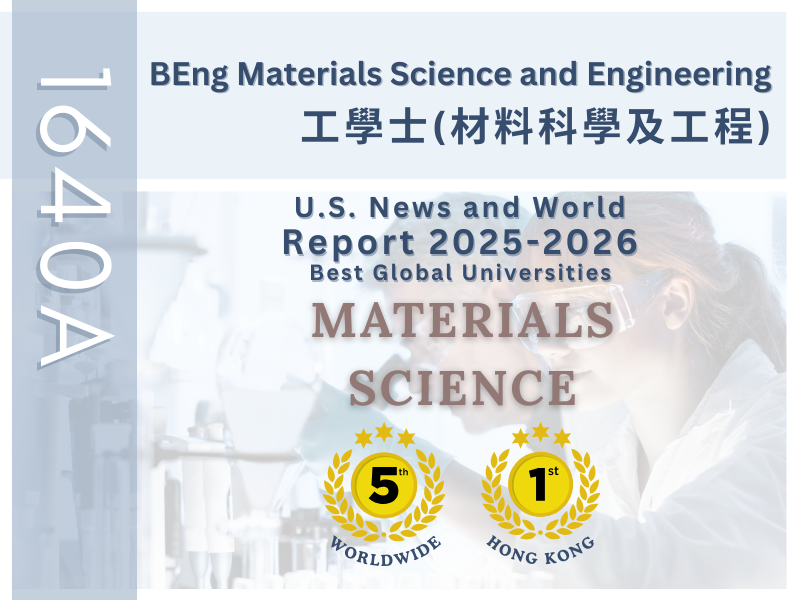
BEng Materials Science and Engineering

College/School
Subtitle
工學士(材料科學及工程)
Thumbnail
Image
MSE admission_1640A_202526
Academic Year of Entry
Admission Code

1640A

Indicative Intake Target

Local Places:

24 (For First Year and Advanced Standing I Entries)*


Non-Local Places  
(All CityUHK programmes except Chinese Mainland Gaokao):

Around 500

Normal Duration of Programme
3 years (For Advanced Standing I entry)
Programme / Major Leader
Prof. Stephen TSANG

PhD University of Toronto, Canada

+852 3442 4618

Remarks

* for JUPAS and non-JUPAS admissions

Why BEng Materials Science and Engineering?

The comfort and convenience of modern life are intimately associated with the discovery, manipulation, and selection of natural and synthetic materials. Advancements in materials science and engineering (MSE) have led to a better understanding and manipulation of materials, which is a prerequisite for future technological processes. 

Our MSE program aims to nurture students to become material experts and contribute to the fast-growing high-tech industry. Besides a broad selection of expertise in construction materials, bio-materials, and energy materials, our program also offers training for students on Artificial Intelligence (AI) assisted material development. There are also various opportunities where the students can gain hands-on experience through research and industrial internship schemes and strengthen their portfolios during their studies.

Join us to Make Something Extraordinary!

Entrance Requirements for Direct/Non-JUPAS Applicants

Entrance Requirements for Direct/Non-JUPAS Applicants

To be considered for admission, you must satisfy the General Entrance Requirements and have studied a science-related discipline at a high school or post-secondary institution,

OR

you have an Associate Degree or Higher Diploma in a relevant discipline such as Applied Science, Engineering, Electronic Engineering, Mechanical Engineering or other technical qualifications.

Curriculum Structure

For details of the programme’s curriculum structure, please visit the ‘Undergraduate Catalogue’.

Department of Materials Science and Engineering

As the first of its kind in Hong Kong, the Department of Materials Science and Engineering was established to develop internationally competitive and cutting-edge research and provide a professional curriculum that equips graduates to contribute to various materials related sectors in Hong Kong, for the fast-growing high-tech industries.

The Department serves as a collaboration platform for developing cross-disciplinary academic programmes and interdisciplinary research projects with other academic units in the University. Further, it aspires to become a world-leading department in research and professional education with a focus on the following four target areas:

  1. Biomaterials
  2. Computational materials science 
  3. Functional materials
  4. Structural materials

The Department also serves as an international platform to encourage collaboration among the leading institutes in the world and to enhance our global research reputation.

BEng Materials Science and Engineering

In the Materials Science and Engineering major, students acquire knowledge that can be used to solve materials problems in engineering processes. Graduates of this major can seek jobs in engineering companies and join the Hong Kong Institution of Engineers as graduate members. They can become professional engineers after receiving the relevant on-the-job training and completing the professional assessment.

材料是技術發展的基礎,隨着各國對核心技術的重點發展,在本地以至國外對材料科學的人才需求將會大增。本課程旨在培育材料科學及工程的專業人才,以配合社會未來在基礎科技的發展。課程包括材料原理、表徵、設計、製造、以及應用等多方面專業範疇,並涵蓋金屬、半導體、生物、建築、能源、納米等重要材料。本課程着重經驗培訓及理論實踐,特設有與公司及科研機構合作的項目。提升學生將來就業機會。相關學歷不但符合香港工程師學會會員的申請資格,修業後亦可申請全額獎學金資助在本地或海外知名學府攻讀相關的碩士或博士課程。

Our Target

This major aims to equip students with the skills and knowledge required to meet local and worldwide needs related to materials science and engineering for the government, industrial and commercial sectors.

Graduates of this major will be able to understand the production, fabrication and service performance of structural and functional engineering materials, including conventional bulk materials, advanced thin film and nanostructured materials. Materials engineers usually work in a multi-disciplinary team with other specialists and scientists. Our graduates contribute to the design, manufacturing, maintenance, evaluation, quality assurance, performance and safety enhancement of the composing materials, engineering components, devices, structures and processing plants.

Start Your Career Here

Materials Science and Engineering is an exciting and fascinating subject. Many of the novel materials invented in the past few decades have substantially influenced and dramatically changed the way we live. If you imagine a world without silicon electronics or engineering plastics, you will realise the obvious contribution of materials scientists and engineers in the history of mankind.

Materials Science and Engineering is essential to almost all industrial sectors. Upon graduation, you will be able to work in various areas such as electronics, toys, plastics, metals, ceramics and construction industries and testing laboratories. You may also be employed as a materials engineer, quality control engineer, production engineer, laboratory manager, R&D engineer or engineering salesperson for equipment, machinery and materials.

Our major provides professional training that equips students with the ability to understand engineering and scientific information, and to analyse complex engineering problems using systematic and scientific reasoning. Some of our recent graduates have applied their strengths in logical, technical and critical analysis to pursue successful careers in fields such as finance and business.

What You Will Be Studying

When you begin your studies, you will be equipped with fundamental knowledge such as engineering mathematics, computing, physical science, engineering drawing and communication skills. These are the necessary foundations for your progression to materials science and engineering study. You will build on these foundations with more in-depth study of the thermodynamics and kinetics of materials processing.

With a strong physical sciences background, you will then take courses related to the properties of conventional and advanced engineering materials, materials testing and examination techniques and the processing of various modern and advanced materials (such as polymers, composites, ceramics and electronic materials). Stress analysis, deformation and fracture of various materials for engineering applications will also be covered.

You need to plan for your career by choosing electives from a wide range of courses such as Environmental Degradation, Microelectronic Materials, Nanocomposite Materials, Advanced Thin Film, Materials Science Modelling, Failure Analysis, Building Materials, Biomedical Materials, Electronic Packaging, Energy Materials, Nanotechnology and Electroceramics.

Workshop training and design laboratory group project courses will allow you to gain hands-on experience in a simulated industrial environment. Selected students will also join established companies for internship training under the guidance of academic staff during the summer vacation.

Every student is required to work independently on a final year project spanning two semesters before graduation. This project is an independent investigation of a materials science and engineering problem. You might find something new and publish a paper in an international journal together with your supervisor! These integrated learning activities in simulated and real industrial environments are essential to you in becoming a professional engineer upon graduation.

Industrial Training and International Exchange

The College of Engineering and the Department offer work placement opportunities through different internship schemes that provide students with full-time job attachments in firms in Hong Kong, the Pearl River Delta region and overseas. Through such placements, students will:

  • gain solid experience in a real-world work environment; 
  • develop problem-solving abilities and interpersonal skills; 
  • learn the right attitudes towards work and professionalism; and
  • broaden their experience and enhance their employability.

For details, please visit the College’s Co-operative Education website.

To help students broaden their educational horizons, gain language experience, and enhance their awareness of different cultures, the Department, College and University offer over 110 credit-bearing exchange programmes with various partner universities around the world, including Australia, Canada, Europe, the US and others in the Asia-Pacific region.

For details, please visit the University’s outbound exchange programme website.

Professional Recognition

This major is the first and currently the only Materials Science and Engineering degree accredited by the Hong Kong Institution of Engineers.

Bonus Features

Graduates of the Materials Science and Engineering major are all-round materials engineers who can participate in design, manufacturing and quality assurance teams in high-tech industries.

Programme Video
Materials Science in Our Daily Lives
Programme Brochure
Programe A-Z
author_college
Title (For sorting)
431
Non-JUPAS Year 1 Admission
Non-JUPAS Senior Year Admission
International Admission
Mainland Non-Gaokao Admission
Deadline applicable to all types of Admission
Interview Arrangement - Direct SY

When necessary

Late Application (Deadline applicable to all types)
Off
Late Application (International Admission)
Off
Late Application (Mainland Non-Gaokao Admission)
Off
Late Application (Non-JUPAS Senior Year Admission)
Off
Late Application (Non-JUPAS Year 1 Admission)
Off
Maths Core / M1 / M2 Calculation as one Subject
Off
Historical Data Display
Off
Reduce the font size?
Off

BEng Aerospace Engineering

College/School
Subtitle
工學士(航空航天工程)
Thumbnail
Image
MNE_new
Academic Year of Entry
Admission Code

1704A

Indicative Intake Target

Local Places:

87 (For First Year and Advanced Standing I Entries)*


Non-Local Places  
(All CityUHK programmes except Chinese Mainland Gaokao):

Around 500

Normal Duration of Programme
3 years (For Advanced Standing I Entry)
Major Leader
Prof. Changhuang WAN
Deputy Major Leader
Prof. Mengze WANG
Deputy Major Leader
Prof. Bin WANG
Admissions Tutor
Prof. Wei Yin MA
Deputy Admissions Tutor
Prof. Jack Hau Yung LO
Deputy Admissions Tutor
Prof. Qiyi FANG
Remarks

* for JUPAS and non-JUPAS admissions

Why BEng Aerospace Engineering?

The aerospace industry is undergoing a profound transformation, rewriting its operational playbook. With the rise of autonomous flight, AI-optimised traffic management, and the Low-Altitude Economy, tomorrow's aircraft are digital ecosystems as much as mechanical structures. Traditional engineering silos alone cannot address this complexity or guarantee the safety and efficiency of future skies.

This major is urgently needed to bridge that exact gap. We produce engineers equally versed in classical aerodynamics and applied machine learning—capable of architecting autonomous collision avoidance, predictive maintenance, and urban logistics systems.

Crucially, CityUHK's strategic location in the Greater Bay Area—a global nexus for aviation MRO, satellite manufacturing, and logistics startups—amplifies this necessity. The region is constructing the future of urban air mobility, demanding graduates who understand airspace regulation and intelligent autonomy. This degree is the essential link between aerospace heritage and its intelligent, hyper-connected future.

The future of aerospace is not a single path; it is a multi-layered frontier. At CityUHK, we equip you to explore it.

Entrance Requirements for Direct/Non-JUPAS Applicants

Entrance Requirements for Direct/Non-JUPAS Applicants

To be considered for admission, you must satisfy the General Entrance Requirements and have studied an engineering-related discipline at a high school or post-secondary institution

OR

have completed an Associate Degree/Higher Diploma with a cumulative grade point average (CGPA) of ≥3.0 or an equivalent overall mark, or a credit award in an engineering-related discipline.

Curriculum Structure

For details of the programme's curriculum structure, please visit the 'Undergraduate Catalogue'.

Our Target

The aerospace sector is undergoing a paradigm shift—driven by autonomous systems, electric propulsion, commercial spaceflight, and the emergence of the Low-Altitude Economy. At the heart of this transformation lies Artificial Intelligence, redefining everything from deep space exploration to urban air traffic management and predictive smart inspection.

Our BEng Aerospace Engineering program is designed to cultivate a new generation of versatile, future-ready engineers. We provide a rigorous, dual-pronged education: a deep foundation in classical aerospace disciplines—aerodynamics, flight mechanics, structures, and propulsion—seamlessly integrated with cutting-edge expertise in AI, digital aerospace, and intelligent systems. This ensures our graduates are equally adept at advancing traditional aviation, contributing to New Space initiatives, or pioneering the autonomous air mobility solutions of tomorrow.

Beyond the aerospace sector, the multidisciplinary rigor of our curriculum cultivates strong analytical, systems-thinking, and data-driven problem-solving skills. This versatility opens doors to high-value careers in technical services, consultancy, advanced manufacturing, and financial analytics—sectors where engineering acumen is increasingly prized. By aligning our programme with the strategic manpower needs of Hong Kong and the broader Greater Bay Area, we position our graduates at the forefront of regional innovation, ready to lead in both established industries and the disruptive ventures that will define the next decade.

Start Your Career Here

The new major benefits from having a two-stream system. Students can specialize in either the Materials or the Aerospace Systems stream in the senior years of the major. This offers employment opportunities in areas that will form the backbone of aerospace technologies of the future. In an Aviation Forum regarding Global Megatrends held at the Royal Aeronautical Society (2019) and attended by delegates from around the world, it was clear that there will be a demand at local, national and global levels for training undergraduates in the fields of advanced materials, systems technologies, conceptual systems design, communication systems, space technologies/exploration, electrical technologies. The proposed new major covers these aspects in addition to the fundamentals of computing, simulation, numerical methods and professional engineering which opens additional career opportunities in R&D, technical services, finance, teaching/research and consultancy.

It is expected that some graduates will continue with postgraduate studies to specialize in some of the next generation fields of developing areas e.g. space urbanization, digital communications and AI, autonomous vehicles, robotics, materials for hypersonic flight, etc. Undoubtedly, career paths for these are already open and more are sure to develop.

What You Will Be Studying

The young professionals educated in this major will meet the needs of Hong Kong as an international financial center and aviation hub as well as the demands for development in innovation and technology, testing and certification. In addition, the major is developed upon the research strengths across a number of excellent departments, such as MNE, Department of Materials Science and Engineering (MSE) and Department of Advanced Design and Systems Engineering at CityUHK. The major will offer professional teaching and conduct cutting-edge research in aerospace materials and manufacturing systems, aerospace statics and dynamics, electric and electronic systems for aircraft, aircraft system design and performance, flight mechanics, aircraft design and communication systems, testing, certification, safety and reliability, manufacturing and robotic technologies, aerospace structures and materials, advanced structural materials, flight control systems engineering, avionic power systems, noise and vibration control, machine learning and artificial intelligence, aeroelasticity, NDT Technologies for aircraft structures and materials.

Industrial Training and International Exchange

The College of Engineering and the Department offer work placement opportunities through various internship schemes that provide students with full-time job attachments in firms not only in Hong Kong, but also in the Pearl River Delta region and overseas. Through such placements, students will:

  • gain solid experience in a real-world work environment;
  • develop problem-solving abilities and interpersonal skills;
  • learn the right attitudes towards work and professionalism; and
  • broaden their experience and enhance their employability.

For details, please visit the College's Co-operative Education Centre's website.

Furthermore, for students to broaden their educational horizons, gain language experience and enhance their awareness of different cultures, the Department, College and University offer a number of credit-bearing exchange programmes with various partner institutions around the world including universities in Australia, Canada, Europe, the US and the Asia-Pacific region.

Please visit CityUHK's website and the Department's website for details of outbound exchange programmes.

Professional Recognition

This major has been granted provisional accreditation by the Hong Kong Institution of Engineers (HKIE), a signatory member of the Washington Accord under which all members agree to recognise each other's accredited Engineering degree programmes.

Admission Talk - Brief Programme Introduction
城大機械工程實驗室
MNE Laboratories
Programme Brochure
About MNE CityUHK
Contact Type
Email
Contact Value
Programe A-Z
author_college
Title (For sorting)
449
Non-JUPAS Year 1 Admission
Non-JUPAS Senior Year Admission
International Admission
Mainland Non-Gaokao Admission
Deadline applicable to all types of Admission
Interview Arrangement - Direct SY

On a selective basis
- December 2026 to May 2027
- Individual interview
- English

Late Application (Deadline applicable to all types)
Off
Late Application (International Admission)
Off
Late Application (Mainland Non-Gaokao Admission)
Off
Late Application (Non-JUPAS Senior Year Admission)
Off
Late Application (Non-JUPAS Year 1 Admission)
Off
Maths Core / M1 / M2 Calculation as one Subject
Off
Historical Data Display
Off
Reduce the font size?
Off

BEng Nuclear and Risk Engineering

College/School
Subtitle
工學士(核子及風險工程)
Thumbnail
Image
MNE_new
Academic Year of Entry
Admission Code

1700A

Indicative Intake Target

Local Places : 

87 (For First Year and Advanced Standing I Entries)*


Non-Local Places  
(All CityUHK programmes except Chinese Mainland Gaokao):

Around 500

Normal Duration of Programme
3 years (For Advanced Standing I Entry)
Major Leader
Prof. Wei WANG
Deputy Major Leader
Prof. Shijun ZHAO
Deputy Major Leader
Prof. Kan MA
Admissions Tutor
Prof. Wei Yin MA
Deputy Admissions Tutor
Prof. Jack Hau Yung LO
Deputy Admissions Tutor
Prof. Qiyi FANG
Remarks

This major is hosted by the Department of Mechanical Engineering (MNE), in conjunction with the Departments of Architecture and Civil Engineering (ACE), Chemistry (CHEM), Physics (PHY) and Systems Engineering (SYE).

* for JUPAS and non-JUPAS admissions

Why BEng Nuclear and Risk Engineering?

This major is a unique undergraduate programme in Hong Kong, aiming at meeting the current manpower requirements and also future economic challenges of Hong Kong. Students of this major will be trained in multi-disciplinary topics related to nuclear engineering and risk engineering. The major will concentrate on five related focus areas which are nuclear engineering, nuclear medicine and medical radiation, materials engineering, risk engineering, and crisis management. These five focus areas are in general aligned with three of the six industries of Hong Kong, namely testing and certification services, medical services, and environmental industries, which have been identified by the Hong Kong SAR Government as having clear advantages for further development. The following are some of the reasons why this major is needed:

  • Rapid development in nuclear energy in Chinese Mainland, especially in regions near Hong Kong, would require many well-trained nuclear engineers in foreseeable future.
  • The increasing use of radiation technology for medical treatments and diagnoses for the aging population means that there is a growing demand for medical radiation professionals.
  • Risk engineering is not only essential to the nuclear industry but also to many big corporations and engineering systems. Many companies have now recognized the importance of assessing and managing risks to ensure the smooth running of their businesses. Risk professionals are highly sought-after.
  • Disaster or crisis management involves dealing with threats after they have occurred. Several well-known disasters and product recall, such as the lead-in-drinking-water crisis in Hong Kong, Gulf of Mexico oil spill, and major vehicle recalls by Toyota due to out-of-control gas pedals, have highlighted the importance of crisis management for reducing the adverse impacts on businesses and governments. Many petrochemical companies, public utility companies, banks and big corporations do employ crisis management professionals to protect their businesses from potential crises.
Entrance Requirements for Direct/Non-JUPAS Applicants

Entrance Requirements for Direct/Non-JUPAS Applicants

To be considered for admission, you must satisfy the General Entrance Requirements and have studied an engineering-related discipline at a high school or post-secondary institution

OR

have completed an Associate Degree/Higher Diploma with a cumulative grade point average (CGPA) of ≥3.0 or an equivalent overall mark, or a credit award in an engineering-related discipline.

Curriculum Structure

For details of the programme's curriculum structure, please visit the 'Undergraduate Catalogue'.

Our Target

We aim to equip our students with multi-disciplinary knowledge in nuclear and risk engineering. In addition to providing discipline-related technical knowledge, we help our students to develop problem-solving skills so that they can analyse and solve a broad spectrum of engineering issues. Students gain a sound foundation in the relevant disciplines through practical hands-on projects and extensive exposure to real-world scenarios via industrial placements and overseas exchange arrangements, with a view to attaining the dynamic levels and standards required by highly competitive markets such as Hong Kong and Chinese Mainland. Graduates are able to contribute their specialist skills, competencies and multi-disciplinary knowledge to a wealth of related industrial sectors such as nuclear engineering, power generation, materials engineering, radiation protection, radiation dosimetry, medical equipment, risk engineering, safety engineering, insurance and disaster management.

Start Your Career Here

Since this major is multi-disciplinary, the related job prospects are promising. Graduates can choose to work in many related professions or industrial sectors including the power generation industry, materials engineering for large corporations, testing and certification services, medical radiation-related fields in hospitals and diagnostic centres, radiation protection and environmental protection in government departments and private consultancy firms, product research and development in nuclear radiation equipment companies, risk assessment in the financial sector and disaster management for the government, public utilities companies and big corporations.

What You Will Be Studying

There are eight main building blocks in this major:

  • General Science and Engineering
  • Nuclear Engineering
  • Nuclear Medicine and Medical Radiation
  • Materials Engineering
  • Risk Engineering
  • Crisis Management
  • Integrative Project
  • Language and Out-of-Discipline Studies 

Innovative teaching approaches are adopted in the delivery of the curriculum to integrate theories with industrial practices. Problem-solving activities, experience-based learning, integrative workshops, industrial attachment, co-operative education and industry-based projects are the typical means for helping students achieve their targets.

Industrial Training and International Exchange

The College of Engineering and the Department offer work placement opportunities through various internship schemes that provide students with full-time job attachments in firms not only in Hong Kong, but also in the Pearl River Delta region and overseas. Through such placements, students will:

  • gain solid experience in a real-world work environment;
  • develop problem-solving abilities and interpersonal skills;
  • learn the right attitudes towards work and professionalism; and
  • broaden their experience and enhance their employability.

For details, please visit the College's Co-operative Education Centre's website.

Furthermore, for students to broaden their educational horizons, gain language experience and enhance their awareness of different cultures, the Department, College and University offer a number of credit-bearing exchange programmes with various partner institutions around the world including universities in Australia, Canada, Europe, the US and the Asia-Pacific region.

Please visit CityUHK's website and the Department's website for details of outbound exchange programmes.

Professional Recognition

This major has been granted full accreditation by the Hong Kong Institution of Engineers (HKIE), a signatory member of the Washington Accord under which all members agree to recognise each other's accredited Engineering degree programmes.

Did You Know?
  • Since this major is multi-disciplinary, it draws expertise from various departments of the Colleges of Science and Engineering. Hence, students receive high-quality teaching and training provided by the most appropriate departments.
  • Rapid development in nuclear energy in Chinese Mainland, especially in regions near Hong Kong, will require many well-trained nuclear engineers in foreseeable future.
  • The increasing use of radiation technology for medical treatments and diagnoses for the ageing population means that there is a growing demand in medical radiation professionals.
  • Risk engineering is not only essential to the nuclear industry but also to many big corporations and engineering systems. Many companies now recognise the importance of assessing and managing risks to ensure the smooth running of their businesses. Risk professionals are highly sought-after.
  • Disaster or crisis management involves dealing with threats after they have occurred. Several well-known disasters and product recalls, such as the lead-in-drinking-water crisis in Hong Kong, the Gulf of Mexico oil spill and the major vehicle recalls by Toyota due to out-of-control accelerator pedals, have highlighted the importance of crisis management for reducing the adverse effects on businesses and governments. Many petrochemical companies, public utilities companies, banks and big corporations employ crisis management professionals to protect their businesses from potential crises.
Admission Talks - Climate Change and Nuclear
城大機械工程實驗室
MNE Laboratories
Programme Brochure
About MNE CityUHK
Contact Type
Email
Contact Value
Programe A-Z
author_college
Title (For sorting)
443
Non-JUPAS Year 1 Admission
Non-JUPAS Senior Year Admission
International Admission
Mainland Non-Gaokao Admission
Deadline applicable to all types of Admission
Interview Arrangement - Direct SY

On a selective basis
- December 2026 to May 2027
- Individual interview
- English

Late Application (Deadline applicable to all types)
Off
Late Application (International Admission)
Off
Late Application (Mainland Non-Gaokao Admission)
Off
Late Application (Non-JUPAS Senior Year Admission)
Off
Late Application (Non-JUPAS Year 1 Admission)
Off
Maths Core / M1 / M2 Calculation as one Subject
Off
Historical Data Display
Off
Reduce the font size?
Off