Social and Arts Global Excellence (SAGE) [Features: Any major in the College of Liberal Arts and Social Sciences (except for BSocSc Social Work) / Non-local experience / Interdisciplinary]#
Subtitle
卓越全球人文社科課程 [特點: 自由選擇學院內任何一個主修科(社會科學學士(社會工作)除外) / 海外體驗 / 跨領域學習]#
Thumbnail
Image

Academic Year of Entry
Admission Code
1120 (JS1120)
Indicative Intake Target
Local Places:
10 (For First-Year Entry)*
Normal Duration of Programme
4 years
Admissions Tutor
Professor CHING May Bo
Remarks
* for JUPAS and non-JUPAS local admissions
#Programme subject to the University's approval
Why Social and Arts Global Excellence (SAGE)?
The Social and Arts Global Excellence (SAGE) stream aims to recruit high-calibre applicants who want to explore their academic interests and make informed decision about their future. Distinguished features of the stream are as follows:
- Free choice of major: Students admitted through the SAGE stream are free to choose a major in the College of Liberal Arts and Social Sciences (CLASS) at the beginning of Year 1 (except for BSocSc Social Work).
- Service Learning courses: Students of the SAGE stream are required to satisfactorily complete two Service Learning courses under the SAGE stream, namely PIA2268 Cross-Sectoral Innovation and Leadership (3 credit units) and SS2300 Leading Public and Social Sector Organizations: Service Learning in Practice (3 credit units), which integrate community service with academic learning. This hands-on experience not only enriches students' education but also enhances their understanding of societal issues, fostering personal growth and civic responsibility.
- Cross-sectoral modules: Students of the SAGE stream will be given the opportunity to widen their horizons by attending different modules of seminars (non-credit bearing) conducted by experts in their respective industries.
- Non-local academic/research exchanges: Upon fulfilling conditions, eligible students of the SAGE stream will be provided with an opportunity to participate in non-local academic/research exchanges in top-ranked universities or prestigious organisations to leverage the diverse disciplines within CLASS.
- One-to-one mentorship: Each student will be paired with a faculty member to meet regularly for academic advising and career planning.
Entrance Requirements
JUPAS Applicants
JUPAS Entrance Requirements
| JS1120 Social and Arts Global Excellence (SAGE) [Features: Any major in the College of Liberal Arts and Social Sciences (except BSocSc Social Work) / Non-local experience / Interdisciplinary] | |
| HKDSE Subject | Minimum Level Required |
| English Language | Level 3 |
| Chinese Language | Level 3 |
| Mathematics | Level 2 |
| Citizenship and Social Development | Attained |
| Elective 1 | Level 3 |
| Elective 2 | Level 3 |
Notes:
- Unspecified electives may include Category A elective subjects, Mathematics extended modules (M1 / M2) and Category C other language subjects. If students take both M1 and M2, they are counted as one subject only.
- Applied learning (ApL) subjects are not counted as elective subjects.
- Past results of HKDSE Liberal Studies (Level 2 or above) are accepted for meeting the subject requirement of HKDSE Citizenship and Social Development in the General Entrance Requirements. However, results obtained in HKDSE Liberal Studies or HKDSE Citizenship and Social Development are not counted in the admission score.
- For details of the entrance requirements, please visit the website of the Admissions Office.
Direct / Non-JUPAS Applicants
Direct/ Non-JUPAS Applicants Entrance Requirements
To be considered for admission (programme code: 1120), you must satisfy the General Entrance Requirements and possess the International Baccalaureate (IB) Diploma or GCE A-level (or International A-level) qualifications.
Admissions Arrangements
Students admitted through the Social and Arts Global Excellence (SAGE) stream are free to choose a major in the College of Liberal Arts and Social Sciences (CLASS) at the beginning of Year 1 (except for BSocSc Social Work). The major options are:
Department of Chinese and History
- BA Chinese and History (SAGE stream)
Department of English
- BA English (SAGE stream)
Department of Linguistics and Translation
- BA Linguistics and Language Applications (SAGE stream)
Department of Media and Communication
- BA Digital Television and Broadcasting (SAGE stream)
- BA Media and Communication (SAGE stream)
Department of Public and International Affairs
- BSocSc International Relations and Global Affairs (SAGE stream)
- BSocSc Public Affairs and Management (SAGE stream)
Department of Social and Behavioural Sciences
- BSocSc Crime Science (SAGE stream)
- BSocSc Psychology (SAGE stream)
Curriculum Structure
For details of the programme's curriculum structure, please visit the Undergraduate Catalogue.
What You Will be Studying
On top of the existing requirements of the respective majors in the College of Liberal Arts and Social Sciences (CLASS), students of the Social and Arts Global Excellence (SAGE) stream are required to satisfactorily complete two Service Learning courses under the SAGE stream, namely PIA2268 Cross-Sectoral Innovation and Leadership (3 credit units) and SS2300 Leading Public and Social Sector Organizations: Service Learning in Practice (3 credit units), which integrate community service with academic learning. This hands-on experience not only enriches students' education but also enhances their understanding of societal issues, fostering personal growth and civic responsibility.
Under normal circumstances, students of the SAGE stream are expected to complete PIA2268 within their first year of study and SS2300 in their second year.
Start Your Career Here
The Social and Arts Global Excellence (SAGE) stream is designed to cultivate global-minded leaders and nurture graduates with a distinct competitive edge across corporate, public and social sectors. Through combining an academic specialization offered by the College of Liberal Arts and Social Sciences (CLASS) with comprehensive cross-sectoral leadership training and non-local academic/research exchange opportunities, the SAGE stream empowers graduates to excel as management trainees, policy analysts, media strategists, consultants of Environment, Social and Governance (ESG), humanities education, and social innovators.
Useful Links
College of Liberal Arts and Social Sciences
Department of Chinese and History
Department of English
Department of Linguistics and Translation
Department of Media and Communication
Department of Public and International Affairs
Department of Social and Behavioural Sciences
Undergraduate Catalogue
Flexible Admission Arrangement
CityUHK Scholarships for Hong Kong Talents
Flagship Programme
This is one of the CityUHK’s Flagship Programmes, which equip students with essential knowledge and skills, cultivate their global leadership abilities, and connect them with leading professionals. The Flagship Scholarships, which cover tuition and hall fees, a guaranteed berth, and a one-off exchange sponsorship of up to HK$500,000, will be awarded to local JUPAS talents who meet the criteria.
Contact Type
Email
Contact Value
Admission Year
Programe A-Z
Description (For Search Result Only)
Title (For sorting)
104
Minimum Entrance Requirement (Elective)
Subject Weighting
Programme Calculation Method
3 Core + 2 Elective Subjects
Non-JUPAS Year 1 Admission
Non-JUPAS Senior Year Admission
International Admission
Mainland Non-Gaokao Admission
Deadline applicable to all types of Admission
Historical Data
Interview Arrangement - Direct Yr1
When necessary
Interview Arrangement - JUPAS
When necessary
Late Application (Deadline applicable to all types)
Off
Late Application (International Admission)
Off
Late Application (Mainland Non-Gaokao Admission)
Off
Late Application (Non-JUPAS Senior Year Admission)
Off
Late Application (Non-JUPAS Year 1 Admission)
Off
Maths Core / M1 / M2 Calculation as one Subject
Off
Minimum Entrance Requirement (Core)
Historical Data Display
On
Reduce the font size?
On
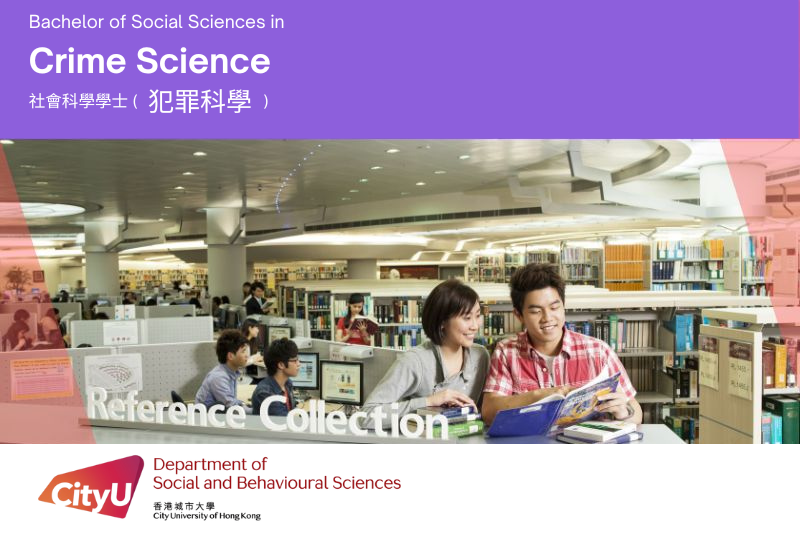
BSocSc Crime Science
Subtitle
社會科學學士(犯罪科學)
Thumbnail
Image
Academic Year of Entry
Admission Code
1359A
Indicative Intake Target
Local Places:
20 (For First Year and Advanced Standing I Entries)*
70 (For Senior Year Entry)
Non-Local Places
(All CityUHK programmes except Chinese Mainland Gaokao):
Around 500
Normal Duration of Programme
3 Years (For Advanced Standing I Entry)
2 Years (For Advanced Standing II Entry)
2 Years (For Advanced Standing II Entry)
Instagram
Major Leader
Prof. HO Wing Chung
Remarks
* for JUPAS and non-JUPAS admissions
Why BSocSc Crime Science?
Crime science is an interdisciplinary approach for developing practical solutions to real world crime problems. This programme aims to equip students with a comprehensive understanding of this approach, including the use of scientific theories, methods and strategies for preventing crime. With a specific focus on safeguarding the public and upholding Hong Kong's reputation as one of the safest cities globally, this programme offers students the opportunity to contribute to societal progress through innovative approaches. The programme considers the prevention of many forms of both small-scale and transnational organised criminal activity – ranging from residential burglaries to cybercrime. It is ideally suited for practical-minded students with a passion for discovery and a commitment to utilizing scientific analytical methods to benefit society and promote social development.
This is the only UGC-funded undergraduate programme in Hong Kong to provide comprehensive training in the discipline of Crime Science.
Entrance Requirements for Direct / Non-JUPAS Applicants
Entrance Requirements for Direct / Non-JUPAS Applicants
To be considered for admission, you must satisfy the General Entrance Requirements.
Curriculum Structure
For details of the programme’s curriculum structure, please visit the Undergraduate Catalogue - Crime Science.
Curriculum structure of the Advanced Standing I degree:
Degree Requirements | No. of Credit Units |
Gateway Education Requirement | 22 credit units |
College / School Requirement | 6 credit units |
Major Requirement | Foundation-year courses: 3 credit units Major core courses: 39 credit units Elective courses: 9 credit units |
Free Electives / Minor (if applicable) | 12 credit units |
Minimum Number of Credit Units Required | 91 credit units |
Curriculum structure of the Advanced Standing II degree:
Degree Requirements | No. of Credit Units |
Gateway Education Requirement | 12 credit units |
College / School Requirement | 0 credit units |
Major Requirement | Foundation-year courses: 0 credit units Major core courses: 39 credit units Elective courses: 9 credit units |
Free Electives / Minor (if applicable) | 0 credit units |
Minimum Number of Credit Units Required | 60 credit units |
What You Will Be Studying
Upon successful completion of this programme, students should be able to:
- describe a range of key concepts, theories and professional values in Crime Science and understand how it differs from traditional criminology;
- identify and critique the underlying assumptions of and devise interventions against criminal issues with a particular interest in different types of informal and formal problem-solving strategies in society;
- apply qualitative and quantitative research methods and use different scientific perspectives for explaining crimes in society;
- evaluate the applicability of crime-scientific theories in practice and develop innovative ideas for preventing crimes and creative ways of reducing re-offending in society with a focus on the local context;
- evaluate the function and operation of social institutions and law enforcement agencies in the criminal justice system;
- conduct scientific research independently; analyse the impacts of social, technological, and environmental changes on individuals and society; present research findings clearly and systematically to the public; and provide creative suggestions and/or solutions for preventing crimes in society; and
- design programmes, generate alternatives, invent ideas, and construct cost-effective means for sustaining social order and safety.
Start Your Career Here
Students will have a broadened exposure to theories and analytical skills training in Crime Science – which specifically engages with devising practical approaches for solving real-world problems. This broad and practical knowledge base will strengthen the employability of graduates. Sample areas of employment for our graduates include positions in law enforcement agencies (e.g. Hong Kong Police Force, Correctional Services Department, Customs and Excise Department, Immigration Department, and Fire Services), schools and universities, non-governmental organisations, security or risk management departments in private companies, research institutes and marketing research firms, media industries, and public relations firms.
https://www.youtube.com/watch?v=nmDsDaFiD2s
Programme Video
https://ssweb.cityu.edu.hk/-/media/project/cityuhk/academic/ssweb/study/cityu_ss-leaflet_ug-programmes-2026_designpro-web.pdf?rev=b05d4d1bc10043c7af2e96d6ccb0208f&hash=995703F9FD482CD7B718D2203F6CC176
Programme Brochure
Contact Type
Email
Contact Value
Admission Year
Programe A-Z
Title (For sorting)
558
Non-JUPAS Year 1 Admission
Non-JUPAS Senior Year Admission
International Admission
Mainland Non-Gaokao Admission
Deadline applicable to all types of Admission
Interview Arrangement - Direct SY
Not required
Late Application (Deadline applicable to all types)
Off
Late Application (International Admission)
Off
Late Application (Mainland Non-Gaokao Admission)
Off
Late Application (Non-JUPAS Senior Year Admission)
Off
Late Application (Non-JUPAS Year 1 Admission)
Off
Maths Core / M1 / M2 Calculation as one Subject
Off
Historical Data Display
Off
Reduce the font size?
Off
