Business and manufacturing industries are key players in advancing sustainable development, says CityUHK experts

On Day 2 of the Global Sustainable Development Congress 2026, sustainability experts from City University of Hong Kong (CityUHK) continued to share views and insights. They focused on strategies to further green solutions and the United Nations’ Sustainable Development Goals.
Professor Denvid Lau, Associate Director of the CityUHK Academy of Innovation, joined a panel discussion titled “Partnerships for impact: Scaling change through collaboration”, which brought together entrepreneurship and innovation experts to cover how cross-industry collaboration will be the key factor for sustainable development in Southeast Asia and beyond.
Professor Lau was joined by Mr Lorenzo Boffi, Associate Director of Corporate Partnerships at Habitat for Humanity International (Asia-Pacific); Ms Etti Seppa, Head of Innovation at KONE; and Mr Abu Hanifah, Seed Operation General Manager at East-West Seed Indonesia (EWINDO). Together, they explored how collaboration between corporates, universities, research institutes, non-profits and governments is gaining currency for applied innovation, talent development and long-term impact.
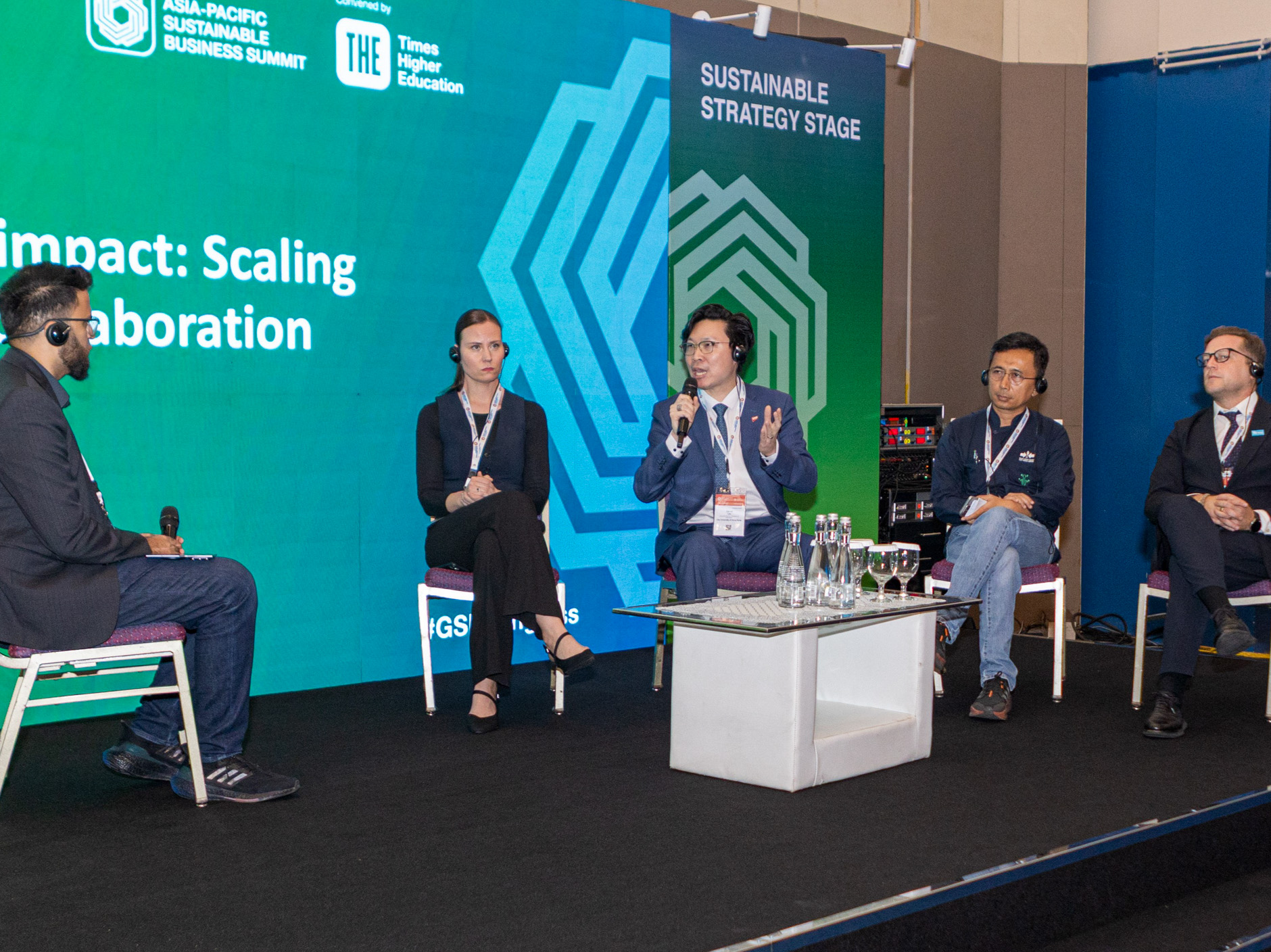
At the panel, Professor Lau explained how multi-stakeholder alliances can accelerate sustainable innovation and deployment. “At the CityUHK Academy of Innovation, we are empowering our students to become confident entrepreneurs through mentorship, workshops, and providing financial support through our HK Tech 300 programme,” he explained, adding that innovation hubs and incubators could be crucial players in scaling up the global impacts of small-scale pilot programmes.
From an industry perspective, we understand that collaboration with academia will greatly aid in scaling up our own operations, so we are always looking for new opportunities to work together,” said Mr Hanifah, when the panellists discussed how higher education partnerships should strengthen talent pipelines and translate research into practical applications, bringing tangible benefits to society.

To round out Day 2, Professor Henry Chung Shu-hung, Chair Professor of the Department of Electrical Engineering, and Professor Fatwa Firdaus Abdi of the School of Energy and Environment each gave an SDG Showcase presentation on building sustainable urban infrastructure and energy systems.
Professor Chung examined the unique opportunity for sustainable energy solutions that is presented by the influx of retired batteries from electric vehicles (EVs), which can be repurposed to foster a circular economy that strengthens charging networks.
“Successful partnerships among higher education, government and industry can effectively transform and connect EV charging networks to establish a circular economy,” he explained, delving into how his research team have successfully repurposed EV waste into new batteries and second-life products for the transportation industry.

On another occasion, Professor Abdi explained that solar chemistry could emerge as another link in establishing circular and carbon-neutral cities. His talk covered how sunlight-powered chemistry can effectively convert urban waste streams into clean fuels and valuable chemicals, while reducing the carbon-heavy impact of the manufacturing industries.
He laid out a framework for how solar-chemical systems can be integrated into cities, driving multiple SDGs and creating a cleaner atmosphere. “With the rise of solar energy, cities need adapt to maximise its potential uses. Future sustainable cities will not simply just run on solar electricity, it will transform sunlight into a manufacturing power through solar chemistry,” he explained.
Please visit the thematic website for more information about how CityUHK sustainability experts are sharing their insights at GSDC 2026.