Green initiatives and social cohesion: CityUHK experts share at sustainability congress

At the Global Sustainable Development Congress (GSDC) 2026, sustainability experts from City University of Hong Kong (CityUHK) shared views and ideas on urgent global topics such as climate change, emerging technologies that address green energy innovation, and the way forward on building a cohesive community.

Serving as the sole Green Innovation Partner for the GSDC for the third consecutive year, CityUHK has multiple scholars speaking at workshops, panel discussions, and showcase presentations during the four-day event in Jakarta, Indonesia, starting from 22 June.

CityUHK’s first keynote speech was delivered by Professor Benjamin Horton, Dean of the School of Energy and Environment, highlighting how Antarctic ice loss increases risks for Asia’s coastal regions, including flooding, storm surges and saltwater intrusion.
Professor Horton stressed that a collapsing Antarctic ice sheet could drive metres of sea-level rise, especially in tropical regions such as Southeast Asia. He pointed that ice cores and satellite observations reveal accelerating and potentially irreversible changes, and demonstrated how Antarctica influences the global climate system through the Southern Ocean and Antarctic Circumpolar Current.
Professor Horton noted that monitoring Antarctica will help improve climate forecasting and urban planning. He said, “Antarctica will help Asian regions design infrastructure and adapt to future risks.”
He stressed that communication will be the key factor in accelerating solutions for climate change. “Corporations and industrial must heed the advice and expertise of climate scientists to create tangible action before it is too late.” he urged.


In another showcase titled “Why multilingualism matters for prosperity and social cohesion”, Professor Niels Schiller and Professor Adel Chaouch-Orozco of the Department of Linguistics and Translation examined how language diversity can contribute to cognitive health, social mobility and justice.
During the showcase, the two professors explored how multilingualism can help delay the symptoms of cognitive decline in an ageing population, and how rendering multilingual service provision can guarantee equitable access to safety and justice more efficiently than an enforced monolingualism.
Professor Schiller noted that diverse and multilingual workforces are more competitive and generate more innovative solutions compared to monolingual institutions. He added, “Multilingual practices build bridges across communities and legitimise minority voices.”
Professor Chaouch-Orozco demonstrated how monolingual policies marginalise and shift economic burden onto linguistic minorities. “When we embrace multilingualism, we create dynamic communities that drive social equity and prosperity.” he noted.
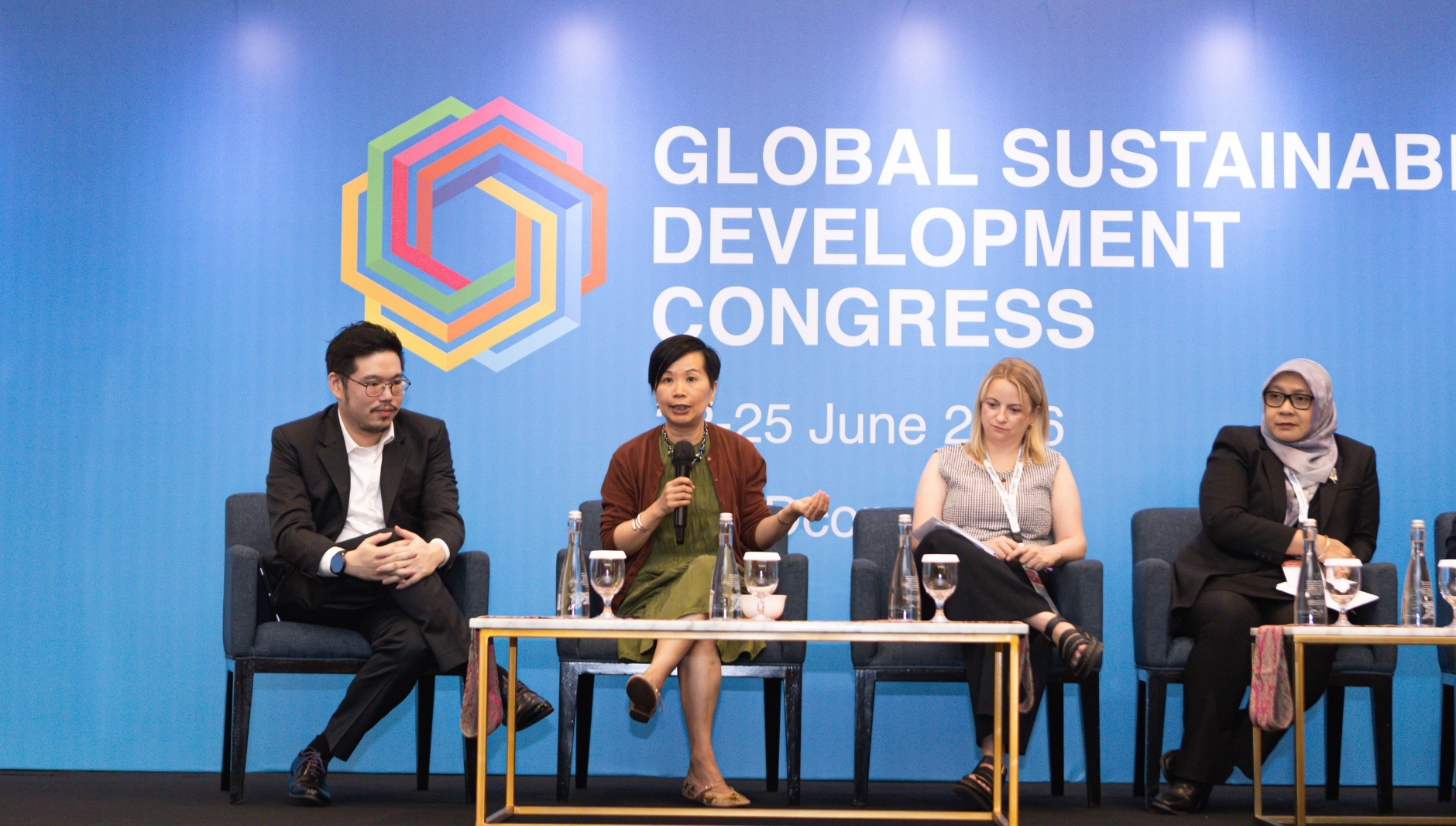
In addition, Professor Shirley Chong, Chief Communications and Global Affairs Officer, joined a group of higher education leaders at a Reputation Lab workshop where attendees over 80 participants from 16 countries had a lively discussion on how sustainable initiatives can help brand building and facilitate collaboration across countries and regions.
Professor Chong was joined by Ms Rachael Burcher, Student Futures Director at the University of Cambridge’s Lucy Cavendish College; Ms Lucie Burnett, Head of Campaigns at the University of Exeter; Professor Sherine Farouk, Assistant Chancellor for Global Partnerships and Impact at Abu Dhabi University; Professor Dian Ekowati, Head of the Strategic Planning and Development Board at Universitas Airlangga; Mr Ashley Mok, Vice-President of Consultancy at Times Higher Education (THE); and Ms Mei Mei Lim, President (APAC) at THE.
At the workshop titled “Turning green into growth: How sustainability builds bridges and boosts your brand”, higher education leaders exchanged views on how embedding sustainability across research, teaching and operations not only drives institutional reputation and brand differentiation, but also attracts and fosters global talents, partnerships and cross-sector collaboration.
“Sustainability strategies are now competitive assets with worldwide application. Working together, we can break down boundaries between global regions and countries and build global partnerships that centre sustainability as a long-term goal. We must ensure a seamless integration of these strategies into the workforce.” said Professor Chong.
Ms Burnett highlighted how sustainability must be a guiding value in shaping decisions for brands. She noted, “By imbuing green initiatives and strategies into each aspect of our work at the University of Exeter, we can truly tell the world that sustainability is part of our core identity.”
“Collective action across institutions will add up to create change that advances SDG achievement and build a green future.” said Professor Farouk.
During the Q&A session, the panellists discussed how to build lasting collaborations that create real change. “When seeking partnerships with other institutions, we must ensure our visions align and leverage our individual strengths to create synergistic initiatives that move beyond paper.” said Professor Chong.
Ms Burcher agreed that relationship building will be the key factor to driving progress and that collaborations should proactively work to achieve specific and focused goals. Professor Ekowati added that young universities should not shy away from seeking partnerships with well-renowned institutions, and that learning and building from each collaboration will help build intuitional reputation.
Please visit the thematic website for more information about how CityUHK sustainability experts are sharing their insights at GSDC 2026.

