Pathways to sustainable fuels and chemicals to achieve net zero

Michael Gibb


Web Story20251020_1880x1408px
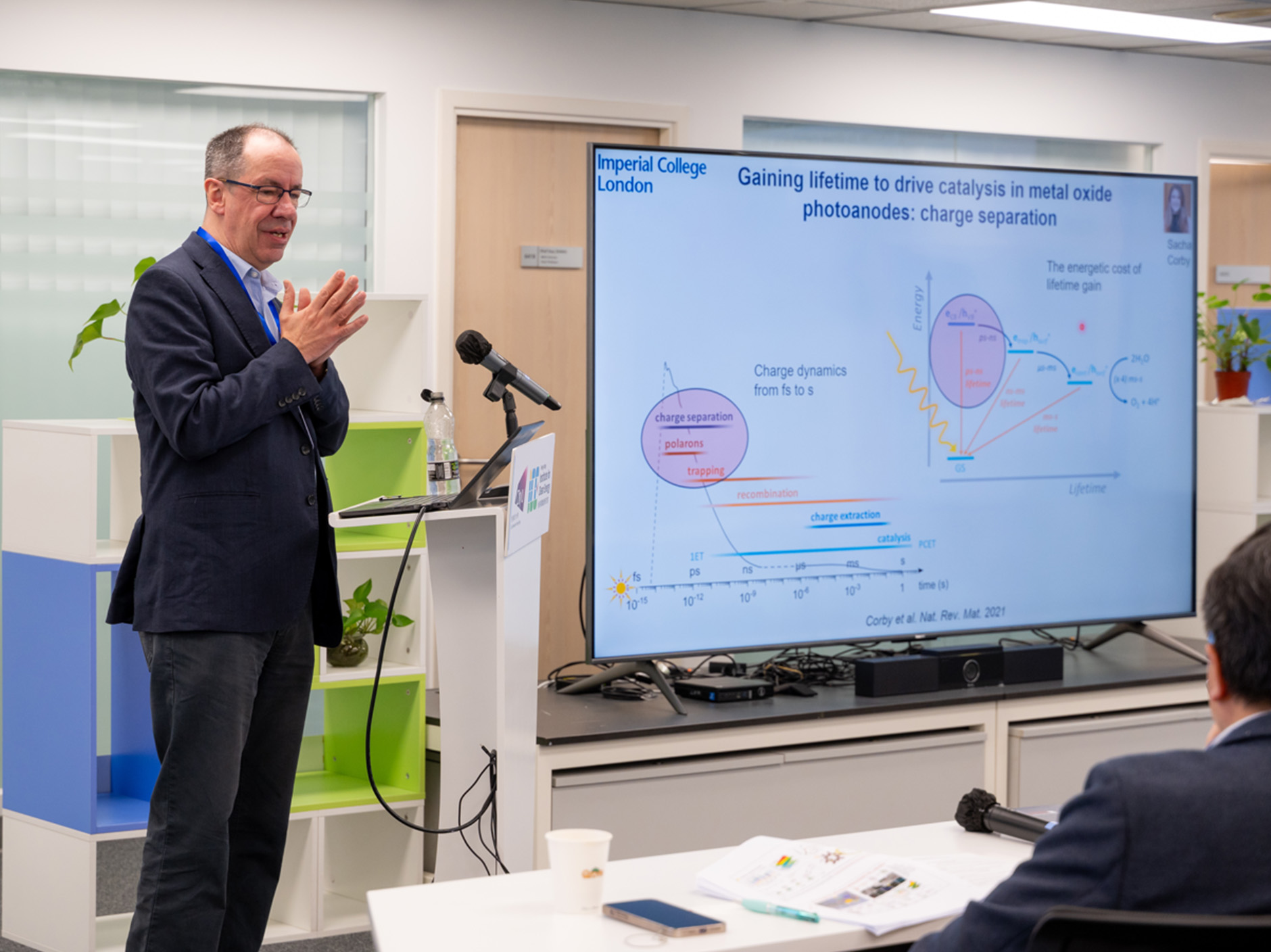
Professor Durrant is a world authority on photochemistry.

The challenge of sustainably synthesising fuels and chemicals as part of the transition to a more sustainable energy system was the main topic of a talk by Professor James Durrant at City University of Hong Kong (CityUHK) earlier as part of the CityUHK Distinguished Visiting Professor Lecture Series.

Professor Durrant is a world authority on photochemistry, which generally refers to the chemical effects of light, based in the Department of Chemistry and the Centre for Processable Electronics at Imperial College London and at SPECIFIC IKC in the Department of Materials Science and Engineering at the Swansea University.

Organised by CityUHK’s School of Energy and Environment, the talk titled “Photocatalytic and Electrocatalytic Pathways to Sustainable Fuels and Chemicals: insights into Reaction Kinetics from Optical Spectroscopy”. On the basis of United Nation’s Sustainable Development Goals, Professor Durrant stressed right away that developing pathways to sustainable fuels and chemicals was a key challenge for achieving net zero.  

He began by introducing photocatalytic, photoelectrode and electrocatalytic pathways to sustainable fuels and chemicals and then discussed the use of transient optical spectroscopies to provide insight into both photocatalytic and electrocatalytic function, focusing in particular on the challenge of splitting water to synthesise green hydrogen.

One of the most important requirements on this quest was minimising the loss of energy at every stage of every process involved in trying to generate such fuels, he said.

For example, a particular kinetic challenge for photocatalysis was the timescale mismatch between the picosecond to nanosecond lifetimes of the photoexcitations of most light-absorbing materials versus the microsecond to second timescales of chemical fuel synthesis, and contrast this with kinetic challenges in photovoltaic solar cells.

Photoexcitation refers to electrons gaining energy when light energy is absorbed by, for example in photosynthesis, a chlorophyll molecule.

“Harnessing sunlight as a sustainable energy source requires addressing the lifetime challenge, i.e. matching the timescales of photoexcitations to functional timescales with minimal energetic loss,” Professor Durrant explained.

In addition to minimising energy loss during the process of generating sustainable fuels, a key need is new materials with the necessary of function to minimise such losses, especially because the catalysis process is usually slow.

“We need to use materials design to minimise the energy losses required to drive the catalysis process,” added Professor Durrant, whose research interests span a range of photochemical applications, including solar cells, solar fuel production and photocatalysis, nanomaterials and plastic electronics.


We use cookies to ensure you get the best experience on our website.

More Information