
News
A computer, a popular and indispensable tool today, may still have not found its place in our students’ homes before. To enable our students to take home a brand new computer for studies or leisure, the Computing Services Centre organised a “Computer Ownership Programme for Students” in October 1999.Special offers on desktop and notebook computers from well-known vendors such as IBM, Dell, Compaq and Sun Microsystems were provided in this Programme, and the prices were guaranteed to be the lowest in town.
With the aim to obtain timely feedback from our end users on the quality of CSC services, our staff have been randomly selecting end users each weekday and giving each one of them a call to see if the jobs being raised in the CSC Work Request Forms (CSCWR) were completed to their satisfaction. They are also invited to give suggestions or comments on how the CSC can further improve its services, and to speak to the CSC management team direct if they so wish.
CityU’s own Internet link was upgraded to 10 Mbps shared bandwidth on 7 October, 1999, and it is now connected to UUNET Hong Kong (UUNET is the largest ISP in the world). The upgrade not only provides faster Internet access to staff and students, but also enables the link to be used as a backup for the local HARNET as well as HARNET’s Internet links.Prior to the upgrade, the link was connected to the NetPlus service of the Cable and Wireless HKT with guaranteed bandwidth of 512 Kbps. The upgrade was intended to increase the Internet bandwidth to 1 Mbps so that the total Internet bandwidth of the university would become comparable with those of the other local universities. A 10 Mbps shared bandwidth would effectively produce at least 1 Mbps equivalent of guaranteed bandwidth under normal situations, but its cost was much less than that of 1 Mbps guaranteed bandwidth. (One major drawback of guaranteed bandwidth is that once the bandwidth is fully utilised, network performance will drop to the floor.)
A wireless LAN (WLAN) is a flexible data communication system implemented as an extension to, or as an alternative for, a wired LAN within a building. Using radio frequency technology, WLAN receives and transmits data over the air, minimising the need for wired connections. As WLAN has gained great popularity in a number of industries in the last several years, it seems that the technology can also be used in education.
To meet the increasing demand of PC laboratories for conducting computer classes and hands-on tutorials, we have swapped Rooms J and K and equipped Room J with more PCs. After this swap, Room K is housed with 30 SUN UltraSparc 5 workstations while Room J has 50 PCs with large 17" XGA monitors. In addition, Room J is redecorated with newly designed furniture, arranging in U-shape layout similar to that of Room E which includes computer desks, printer tables and an instructor desk.
In this summer, the Computing Services Centre has been working on upgrading the PolyLink e-mail to a new Web-based e-mail system. The e-mail system is built upon the Sun Internet Mail Server (SIMS) system and the Mailspinner Web-based e-mail user interface running on the powerful Sun UltraSparc Enterprise servers. Besides having a better user interface and system performance, this new system also supports all open standard features, including the binary attachment feature, which is missing in our current PolyLink e-mail system.
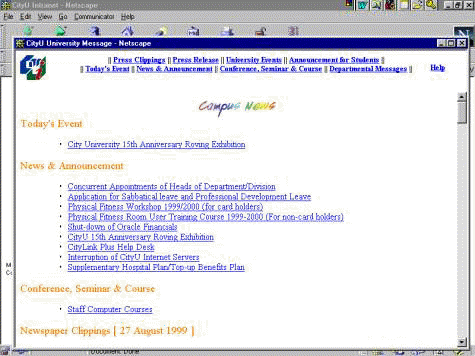
The CityU Intranet was successfully implemented in early August. Since then, University Messages followed suit and became Web-based. Therefore it is possible to add many interesting elements like pictures, images, sounds etc. to the messages. Incorporating hyperlinks also makes it easy to direct Web surfers to related or more detailed information. Most important of all, you can now read these messages wherever and whenever you have an Internet connection.If you are using your office networked PC, simply double click the
WeWe have been providing in-house dial-up facility for members of the University for several years. Though we always employ the most advanced technologies at the time of installation, as time goes by, the advancement of new telecommunication technologies is so rapid that it becomes impractical to keep on upgrading our existing modem pools to catch up with the contemporary standards. This results in a degradation of performance. On the other hand, the emphasis on using IT for teaching has stimulated a large crowd of users who need fast Internet access frequently and the demand for dial-up facility to support Web-based instructions keeps increasing. As such, there is an urgent need to replace our present dial-up equipment. However, sooner or later we will encounter another cycle of obsolescence. Therefore, the only way out is outsourcing.
Are you a person who likes to spend an afternoon at the Computer Expo’ just to see what’s happening in the computing arena? Does your job require you to keep up-to-date with the latest technology? If your answer to either or both of these questions is ‘yes’, you should consider attending seminars and talks organised by the Computing Services Centre (CSC).Starting Semester A 1999/2000, we will be hosting a number of exciting seminars. The first to be held this fall will feature the Office 2000 that everyone has been waiting for. As Linux is becoming more and more popular nowadays, a special seminar has been organised for this topic of interest. Other hot topics include FrontPage 2000, Web Security, PC Technology Trend in 1999/2000, and Chinese Input. Apart from the CSC Forum, we also have some casual Small Talk sessions in store for you during this Semester. Being held in a casual atmosphere and chaired by our most experienced CSC staff members, Small Talk serves as a channel to deliver vital and useful information so that all CityU staff are properly educated in the use of the computing facilities and services offered by the CSC.
 CityU IT ChatBot