
News
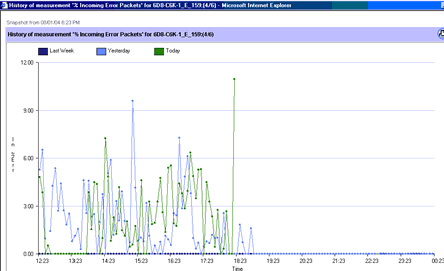
During the recent CTNET upgrade, the CityU's campus network had expanded in terms of capacity and supported features so as to provide a smooth platform for deploying advanced network applications and services. After the upgrade exercise, the CTNET now composes more than 200 networking devices, including switches, routers and network appliances. A single Network Management System (NMS) is therefore required to monitor the complex and expanding network.
With a view to resolving the laser printing problem in the Computing Services Centre (CSC), the CSC has conducted a pilot run of print monitoring system in the three large terminal rooms and then the other teaching studios as well from mid December 2003 to mid January 2004 (i.e. the semester break). During this period, the students were well informed of it and no quota was set for them.
In August 2003, the MS Blaster worm got through a known security loophole in Microsoft Windows and attacked millions of computers around the world, resulting in an enormous economic loss. Actually, this disaster could have been avoided if users had applied the security patch MS03-026 released a few months before the attack. However, many users might be too busy to perform Windows Update on time, or hoped that they could luckily survive in the attack.
The CityU homepage, the University's digital face gains a more comprehensive Chinese aspect, as of now, (12 January 2004).As the official language of the University is English, the CityU website is essentially an English site with the majority of pages written in English only. A Chinese website has been developed as an auxiliary to the English one. The Chinese webpages are not necessarily direct translations of the English pages; rather, they are complementary descriptions of the University, its departments/units, or reports on particular events and activities.
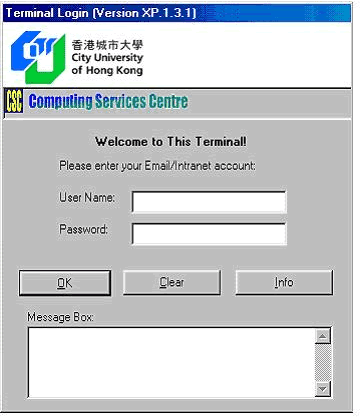
Network security is of great importance when information exchange is concerned. For public machines like the Express Terminals that are easily reached by outsiders, system logon is a must to safeguard the users, and that was why it was introduced several years ago. However, it seems that this measure is still not enough, and therefore a smart card authentication system is now in place.Express Terminals always provide an immediate access to the Internet. For instance, students prefer to use the Express Terminals to check their email, book University facilities, download lecture notes, etc. The smart card authentication system can secure all these processes and no one can use the students' accounts to login if he/she doesn't produce their CityU Smart Card.

A series of upgrades has been carried out in recent months on the HARNET (Hong Kong Academic and Research Network), a network that interconnects all the local universities). Major upgrades include The routers at the HARNET core as well as the router at each institution used for the HARNET connection are replaced with higher-end models, which can support multiple gigabit Ethernet connections.Gigabit Ethernet instead of ATM technology is now adopted for inter-connecting HARNET members at a speed of either 100Mbps or 300Mbps, depending on individual bandwidth requirements. The Gigabit Ethernet links are supported by a Metro Ethernet network (a metropolitan area network based on Ethernet technology), which is set up by PCCW for HARNET. A HARNET router is co-located at HKIX (Hong Kong Internet eXchange) and it is connected to HKIX using a Gigabit Ethernet link. The shared overseas Internet bandwidth is upgraded from 96Mbps to 155Mbps.
In the past, when people need to transfer files from PC to PC, the type of portable data storage media that first come in their minds are floppies, CDs and Zip disks. Floppy disks are the least expensive of the three but they only provide about a megabyte (MB) of storage. What's more, floppy disks are easy to break and susceptible to magnetic fields and dirt. Rewritable CDs are not practical for frequently saving data because of the time it takes to burn data and the inconvenience for notebooks without built-in CD drives. Zip disks require a Zip drive in every computer you use, something you cannot risk when you're travelling. So what durable storage device could provide greater portability while at the same time give you instant access to your files via any computer without the need of an additional drive? The answer is a Universal Serial Bus (USB) Flash disk, a portable device the size of a chewing gum pack that conveniently plugs into any computer with a USB port and stores data on flash memory chips. The all-in-one unit requires no batteries, no external power, and no additional cables or adapters.
In response to the increasing demand of accessing the Wireless LAN (WLAN) with various devices such as pocket PC and Palm, the Computing Services Centre (CSC) has upgraded the WLAN authentication system to adopt more generic authenticate methods such as using a Web browser for user validation. Unlike the old system that requires special authentication software installed in the client side, the new system utilizes built-in features of most modern operating systems to logon and no additional software is required.
As part of the computer provision, 300 new notebook computers have been purchased for loan to students for on-campus use. These new machines, featuring Pentium M 1.4GHz (Centrino) CPU, 256MB RAM, built-in wireless LAN card, light weight (5.4lb w/ battery), and ease of use, were put into service on 29 December 2003. These machines are secured by advanced anti-virus software and the Recover Genius 3.55 utility so that they are virus-free and the operating environment can be recovered instantaneously when re-booted. In addition, essential software applications, such as Microsoft Office, commonly used plug-ins, secure remote access and file transfer utilities, popular Chinese input tools, and Kingsoft instant translation software, have been pre-installed on the local hard disk for general use.
Providing the best services and facilities for students is one of CSC's goals. Therefore, in 2002, the CSC installed 130 laser printers in the CSC Student Terminal Area and provided free laser printing facility to students to encourage academic work and learning. After installation, students enjoyed using this facility and the usage was closely monitored. From time to time, we gave guidelines to students and seek their assistance to reduce toner consumption. During year 2002-03, the consumption of toner was maintained at a satisfactory level. In view of printing needs, the CSC increased the budget of laser printing by 11% even though the central budget was reduced by 15%.
 CityU IT ChatBot