
News
Virus, Worm or Trojan is no longer a technical jargon. They are so common and their impacts are so severe that they have appeared many times in the headlines of newspaper and media, such as CNN at http://www.cnn.com/2005/TECH/internet/08/16/computer.worm/index.html.Although anti-virus vendors are trying their best to stop these attacks, new types of virus/worm are discovered everyday. New techniques must be employed to supplement our existing methods to detect and stop these attacks.
At times, most departments may have genuine needs of sending email to a large number of external recipients, and yet quite a number of such email was either bounced as undelivered email or returned with undeliverable notifications by the recipients' email servers due to the following reasons:Departments' email recipient lists were outdated (e.g. the recipients' email addresses are invalid)The size of the email attachment was too large, resulting in the email being rejected by the email servers at the recipients' end.Sometimes the number of such bounced email or undeliverable email notifications was so huge (as the email is often delivered at the same time) that it jammed our email servers, causing prolonged sluggish email delivery. Worse still, complaints were received to ask the CityU to stop sending the email for reasons such as the recipients considered it as spam mail, or the email attachment caused the recipients' email disk quota severely depleted, resulting in their subsequent incoming email being missed.
According to statistics, our students printed more than 12 million pages (black & white) in year 2005-06 inside the Computing Services Centre (CSC). This is a new record! In fact, the demand for laser printing has been increasing steadily in recent years due to increased e-Learning activities. Without the space to install extra laser printers, students will have to wait longer for obtaining printouts.
In response to the University's teaching requirements for more large-sized classrooms for conducting computer tutorials and practicals, the Computing Services Centre (CSC) has started the renovation of Room H by changing it from an open access terminal room to a dual purpose Classroom/Teaching Studio with a capacity of more than 80 seats.
Mass communication in the University is mostly done electronically via the Electronic Broadcast Service (EBS), news posted on the Staff homepage and the Student homepage, news posted in the University e-Portal, and Staff Forum in the University e-Portal. Let us take a look at them in turn:The EBS makes use of the departmental mailing lists that are updated daily from staff and student enrollment data in AIMS. Each department, office and unit owns an EBS account for sending e-mail messages to staff and/or students of all or selected department(s).News posted on the Staff homepage and the Student homepage was introduced this February. Departments maintain news items in their departmental websites, which are harvested daily and posted to the designated homepages. As the Staff and Student homepages are also the login pages to the University e-Portal, they are ideal places for news announcement.
Currently, there are about 150 teaching classrooms and lecture theatres (LTs) on campus, all of which are equipped with computers and audio-visual equipment. For most users, the desktop computers in these rooms are already sufficient for their teaching purposes. However, users may prefer bringing along their own notebooks or another PC in addition to the one provided due to the following circumstances:
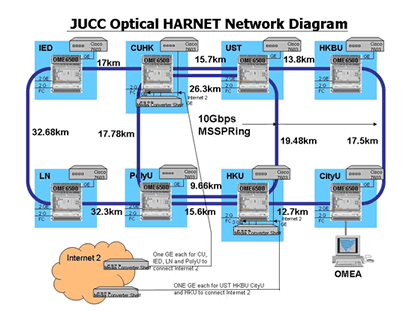
It is the first time in years the local universities are able to lease dark fibers from a local carrier for setting up the Optical HARNET, an experimental optical network linking up all the HARNET member institutions for collaborative research and academic activities which require high network bandwidth. The optical network was installed and became operational in late August 2006.
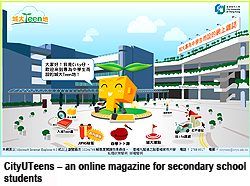
CityU has launched CityUTeens, a custom-made online magazine aimed at introducing the latest developments at CityU to teenagers studying in local secondary schools.The aim of the magazine is to introduce the latest developments about CityU and campus life. In the debut issue, Professor Richard Ho Yan-ki, CityU’s Vice-President (Undergraduate Education), provides tips for course selection under the new 3-3-4 curriculum structure.“CityU has been building close links with the secondary school sector recently,” said Professor Ho at the launching ceremony on 18 July. “The faculties, schools and departments at CityU have organized a number of activities such as competitions, workshops and exhibitions to help secondary school students learn more knowledge and skills as well as find out more about CityU.”

Walking into the Run Run Shaw Library at City University of Hong Kong (CityU), you will sense a unique cultural ambiance. A total of 58 paintings, calligraphy, sketches and pottery created by CityU people for the “Exhibition of Art Works by Members of CityU Community” are on display at the Library. The exhibition, the first of its kind at the University, exemplifies the passion for the arts among the CityU community.

We have used Microsoft's Software Update Services (SUS) for desktop patch management since 2003. According to statistics, the number of desktop computers with missing patches has been under control, making our campus network more secure. However, SUS mainly supports Microsoft's operating systems while other popular Microsoft software products are not covered. (See Network Computing, Issue 45 - September 2005 for details.) Windows Server Update Services (WSUS) is Microsoft's new tool for patch management, replacing the existing SUS. There is not much difference between the patch management process of SUS and WSUS. It enables the management of individual PCs as well as groups of PCs, performs tests before approval, and controls the timing of when a patch is going to be applied to the PCs.
 CityU IT ChatBot