
News
Student Work Programme is designed by the Computing Services Centre (CSC) to offer students opportunities to gain IT experiences through practical work in the CSC. Students have the precious chance not only to learn the state-of-the-art technology but also to contribute their skills to serve the University community.The opportunities cover various types of jobs as described below:
Those computers on the campus network with invalid network connection registration information on MAC/IP addresses, users' names, user locations, etc or with no registration at all are like illegal residents in the University cyber-community. Some are using unauthorized or other users' IP addresses to conduct their network activities while others become anonymous network users as no one officially knows their true identities or whereabouts, hence they may potentially pose serious security threats to our cyber-community especially during a crisis situation. Take the Windows client PCs as an example, when they become targets during an outbreak of viruses or at the imminent attacks by the hackers, the Computing Services Centre (CSC) could not reach them to issue timely alert or lend them a helping hand. When they become victims, the CSC would not be able to locate them quickly enough to stop them from further spreading the virus or from being exploited by hackers to launch other attacks.
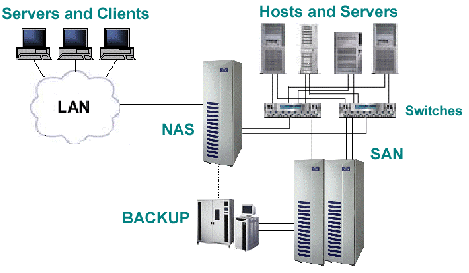
If you have been following the issues on how we have been doing to improve the Storage Management for Central Servers, we have mentioned the implementations of the SAN and EDM Backup solutions, and how they can help to improve our storage management. In this issue, we continue our discussion by focusing on the inclusion of the NAS solution as another part of our storage improvement project.Benefits of NAS File service for staff in their departmental LAN is currently provided by the implementation of departmental server. Normally, each department will have its own departmental server, with a few exceptions where a single server will be allocated for a mixture of departments and units within the same faculty. These servers, which amount to over 60, consist of a mixture of Windows NT 4.0 and Windows 2000 Server systems.
CityU staff based in Festival Walk will soon have a new communication tool on their desks: an IP phone handset. In a pilot scheme scheduled to be implemented in August or September, 300 staff members will try out the new technology before the digital system is installed on the main campus.The Director of Computing Services, Mr K H Poon, gave Linkage the background to the decision to change the way we talk to each other.
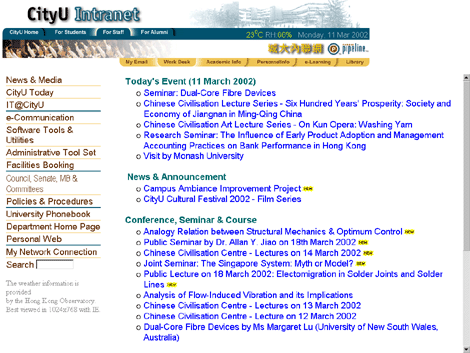
By now, you are probably quite familiar with the fresh new look of the CityU Intranet, which was revamped and launched in late December 2001. The new arrangement of the menus aims to provide faster and easier access to network services and information. In this article, we will introduce some of the major features of the new Intranet Home Page.
Phase 1 network upgrade was successfully completed in January 2002. In this phase a Gigabit network core was set up with full-redundant links between the core layer and distribution layer switches. Apart from that the network switches in most of the wiring closets on the 6/F and 7/F of the Academic Building were also upgraded providing a total of over 2600 10/100 Mbps ports.
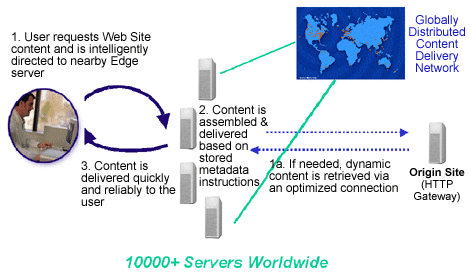
The Computing Service Centre (CSC) is pleased to announce that the CityU has become the first university in Hong Kong to sign with Akamai for providing free and fast access to many popular Web sites such as: CNN, Mcafee, Symantec, NBC, Reuters and Lycos. With Akamai hosting some or all of their Web contents, these popular sites will no longer need to constantly upgrade their Web servers or even purchase any Web server at all, and yet we, as end users, can expect unfailing deliveries of Web contents quickly and reliably.
The Windows 2000 pilot run started in October 2001. Currently about 26 departments have participated in the pilot run. It is estimated that over 400 colleagues have already tested the new Windows 2000 Intranet environment. To join the Windows 2000 Professional pilot run, the departmental Network Administrator (NA) has to submit a CSC Work Request to initiate the task. Upon receiving the request, the Computing Services Centre (CSC) will check the disk space of the departmental LAN server and refer the user to important notes before the upgrade. The NA should read the notes carefully in order to fully understand the upgrade procedure and limitations, ask the colleagues concerned to attend related training courses organised by the CSC, send us a list of the computer node names for those who would like to participate in the upgrade, and arrange the pilot run. When the department is ready, the CSC will create the Windows 2000 Professional Intranet menu, register the computer node names provided, and notify it when the preparation is done.
The number of security breaches in our university's computer network has significantly increased in recent years. In the last few months we experienced severe damages brought about by increasingly and highly advanced malicious attacks. The situation will worsen in the near future if we fail to step up our effort in strengthening our network security measures. Prevention, detection, and rectification of security breaches are now top priority for the computing community of the university. Based on our experience as well as reports from universities elsewhere, most of the network attacks and security loopholes are due to improper management of network servers that intentionally or unintentionally offer access or services to outsiders. These servers are easy targets to attack: to be used for spreading viruses, to bring down the campus network, or to launch attacks to others. Even worse, they may be hijacked by hackers to conduct criminal activities.
The University campus network has become the de facto pedestal upon which all computing services in our University are delivered, and the recent major upgrade has further strengthened its importance as the indispensable facility for our University. The advancement of the campus network urges for better administration, and the cooperation and assistance of departments will be crucial to it. In the light of this, it becomes necessary for each department office to designate a staff member to be the Network Administrator (NA), who acts as the departmental representative to serve as a single point of contact on matters related to campus network and networked computers, and, more importantly, to take charge of the related responsibilities, including:
 CityU IT ChatBot