
News
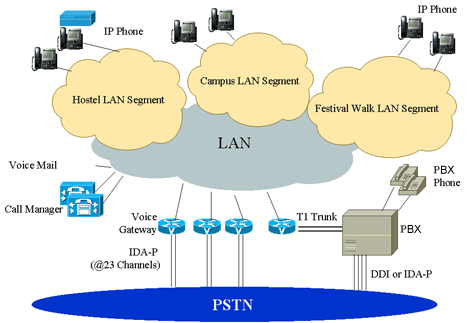
The current telephone service on campus is provided by a Public Branch Exchange (PBX) system and supported by the Facilities Management Office (FMO). Though the PBX offers reliable telephone services, yet most of the manufacturers see it soon becoming an obsolete technology and thus have ceased further development on it. They are now concentrating their effort on developing Voice over IP (VoIP) technologies, and IP Phone is just one of the VoIP products that can integrate voice, data as well as video on the same handset. IP Phone not only allows voice, data and video to share the same network cable (hence reducing cabling and support cost) but also offers many features normally not found or cannot be implemented under the conventional PBX system. Unlike PBX technology, the infrastructure of the VoIP technologies is pretty much like an ordinary data networking equipment. Consequently, the maintenance and support cost of an IP phone system are significantly lower than that of a conventional PBX system.
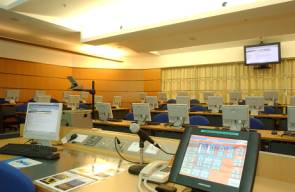
Even though multimedia has been used for teaching in the university for quite some time, well-equipped multimedia-teaching classrooms are still most welcome, and in particular, two new classrooms on the 2/F of Cheng Yick-chi Building should not be missed! Upon entering these new classrooms, you can expect to see a fresh design: from the theatre-like raised floor, ceiling lights, audio/visual equipment to the latest computer workstations. All the facilities were planned and installed with user friendliness in mind.
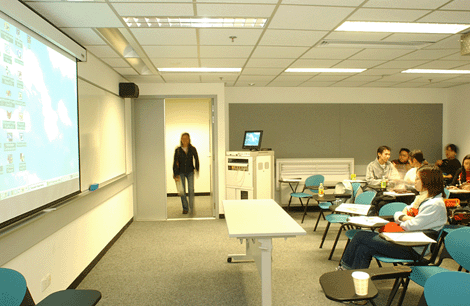
Easy access to modern information technology is essential to the pursuit and achievement of the mission of CityU for excellence in teaching, research, and service outreach. The readily accessible computing systems as well as internal and external data networks in the classrooms is certainly one step forward towards that direction.
/dec2001-6g1.gif?rev=1c96893964d64df88d72d0e22ec7557a&hash=13C6CE7AE6DF73BEEE94A3FDFE504B72)
There was some good news for your students who own a notebook computer and a wireless LAN card! From mid-October 2001, just register their wireless LAN cards with the Computing Services Centre (CSC) and these students can easily connect their notebooks to the Campus Wireless LAN (WLAN) whenever and wherever they are.
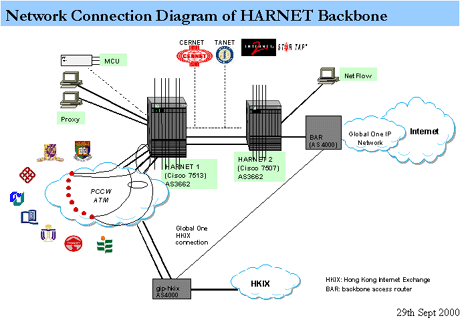
In order to meet the increase in demand of Internet bandwidth of the local universities, the International Internet link (via EQUANT) of HARNET (Hong Kong Academic & Research Network) was upgraded from 48 Mbps to 72 Mbps on 18 July, 2001. The local ATM connections linking up the eight local universities to HARNET were also upgraded to match the newly improved International Internet bandwidth on 1 September, 2001. As a result of the upgrade, the City University (CityU) is now connected to HARNET at a bandwidth of 36 Mbps.
For continuous improvement of service quality, the Computing Services Centre (CSC) is regularly reviewing the dial-up facility and searching for the best service providers in the market. After a vigorous selection, the CSC is pleased to announce that the New T&T Hong Kong Limited has been chosen as our new service provider and the new CityU dial-up facility was launched on 1st December 2001. To facilitate a smooth switch over, all dial-up numbers in-use remain unchanged.
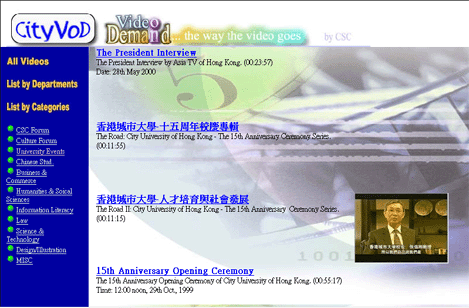
The University's Video-on-Demand facility has been in service for a long time, enabling users to watch archived videos on campus. Now the facility has been extended to your home and you can view the videos via the CityLink Plus dial-up facility. Currently, there are more than 170 videos, and the number keeps growing. Apart from the academic topics, such as lectures, conferences, forums, seminars, demonstrations and course materials, videos of other interests like "The President Interview" and
In recent months, there is a significant increase in the number of virus attacks and hacking activities targeted at or originated from our campus network. During the trouble-shooting and investigations of these incidents, the Computing Services Centre (CSC) discovered that the network database (which contains such information as IP addresses, network card addresses, and the locations and names of their owners, etc.) was quite outdated. As a result, this led to a delay in rectifying problems as well as notifying the victim users, and had caused unnecessary inconvenience or disturbance to those who were thought to be involved but in fact had nothing to do with those unfortunate incidents.In order to provide the University community a safe and reliable computer network to work on and to enable effective network management (easy fault isolation, quick identification of network problems, speedy recovery, etc.), the following measures will be taken:
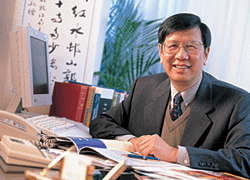
The new structure of the CSC consists of 7 groups led by two Associate Directors, who will then report to the Director of Computing Services:Infrastructure Communication and Network Group -- responsible for the support of backbone network, wide-area network connections, wireless LAN, dialup, and network services such as: DHCP, DNS, Proxy, etc.Facilities Support Group -- responsible for the hardware and software support as well as repair services for computer equipment in departments, Lecture Theatres, and CSC terminal areas. It will also support the video conferencing system, the smart-card systems, and CSC express terminals scattered around the campus.
Early in the morning of 20 September 2001 when I came into the office and switched on the PC as usual, the screen was appearing funny and small windows kept popping up as if they were saying hello to me. While I was wide at sea about what had happened, a neighbouring colleague came to my rescue and told me that we were likely to be attacked by a virus/worm.And the Operation Fighting Nimda formally began.
 CityU IT ChatBot