

Research Highlights

Posted
Involved Member: Dr. Vincent Chi Chiu KO
A series of luminescent bis(isocyanoborato) rhenate-(I) phenanthroline complexes with the general formula of cis,trans-[Re(CO)2(CNBR3)2(phen)]K(R=C6F5 and C6H5) have been designed and synthesized. The solutions of these complexes exhibit MLCT phosphorescence. Detailed anion titration study showed that the emission intensity of bis(isocyanotriphenylborato) complex in CH3CN/H2O solution would be significantly decreased in the presence of cyanide anion, while such a change would not be observed in the presence of other anions including F−, Cl−, Br−, I−, OH−, AcO−, N3−, ClO4−, H2PO4−, HSO4−, NO3−, NO2−, IO3−, and SCN−.
This represents the first example demonstrating the application of isocyanoborate ligand for selective chemosensing purpose. It is anticipated that it would initiate a new design strategy for selective cyanide sensors from the borane adducts other luminescent transition metal complex systems.
Reference:
Xiao, Y.L., Chu, W.K., Ng, C.O., Cheng, S.C., Tse, M.K., Yiu, S.M. and Ko, C.C. (2020). Design and synthesis of luminescent bis(isocyanoborato) rhenate(I) complexes as a selective sensor for cyanide anion. Organometallics, 39(11), 2135-2141.
Posted
Involved Member: Prof. Michael Hon Wah LAM
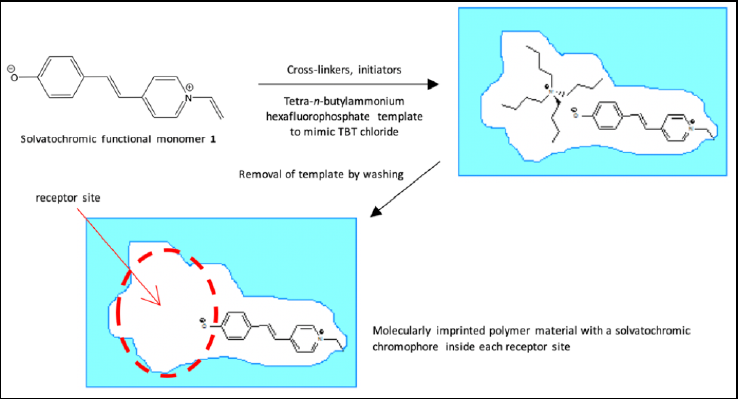
Our research group at the State Key Laboratory of Marine Pollution focuses on the development of chemosensing materials via molecular imprinting (MIP) and has already acquired a lot of experiences in the fabrication of MIPs and other related materials. To tackle the challenge of the chemosensing of non-polar, hydrophobic organic contaminants that do not generally interact with commonly used signal transducers, we developed a novel molecular imprinting technology that makes use of solvatochromic molecular reporters to sense the minute changes in the polarity of the micro-environment within the molecularly imprinted receptor sites upon the molecular recognition and binding of such organic contaminants. To demonstrate the unique capability of our chemosensing technology, a special molecularly imprinted polymer material that can produce colorimetric and fluorometric responses upon the binding of tributyltin chloride is fabricated. This is the first time that tributyltin species can be detected by a chemosensor.
We will continue our work to develop more intrigue molecular sensing strategies that do not require specific molecular interactions with non-polar and hydrophobic analytes for molecularly imprinted chemosensing materials. These new chemosensing mechanisms as well as the chemosensing materials developed will be very useful for the rapid, in-situ screening of selected environmental contaminants that are currently unable to be conveniently detected in complex sample matrices without the use of sophisticated analytical instrument after tedious ex-situ separation, pre-concentration and clean-up procedures.
Posted
Involved Members: Prof. Rudolf Shiu Sun WU, Prof. Kenneth Mei Yee LEUNG, Dr. Jill Man Ying CHIU
To overcome the longstanding problem and limitation of metal monitoring in the marine environment, a novel chemical sampling device, artificial mussel (AM), has been developed by Wu et al. (2007) for monitoring metals in marine environments. The device consists of a non-permeable Perspex tubing with the polymer-ligand Chelex100 resin suspended in artificial seawater inside and enclosed with semi-permeable polyacrylamide (SPP) gel at both ends. The SPP gel allows slow passage of metal ions through the pores before chelating with the resin.
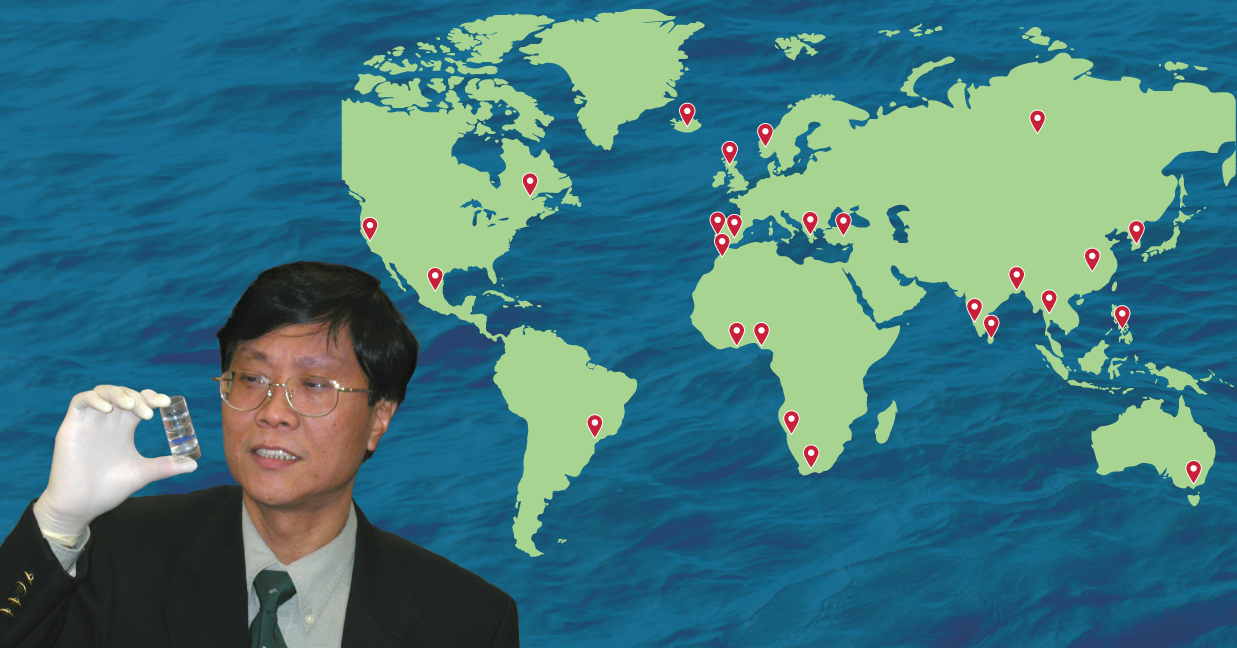
Field tests with AMs in coastal environments of Scotland, Iceland, South Africa, and Portugal have illustrated that AMs and different species of native mussels exhibit similar accumulation patterns for common toxic metals (Leung et al., 2008; Degger et al., 2011; Gonzalez-Rey et al., 2011; Claassens et al., 2016), but a significant difference was found for Zn (Degger et al., 2011; Gonzalez-Rey et al., 2011), and Pb (Leung et al., 2008; Gonzalez-Rey et al., 2011). Kibria et al. (2012) used AMs to identify “hot spots” of trace metal in freshwater catchments in Victoria, Australia, and estimate the potential environmental and public health risks.