

Research Highlights

Posted
Involved Members: Dr. Ruquan YE, Dr. Zhiyuan ZENG
This paper presents a novel metal-free electrocatalyst for direct nitrate-to-ammonia electroreduction, an important process in the agricultural and pharmaceutical industries. The unique atomic properties of amorphous graphene facilitate the adsorption of intermediates and the formation of NH3 during the NO3 reduction process. The electro-reduced nitrate electrolyte can be used to grow vegetables and significantly increase crop yields. Compared to metal-based catalysts, this is the first report of a metal-free material with comparable or superior nitrate-to-NH3 selectivity. These results have significant implications for the remediation of nitrate-contaminated water and the closing of the NOX cycle.
Reference:
Huang, L., Cheng, L., Ma, T., Zhang, J.J., Wu, H., Su, J., Song, Y., Zhu, H., Liu, Q., Zhu, M., Zeng, Z.Y., He, Q., Tse, M.K., Yang, D.T., Yakobson, B. I., Tang, B. Z., Ren, Y., Ye, R.Q., (2023). Direct synthesis of ammonia from nitrate on amorphous graphene with near 100% efficiency. Advanced Materials, 35(24), 2211856. (impact factor: 32.086)
Posted
Involved Members: Prof. Rudolf Shiu Sun WU
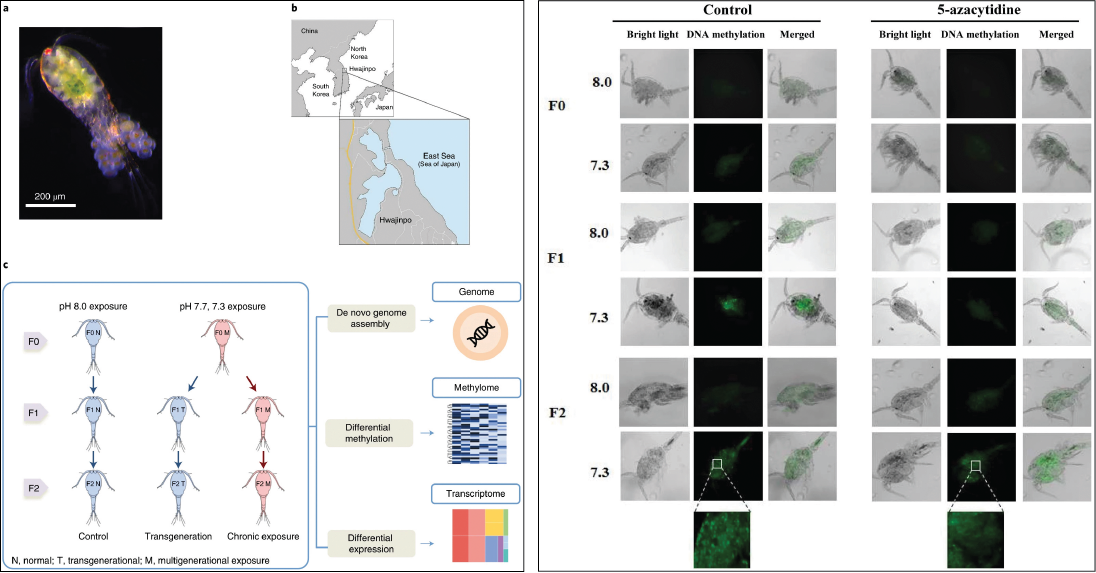
Copepods are planktonic crustaceans that are widely distributed in marine, fresh and brackish waters. They can indicate the health of the nature, but the increasing ocean acidification is affecting their reproductive rates in many ways. SKLMP member Prof. Rudolf Shiu-Sun Wu and a research team from Sungkyunkwan University in South Korea jointly discovered that copepods could adapt to ocean acidification through epigenetic changes. When copepods were exposed to acidified water across generations, there were epigenetic changes in their genes related to reproduction which enhanced the adaptability of copepods and helped them to recover their reproductive capacity in the adverse environment. This important finding has been published in the international journal Nature Climate Change.
Reference:
Lee, Y.H., Kim, M.S., Wang, M.H., Bhandari, R.K., Park, H.G., Wu, R.S.S., Lee, J.S. (2022). Epigenetic Plasticity Enables Copepods to Cope with Ocean Acidification. Nature Climate Change, 12, 918. (impact factor 28.862)

Posted
Involved Members: Dr. Moriaki YASUHARA
Marine and coastal ecosystems are undergoing new problems that still lack scientific research and understanding, and can have an impact on biodiversity. In the inaugural Marine and Coastal Horizons Scan by scientists, 15 horizon issues of three categories were ultimately identified, including large-scale alterations to marine ecosystems, changes to resource use and extraction, and emergence of new technologies. The scan was held to confirm potential emerging issues that could significantly affect the functioning and conservation of marine and coastal biodiversity in the next 5-10 years. The results of this scanning strongly contributes to raising public awareness, promoting relevant marine research, and pressing policymakers to take appropriate actions.
Reference:
Herbert-Read, J.E., Thornton, A., Amon, D.J., Birchenough, S.N., Côté, I.M., Dias, M.P., Godley, B.J., Keith, S.A., McKinley, E., Peck, L.S., Calado, R., Defeo, O., Degraer, S., Johnston, E.L., Kaartokallio, H., Macreadie, P.I., Metaxas, A., Muthumbi, A.W.N., Obura, D.O., Paterson, D.M., Piola, A.R., Richardson, A.J., Schloss, I.R., Snelgrove, P.V.R., Stewart, B.D., Thompson, P.M., Watson, G.J., Worthington, T.A., Yasuhara, M., Sutherland, T.A. (2022). A Global Horizon Scan of Issues Impacting Marine and Coastal Biodiversity Conservation. Nature Ecology and Evolution, 6(9), 1262-1270. (impact factor 19.100)

Posted
Involved Member: Dr. Moriaki YASUHARA
In addition to causing dreaded storms and fires, climate change will also cause invisible phenomena, such as reducing oxygen in seawater and warming seawater, threatening marine ecology. Dr. Moriaki Yasuhara, a member of SKLMP, published an article in the prestigious journal "Science" on predicting and understanding the future ocean conditions through palaeontology. Based on observations in paleobiology studies, it is predicted that a warming and deoxygenating ocean will make species smaller and push them from the tropical zone to the temperate zone, from the temperate zone to the polar zone, and from the polar zone to extinction, resulting in a loss of biodiversity in the tropics and higher biodiversity in higher latitudes. This domino effect of species displacements leads to the prediction that warming may reduce tropical diversity while causing extinction for polar endemic species. Thus, a warmer future will alter ecological communities in tropical oceans, which disproportionally affect developing countries, where the reliance on small-scale fishing is especially high.
Reference:
Yasuhara, M., Deutsch, C.A. (2022). Paleobiology Provides Glimpses of Future Ocean. Science, 375(6576), 25-26. (impact factor 63.798)
Posted
Involved Members: Dr. Henry Yuhe HE, Prof. Paul Kwan Sing LAM, Prof. Kenneth Mei Yee LEUNG, Dr. Phoebe Yuefei RUAN
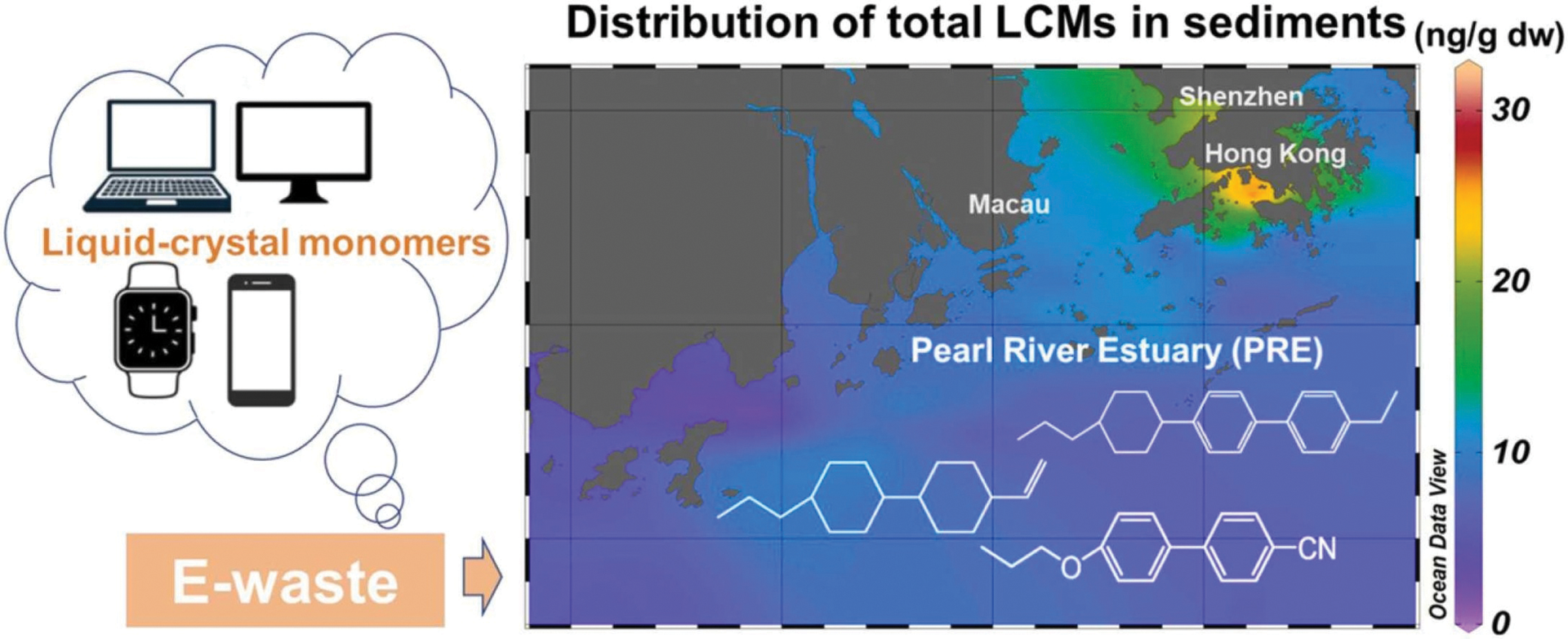
Liquid crystal monomers (LCMs) can accumulate in fatty tissues of animals and affect the health of marine life and humans. SKLMP member Dr. Yuhe He and his team have detected LCMs in the waters off Stonecutters Island and Tuen Mun in Hong Kong. He postulated that the LCMs detected off Tuen Mun may have been released from damaged LCDs in the West New Territories Landfill. Most Hong Kong households today have more than one mobile phone or tablet computer, so when they clean these electronic devices, domestic sewage with LCMs is discharged to Sewage Treatment Works. Sewage treatment probably fails to remove all LCMs, resulting in contamination of inshore waters.
Reference:
Tao, D.Y., Jin, Q.Q., Ruan, Y.F., Zhang, K., Jin, L.J., Zhan, Y.T., Su, G.Y., Wu, J.X., Leung, K.M.Y., Lam, P.K.S., He, Y.H. (2022). Widespread Occurrence of Emerging E-Waste Contaminants-Liquid Crystal Monomers in Sediments of the Pearl River Estuary, China. Journal of Hazardous Materials, 437, 129377. (impact factor
14.224)

Posted
Involved Members: Prof. Paul Kwan Sing LAM, Prof. Kenneth Mei Yee LEUNG, Dr. Phoebe Yuefei RUAN
Most organophosphate esters (OPEs) enter the marine environment through atmospheric deposition and surface runoff. In this study, samples of size-segregated atmospheric particles, suspended particulate matter in seawater, and sediments in the Pearl River Estuary (PRE) were collected and analyzed for OPEs. Concentrations of atmospheric particulate OPEs showed a decreasing trend with increasing offshore distance in the PRE. Sediment in the region close to Modaomen outlet was subject to relatively high OPE concentrations. The input and environmental fate of particulate OPEs are dependent on sources, particulate media, and chemical species. The present study calls for more concern on anthropogenic impact on the estuary.
Reference:
Lao, J.Y., Wu, R.B., Cui, Y.S., Zhou, S.W., Ruan, Y.F., Leung, K.M.Y., Wu, J.X., Zeng, E.Y., Lam, P.K.S. (2022). Significant Input of Organophosphate Esters Through Particle-Mediated Transport into the Pearl River Estuary, China. Journal of Hazardous Materials, 438, 129486. (impact factor 14.224)