

Research Highlights

Posted
Involved Member: Prof. Wenxiong WANG
This study investigated the subcellular trafficking of zinc ions (Zn) in fin cells of rabbitfish. The results showed that the toxicity and bioaccumulation of Zn were both dose- and time-dependent. Cellular homeostasis was maintained at lower Zn concentrations, but disruptions occurred at higher concentrations (>200 μM) and longer exposure time. Lysosomes played a crucial role in Zn regulation during the initial exposure period, storing Zn and exhibiting increased activity. However, beyond a certain threshold, Zn spillover occurred, affecting other cellular organelles, particularly mitochondria. This Zn-induced damage to mitochondria led to morphological changes, increased production of reactive oxygen species, and decreased cell viability. The study also found that the amount of Zn in mitochondria served as a reliable predictor of Zn toxicity in fish cells.
Reference:
Xia, Y., Tsim, K.W., Wang, W.X., (2023). How fish cells responded to zinc challenges: Insights from bioimaging. Science of The Total Environment, 875, 162538. (impact factor: 10.754)

Posted
Involved Members: Dr. Leo Lai CHAN
This research focuses on the ciguatera poisoning (CP) risks associated with Gambierdiscus and Fukuyoa dinoflagellates that produce Ciguatoxins (CTXs) and Maitotoxins (MTXs). The analysis revealed the presence of ciguatoxic strains of Gambierdiscus in both Kiribati and Malaysia, however, no solid evidence of their contribution to the incidence of CP outbreak was recorded. The study examined the regional differences in CP risks through a region-specific toxicological assessment of Gambierdiscus and Fukuyoa. The results showed that Gambierdiscus from both Kiribati and Malaysia had detectable ciguatoxicity, with the Kiribati strains being more haemolytic. Putative 44-methylgambierone was identified as part of the contributors to the haemolytic activity, and other unknown hydrophilic toxins produced could be potentially linked to the higher CP incidence in Kiribati. Haemolysis assay was suggested to discriminate the hydrophilic CTX precursor produced.
Reference:
Zhu, J., Lee, W.H., Yip, K.C., Wu, Z., Wu, J., Leaw, C.P., Lim, P.T., Lu, C.K., Chan, L.L., (2023). Regional comparison on ciguatoxicity, hemolytic activity, and toxin profile of the dinoflagellate Gambierdiscus from Kiribati and Malaysia. Science of the Total Environment, 872, 162236. (impact factor: 10.754)
Posted
Involved Members: Prof. Paul Kwan Sing LAM, Dr. Phoebe Yuefei RUAN, Dr. Meng YAN
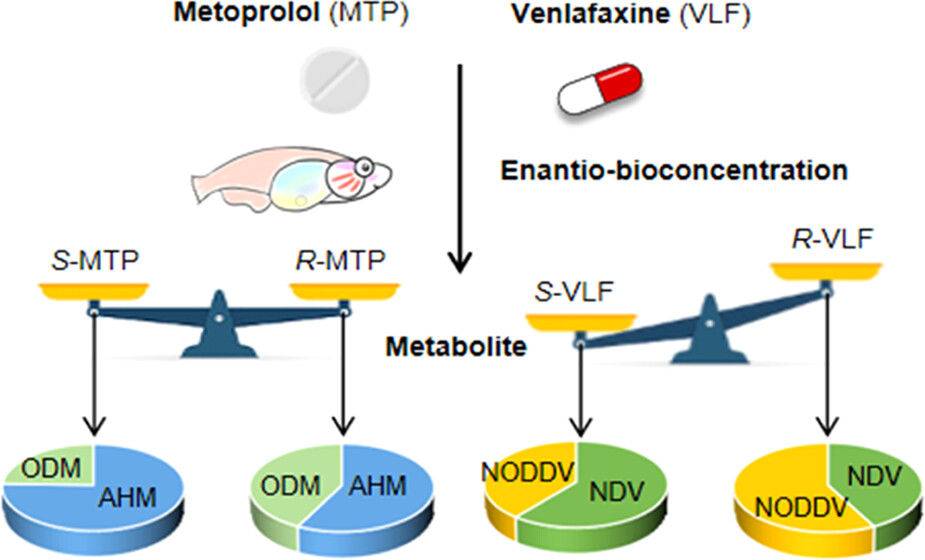
This study investigates the tissue-specific uptake and depuration kinetics of two pairs of pharmaceutical enantiomers, metoprolol and venlafaxine, in marine medaka during a 28-day exposure and 14-day clearance period. Considerable bioconcentration potential of these chemicals was found in the exposed fish. Metoprolol and venlafaxine exhibited higher bioconcentration potential in the eyes than other tissues, indicating the possibility of impairment in the visual function of marine medaka, which needs further investigation. This is the first time to report the toxicokinetic parameters of pharmaceuticals concerning chirality in marine model organisms. The enantiospecific difference in bioconcentration and metabolism provides future directions for eco-toxicodynamic studies, especially for marine species.
Reference:
Jin, L., Wang, Q., Yan, M., Gu, J., Zhang, K., Lam, P.K., Ruan, Y.F., (2023). Enantiospecific Uptake and Depuration Kinetics of Chiral Metoprolol and Venlafaxine in Marine Medaka (Oryzias melastigma): Tissue Distribution and Metabolite Formation. Environmental Science & Technology, 57(11), 4471-4480. (impact factor: 11.357)
Posted
Involved Members: Prof. Vincent Chi Chiu KO, Prof. Rudolf Shiu Sun WU
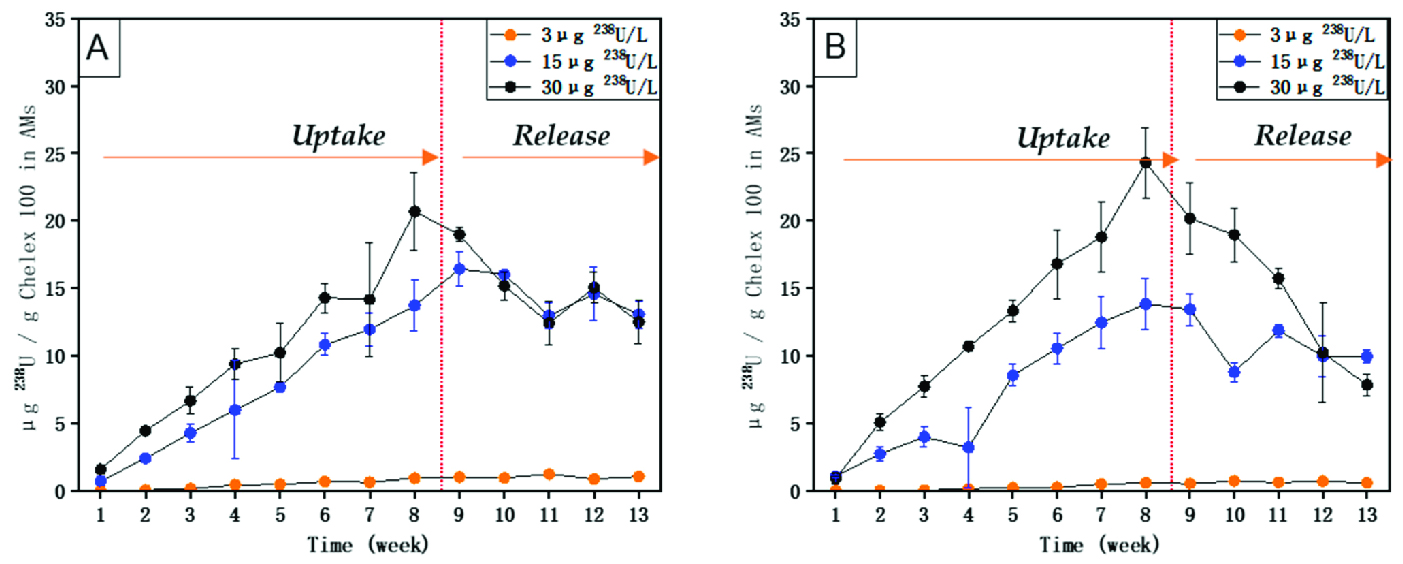
This study aimed to explore the feasibility of using the ‘Artificial Mussel’ (AM) as a new tool for monitoring radionuclides in marine environments. It was found that the uptake and accumulation of 238U, 88Sr, and 133Cs by AMs were directly related to their concentrations in water and equilibrium could be reached within 7 to 8 weeks, with high concentration factors. The results suggest that AMs can be an effective and practical tool for monitoring of radionuclides in aquatic environments, overcoming the challenges faced by existing methods. By offering a low-cost and efficient alternative, AMs have the potential to revolutionize long-term and large-scale radionuclide monitoring, providing valuable insights into the presence and levels of radioactive substances in marine ecosystems.
Reference:
Yang, Y., Chow, T. W., Zhang, Y.Q., Yu, P.K., Ko, C.C., Wu, R.S.S., (2023). Artificial Mussels: A New Tool for Monitoring Radionuclides in Aquatic Environments. Journal of Marine Science and Engineering, 11(7), 1309. (impact factor: 2.744)

Posted
Involved Members: Dr. Xue WANG, Dr. Ruquan YE
In this study, CuxO bipyramids with controlled tip angles and abundant nanograins were synthesized using laser-assisted manufacturing. The relationship between electron transport/ion concentrations and electrocatalytic performance was investigated through various tests and simulations. The results demonstrated the contributions of a strong electric field at the sharp tip and provided insights into the dynamic evolution of critical *CO/*OCCOH intermediates and product profiles. By modulating electron transport and ion concentrations, high Faradaic efficiency was achieved for C2+ products via CO2RR and nitrate reduction reaction (NITRR), showcasing the potential for carbon-nitrogen cycling.
Reference:
Guo, W., Zhang, S., Zhang, J., Wu, H., Ma, Y., Song, Y., Cheng, L., Chang, L., Li, G., Liu, Y., Wei, G., Gan, L., Zhu, M., Xi, S., Wang, X., Yakobson, B. I., Tang, B. Z., Ye, R.Q., (2023). Accelerating multielectron reduction at CuxO nanograins interfaces with controlled local electric field. Nature Communications, 14(1), 7383. (impact factor: 16.6)

Posted
Involved Member: Dr. Meng YAN
A new method for classifying microalgae based on the physical properties encoded in the Mueller matrix is presented in the paper, which is a “polarization fingerprint” composed of sixteen polarization parameters that are selected based on their explicit physical meanings and associations with the structural properties of microalgae. Microalgae can be effectively classified by the polarization fingerprint and machine learning algorithms. This work demonstrates the potential of the polarization fingerprint to classify microalgae and monitor aquatic environments in-situ.
Reference: Li, J., Wei, J., Liu, H., Wan, J., Huang, T., Wang, H., Liao, R., Yan, M., Ma, H., (2023). Polarization fingerprint for microalgae classification. Optics and Lasers in Engineering, 166, 107567. (impact factor: 5.666)