

Research Highlights

Posted
Involved Members: Dr. Henry Yuhe HE, Prof. Paul Kwan Sing LAM, Prof. Kenneth Mei Yee LEUNG
Surgical masks (SMs) are the most commonly used personal protection equipment during the COVID-19 pandemic. Due to their vast application and inappropriate disposal worldwide, SMs could potentially bring a serious pollution of microplastics (MPs) into coastal marine environments. This study aimed to investigate the kinetic release of MPs from polypropylene SMs (PP-SM) in seawater and evaluate the chronic toxicity of the MPs to the marine copepod Tigriopus japonicus. Based on the kinetic study results and available relevant data, we estimated that SMs discarded throughout the year 2020 would lead to at least 117 trillion MPs entering the coastal marine environment globally, with a release rate of 415 billion MPs per day. Our results also demonstrated that the copepods ingested the MPs released from PP-SMs, resulting in a significant decline in their fecundity. The results evidently suggested the MPs released from improperly discarded SMs could pose a long-term domino effect on coastal marine ecosystems. To minimize the risk of this emerging threat, better environmental management, policy and law enforcement for ensuring proper disposal of SMs are deemed to be necessary.
Reference:
Sun, J., Yang, S., Zhou, G.J., Zhang, K., Lu, Y., Jin, Q., Lam, P.K.S., Leung, K.M.Y. & He, Y.H. (2021). Release of microplastics from discarded surgical masks and their adverse impacts on the marine copepod Tigriopus japonicus. Environmental Science & Technology Letters, 8(12), 1065-1070.
Posted
Involved Members: Prof. Jianwen QIU, Dr. Moriaki YASUHARA
Our members of SKLMP, Dr. Moriaki Yasuhara (School of Biological Sciences and Swire Institute of Marine Science (SWIMS) of the University of Hong Kong) and Prof. Jianwen Qiu (Department of Biology, Hong Kong Baptist University) jointly published an important co-authored paper in Science Advances to report on the historical trend of corals in the marine environment of the Greater Bay Area (GBA) of China, including Hong Kong. This work was led by a PhD candidate and National Geographic Explorer, Mr Jonathan Cybulski and his supervisor Dr. David Baker from SWIMS. The research team, for the first time, investigated the historical presence of coral communities in GBA, revealing a catastrophic range collapse and loss of diversity that occurred in the last several decades. They examined fossil corals collected from over 11 sites around Hong Kong, and created the first palaeoecological baseline for coral communities in GBA. They uncovered what coral genera were present in the past well before major human impacts, and these coral genera include: Acropora, Montipora, Turbinaria, Psammacora, Pavona, Hydnophora, Porites, Platygyra, Goniopora and Faviids. Most importantly, this historical research showed that the historical collapses of the corals was likely due to water pollution and habitat loss associated with coastal development. Their results imply that poor water quality driven by increased development and lack of proper treatment is presently the greatest threat to the survival of corals in GBA.

Posted
Involved Members: Dr. Siu Gin CHEUNG, Dr. Ball Keng Po LAI
Research on plastics fragmentation is important for the estimation of amount of microplastics but the biological causes for fragmentation have not been acknowledged. From microplastics collected in beaches of Hong Kong, we revealed an abnormal type of fragment which has not been reported before. These fragments, composing about 6% of the microplastics (pellet, foam, bead, fragment) collected, were interestingly triangular in shape with at least two of the three sides being characteristically straight and resembling a cut made by compression. Objective observations have distinguished these “trimmed triangular fragments” to those triangular fragments that were fractured randomly. By comparing with additional evidence, we proposed that these trimmed fragments were the daughter pieces of macrofaunal biting. If this was so, there would be wide implications on fragmentation modeling studies for microplastics since active biting of large plastic debris has generally not been considered as a factor of plastics fragmentation.
Reference:
Po, B.H.K., Lo, H.S., Cheung, S.G. and Lai, K.P. (2020). Characterisation of an unexplored group of microplastics from the South China Sea: Can they be caused by macrofaunal fragmentation? Marine Pollution Bulletin, 155, 111151.

Posted
Involved Member: Prof. Kenneth Mei Yee LEUNG
Mean species richness (i.e., number of species) of mobile species on experimentally enhanced tiles (Flat, 2.5 cm, 5.0 cm) after 12 months using destructive sampling data in: a) Lok On Pai and b) Sham Shui Kok. Control seawall and reference natural sites using in-situ observations are shown for reference.

Posted
Involved Member: Prof. Kenneth Mei Yee LEUNG

Posted
Involved Member: Dr. Leo Lai CHAN
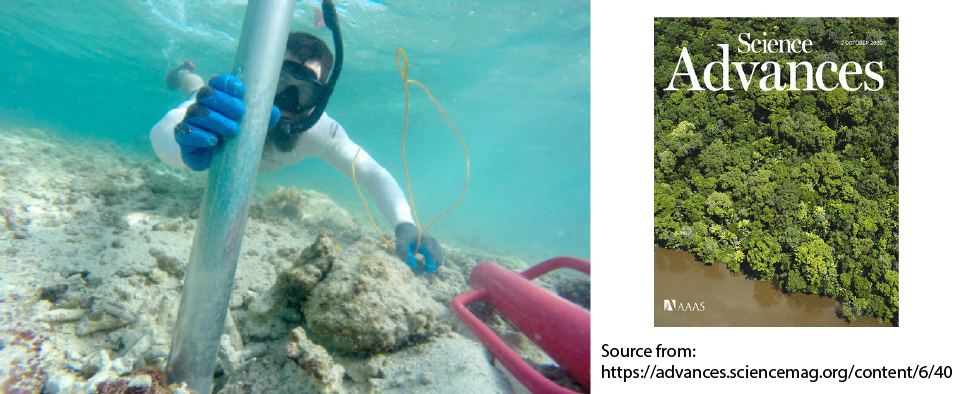
Underwater visual monitoring methods are used broadly to evaluate coral reef conditions in the natural environment, but quantitative measurements of the coral holobiont has been largely restricted to photo-physiological assessment of the endosymbionts. An underwater respirometer has been designed to make routine, diver-operated, non-invasive measurements at coral surfaces, but the realistic in situ accuracy and precision capabilities of this device have not been critically assessed; an essential step if these measurements are to be useful for quantifying spatial and seasonal patterns of coral metabolism. We developed specific protocols for this system to survey shallow coral colonies and detect metabolic profiles (respiration, photosynthesis, and biocalcification), diel cycles (day and night), and photosynthesis-irradiance curves. Analysis of data from in situ and laboratory-controlled conditions showed good agreement among coral colonies and high precision measurements of temperature, oxygen and pH fluxes over 15-min incubation times without noticeable detrimental effects on coral health. Moreover, marked differences were observed in coral calcification rates between estuarine-influenced and coastal marine conditions, despite the absence of significant differences in visual appearance or other health indicators, revealing the system’s potential for early detection of marginally adverse conditions for coral metabolism.