

The Jockey Club College of Veterinary Medicine and Life Sciences (JCC) offers a Bachelor of Veterinary Medicine (BVM) Programme, which has been jointly developed with our partner, Cornell University's College of Veterinary Medicine (CVM), ranked 3rd in the world for veterinary education (QS World University Rankings for Veterinary Science 2023). Our BVM has been tailored for the Asian veterinary environment through its four themes (Animal Welfare, Aquatic Animal Health, Emerging Infectious Diseases, Food Safety).
Key Information
| Major: | Veterinary Medicine |
| Award Title: | Bachelor of Veterinary Medicine |
| Mode of funding: | Government funded |
| Programme Code: | JS1801 (JUPAS) / 1801 (Non-JUPAS) |
| Tuition Fee: | Click HERE for more information |
| Mode of Study: | Full-time |
| Duration: | 6 years |
| Credit Units: | 242^/243* |
| Application Deadline | Direct applicant: 15 January 2027 / JUPAS: 2 December 2026 |
^ for students admitted prior to Semester A 2025/26
* for students admitted in Semester A 2025/26 & thereafter
In 2008, City University of Hong Kong set a goal to create the first school of veterinary medicine in Hong Kong. The CityUHK School of Veterinary Medicine was first established in 2014 and was renamed the Jockey Club College of Veterinary Medicine and Life Sciences (JCC) in 2017.
Visions and Mission of Jockey Club Veterinary Medicine and Life Sciences
Vision: to become a centre of excellence for education and research in veterinary medicine and life sciences, and one of the world’s top 20 veterinary schools within the next 20 years.
Mission: to establish world-class programmes to train high-calibre veterinarians and biomedical and life sciences professionals who can respond to the grand challenges of our time.
Our overall goal is to improve the quality of life and the health of people, animals, and the environment under the One Health paradigm and to ensure sustainable food production by promoting animal welfare.
Cornell University Collaboration
The Jockey Club College of Veterinary Medicine & Life Sciences has a long-established, successful partnership with Cornell University’s College of Veterinary Medicine (CVM) in Ithaca, New York, one of the premier veterinary education and research providers in the world. In 2009, CityU established a collaborative relationship with Cornell University relative to the planning, establishment and operation of a School of Veterinary Medicine in Hong Kong. The ‘Interdisciplinary PhD Programme in Veterinary Medicine’ with Cornell CVM was introduced in 2015, and in 2016 the ‘Bachelor of Veterinary Medicine’ programme was launched, with its first student intake in 2017. The curriculum of this programme is modelled on the Cornell University veterinary medicine programme and was designed to include the pre-requisites and the four-year curriculum of Cornell’s Doctor of Veterinary Medicine (DVM) programme. Cornell University provides ongoing involvement and support in curriculum roll-out, staff recruitment, etc.. It has made a long-term commitment to achieve excellence in veterinary medicine training and research in Hong Kong.
Dual Accreditation
The Bachelor of Veterinary Medicine (BVM) program at City University of Hong Kong (CityU) is the first dual-accredited veterinary program in Asia, holding accreditation from both the Australasian Veterinary Boards Council (AVBC)and the Royal College of Veterinary Surgeons (RCVS). This means graduates are eligible to register to practice in Hong Kong, the UK, Australia, and New Zealand, as well as other countries that recognize either body.
Student Sharing
JUPAS applicants
Direct / Non-JUPAS applicants
Key dates for JUPAS applicants
| 2026 | |
| 7 October | Start date for JUPAS applications |
| 2 December | Deadline for JUPAS applications |
| 2027 | |
| Early-June | JUPAS applicants will be notified via email regarding the submission method for non-academic criteria |
| Early to mid-June | Casper Online test for JUPAS applicants (Applicants will be invited to register for the Casper test in late May to early June) |
| Late June | Interviews for applicants nominated through the School Principal’s Nominations Scheme |
| 9 July, noon | Deadline for document submission of non-academic requirements |
| 14 July | Release of HKDSE Results |
| 14-16 July | Period for modification of JUPAS programme choices (after the release of HKDSE examination results) |
| 21-22 July | Interview for selected DSE applicants |
| 4 August | Announcement of JUPAS Main Round offer |
Key dates for Direct / Non-JUPAS applicants
| 2026 | |
| 24 September | Start date for direct/ non-JUPAS applications |
| 2027 | |
| 15 January | Application deadline for direct/ non-JUPAS applications |
| Mid-late January | Casper Online Test for applicants (Applicants will be invited to register for the Casper test in mid-June) |
| 13-14 March | Regular round Multiple Mini Interview (MMI) for selected applicants |
| Late April | Issuance of admission offers |
In addition to the University General Entrance Requirements, applicants must satisfy the following BVM-specific entrance requirements in order to be considered for admission.
Academic Requirements:
| Qualifications | Minimum Entrance Requirements |
| JUPAS - HKDSE (JS1801) |
|
Remarks:
-
Past results in HKDSE Liberal Studies (Level 2 or above) are recognized for replacing HKDSE Citizenship and Social Development in meeting the University’s entrance requirements.
-
Elective Subjects:
- Unspecified electives can only include Category A elective subjects,
-
Applied Learning (ApL) subjects are not counted as elective subjects
-
Non-Chinese Speaking (NCS) Students
Applicants who have (i) learned Chinese Language for less than 6 years while receiving primary and secondary education or (ii) learned Chinese Language for 6 years or more in schools but have been taught an adapted and simpler Chinese Language curriculum not normally applicable to the majority of students in local schools can use one of the following alternative qualifications in Chinese Language (ACL) to replace HKDSE Chinese Language Level 3 to meet the entrance requirement.
- HKDSE Applied Learning Chinese “Attained” or above
- GCEAL/AS Chinese grade E or above
- GCSE/IGCSE Chinese grade C / grade 4 or above
Assessment of Applications and Competitive Scores
When calculating the JUPAS academic score, the best five subjects are taken into account, with English, Mathematics, Biology, and Chemistry being mandatory. Chinese Language can also be included, but if there is another subject with a higher score, it will be used for the scoring. Additionally, CityUHK accepts repeated or past exam results.
Successful applicants have typically achieved HKDSE scores of *30.5 or higher. As competition varies yearly, this cut-off score serves only as a reference. We may consider applicants with lower academic scores if they have sufficient work experience with animals and are an excellent fit for the BVM programme.
*Total score for the best five subjects
Scoring Scale
| Category A Core and Elective Subjects (including M1 and M2) | ||||||||
| Level | 5** | 5* | 5 | 4 | 3 | 2 | 1 | Unclassified / Others |
| Score | 8.5 | 7 | 5.5 | 4 | 3 | 2 | 1 | 0 |
In addition to the University General Entrance Requirements, applicants must satisfy the following BVM-specific entrance requirements in order to be considered for admission.
| Qualifications | Minimum Entrance Requirements |
|---|---|
| IB |
The ‘English A’ subject may be ‘Language English A: literature’ or ‘English A: language and literature’ subject * For Mathematics, both Analysis and Approaches (AA) and Applications and Interpretation (AI) are acceptable. |
An alternative to IB English is a TOEFL score of 100 in the Internet-based test (iBT) or an overall IELTS score of 7 (Academic Module).
- TOEFL: The test must be taken within two years prior to the start date of Semester A of admission year. Only accepts internet-based scores from a single test date, not MyBest scores. Online/ Home edition test results including TOEFL iBT (Home Edition) are not accepted.
- IELTS: The test must be taken within two years prior to the start date of Semester A of admission year. Online/ Home edition test results including IELTS Indicator (home edition), IELTS Online and IELTS One Skill Retake are not accepted.
Competitive Scores
The competitive scores below serve only as a reference, as competition varies yearly. Consideration will be given to other factors, such as English proficiency, applicant statement, and interview performance. We may consider applicants with lower academic scores if they have sufficient animal-handling work experience.
| Indicative scores/ grades | |
| IB | ≥ 37 |
In addition to the University General Entrance Requirements, applicants must satisfy the following BVM-specific entrance requirements in order to be considered for admission.
| Qualifications | Minimum Entrance Requirements |
|---|---|
| GCE |
|
An alternative to GCE/GCSE English is a TOEFL score of 100 in the Internet-based test (iBT) or an overall IELTS score of 7 (Academic Module).
- TOEFL: The test must be taken within two years prior to the start date of Semester A of admission year. Only accepts internet-based scores from a single test date, not MyBest scores. Online/ Home edition test results including TOEFL iBT (Home Edition) are not accepted.
- IELTS: The test must be taken within two years prior to the start date of Semester A of admission year. Online/ Home edition test results including IELTS Indicator (home edition), IELTS Online and IELTS One Skill Retake are not accepted.
Competitive Scores
The competitive scores below serve only as a reference, as competition varies yearly. Consideration will be given to other factors, such as English proficiency, applicant statement, and interview performance. We may consider applicants with lower academic scores if they have sufficient animal-handling work experience.
| Indicative scores/ grades | |
| GCE - AL / IAL | Three Grade A or above in the pre-requisite subjects (English, Mathematics, Biology, and Chemistry) |
自2026学年起,香港城市大学(港城大)透过「中国内地高考单独招生」独立招收中国内地普通高等学校招生全国统一考试(中国内地高考)学生,不参加「全国普通高等学校统一招生计划(统招)」,不占统招志愿。港城大以择优方式录取,各省市不设名额上下限。
有意报读港城大的应届高考生必须于申请截止日期前通过港城大官方网站直接提交入学申请。9月24日开始接受入学申请,截止日期为2027年6月13日。
| 课程编号 | 课程名称 | ⽂理科要求 |
| 1801 | 兽医学学士 (特点: 健康一体化/动物健康与福利/公共卫生/双认证兽医课程) | 理科化学、生命科学/生物 |
- 指定选考科⽬备注:赛马会动物医学及生命科学院兽医学学士为六年制课程
Applications by graduates and current students completing a degree programme at a University in Hong Kong or overseas will be considered on a case-by-case basis. However, applicants must be able to demonstrate competencies in English*, Mathematics, Biology and Chemistry to levels equivalent to those specified above.
* The English requirement is a TOEFL score of 100 in the Internet-based test (iBT) or an overall IELTS score of 7 (Academic Module).
- TOEFL: The test must be taken within two years prior to the start date of Semester A of admission year. Only accepts internet-based scores from a single test date, not MyBest scores. Online/ Home edition test results including TOEFL iBT (Home Edition) are not accepted.
- IELTS: The test must be taken within two years prior to the start date of Semester A of admission year. Online/ Home edition test results including IELTS Indicator (home edition), IELTS Online and IELTS One Skill Retake are not accepted.
Other international qualifications will be considered on a case-by-case basis. However, applicants must be able to demonstrate competencies in English*, Mathematics, Biology, and Chemistry to levels equivalent to those specified above
* The English requirement is aTOEFL score of 100 in the Internet-based test (iBT) or an overall IELTS score of 7 (Academic Module).
- TOEFL: The test must be taken within two years prior to the start date of Semester A of admission year. Only accepts internet-based scores from a single test date, not MyBest scores. Online/ Home edition test results including TOEFL iBT (Home Edition) are not accepted.
- IELTS: The test must be taken within two years prior to the start date of Semester A of admission year. Online/ Home edition test results including IELTS Indicator (home edition), IELTS Online and IELTS One Skill Retake are not accepted.
All applicants (Direct and JUPAS applicants) are required to complete the following non-academic requirements:
Letter(s) of Accomplishment [suggested letter template] for work experience with animals:
- 70 hours, approx. 10 days (e.g., in animal shelters, veterinary clinics, zoos, aquariums). Completion of the CityUHK Veterinary Immersive Programme satisfies the 70 hours requirement.
Submission Deadlines and Methods:
-
Non-JUPAS applicants: at the time of the application (15 January 2027)
Upload the documents for non-academic requirements via the application system under “supporting documents”.
-
JUPAS applicants: 9 July 2027, noon
Submission link will be emailed to all JUPAS applicants in late May to early June 2027. Applicants must combine the Letter(s) of Accomplishment into one PDF file and upload it to the submission box. The file size must not exceed 1MB. Late submissions will not be considered.
Remarks:
- Incomplete submissions may delay the processing of your application may result in rejection.
- Documents unclear or written in a language other than English cannot be accepted.
- Meeting the deadlines for non-academic requirements may enhance the likelihood of receiving an interview invitation.
- Late submission of documents may lead to the rejection of the candidate’s application.
Selection Process
Situational Judgement Test (Casper)
All applicants are required to complete Casper as part of their application for the 2027/28 admissions cycle. Casper is an online, open-response situational judgment test that takes 65-85 minutes to complete.
Casper measures different personal and professional skills that we believe are important for successful students and graduates of our program. It will complement the other tools we use for applicant review and evaluation, and we require Casper as part of our efforts to enhance fairness in our selection process.
Visit takecasper.com to create an account, register to complete Casper, and learn more about this assessment, including important dates and technical requirements.
Test Dates
The Casper test for Direct applicants will be administered in Late January 2027. Shortlisted applicants will be invited to register for the examination in mid-January 2027 following the review of your application.
The Casper test dates for JUPAS applicants will be administered in Early to mid-June 2027. JUPAS applicants will be invited to register for the Casper test during end of May to early June 2027.
Technical requirements for Casper
To take the assessments, you will need a:
- Valid email address (the same one you will use to submit your application).
-
Desktop or laptop computer, ideally using Windows or macOS.
- Smartphones and tablets are not supported.
-
Working webcam and microphone.
- Wired inputs or your computer’s built-in microphone are recommended.
- Reliable high-speed internet connection with download speeds of at least 1.5 Mbps and upload speeds of at least 2 Mbps.
Learn more about technical requirements.
Accommodations
Applicants requiring testing accommodations to complete Casper should submit an Initial Request Form (Part 1 and 2) at least four (4) weeks prior to your scheduled Casper test date.
Learn more about the accommodations policy.
Help with Casper
If you have any questions, please contact the Acuity Insights team via the chat bubble on the bottom right of your Acuity Insights account or on takecasper.com. You can also review their collection of Frequently Asked Questions.
Shortlisting
Applicants are shortlisted for admission interviews based on the Academic Score (70%) and Casper score (30%). Students with the highest scores will be granted an MMI interview according to the interview quota.
The Academic Score of applicants holding different qualifications is calculated as follow:
JUPAS: calculated from the final HKDSE results; the unweighted sum of the best five subject grades (which must include English, Mathematics, Biology and Chemistry).
IB: students must meet the minimal entry requirements for the programme; academic score then calculated from the latest academic results available at the time of application which are the predicted scores for final-year secondary school applicants; total academic score is the predicted score of all subjects divided by total score(45).
GCE: calculated from the latest academic results available at the time of application which are the predicted scores for final-year secondary school applicants; the unweighted sum of English, Mathematics, Biology and Chemistry grades according to the UCAS Tariff score system.
Other internationally recognised secondary school qualifications: a comparable formula focusing on English, Mathematics, Biology and Chemistry components according to the UCAS Tariff score system when available.
Tertiary applicants: the latest overall grade point average (GPA) or average marks available at the time of application, also taking into consideration whether or not the study programme is related to veterinary medicine with priority given to applicants transferring from veterinary or closely veterinary-related studies (such as medicine or animal science).
Multiple Mini Interview (MMIs)
Shortlisted applicants are invited to participate in a multiple mini interview (MMI) session. The MMI is intended to assess the applicants’ communication and personal attributes in response to written scenarios. The scenarios reflect some of the common challenges that a veterinary student could face during their studies or pre-clinical or clinical EMS, although applicants do not need prior veterinary-specific knowledge in order to score well in an MMI.
Applicants will be provided with 8 scenarios. For each scenario, interviewees will have a short time to review, interpret, and discuss the scenario with a rater. Interviewees will be given 2 minutes to read the scenario, and a total of 6 minutes for discussion of the scenario with the rater.
MMI sessions will be held in person, with an online option for international candidates if they are unable to attend the in-person session.
MMIs for the Direct Applicant round are scheduled for 13-14 March 2027. Shortlisted applicants have been sent information via email about the MMI process.
MMI interviews for the JUPAS selection will be held on 21-22 July 2027. Additional information about the MMI process will be sent to shortlisted applicants closer to these dates.
Offer
Following the interviews, applicants are ranked and offers are made to the highest-ranking applicants until the intake quota is filled.
Direct applicants may receive a firm offer (if they have already completed their secondary diploma) or a conditional offer (if they have not yet completed their secondary diploma). For conditional offers, the conditions listed in the offer letter must be met before the offer is confirmed.
For qualified direct applicants who do not receive an immediate offer after the interviews due to the intake quota, you may be placed on our wait list. On the wait list, our admissions team will stay in regular communication with you about your application status. If we have any additional quota or spots for the BVM programme, wait-listed candidates are given preference for these open spots.
Appeal
JUPAS: there are existing guidelines set by the JUPAS system. JUPAS candidates will submit requests for admissions reconsideration directly through the JUPAS system.
Direct/Non-JUPAS: The BVM Admissions Committee adheres to the BVM entrance requirements published on the College website. Candidates are selected according to their academic score, applicant statement, animal work or animal volunteer experience, interview score, in conjunction with the approved BVM intake quota. If there is compelling reason for an appeal, this shall be submitted to the BVM Admissions Committee. The appeal letter shall specify and explain the basis of the appeal and provide supporting evidence. The BVM Admissions Committee will evaluate the appeal statement and the evidence provided in light of the original application package, and take a vote for candidate reconsideration for admissions. The decision will be made within two weeks of receiving the appeal letter, and the BVM Programme Leader and the Dean will be informed. The candidate will be notified of the final decision of the appeal within 30 days.
Remarks: Grade appeal of non-local public examination results (i.e. General Certificate of Education (GCE) System (GCEAL/IAL and GCSE) and International Baccalaureate (IB) Diploma or equivalent) is NOT the basis of appeal for BVM admission decision. If candidates request the examiner to re-mark the subject grade(s) to meet the offer conditions, s/he should email the BVM Admission Committee via adm.bvm@cityu.edu.hk for information immediately. They should notify the BVM Admission Committee immediately from the date of publication of the re-marked results for reconsideration of their applications, but NOT to submit an appeal request against his/her examination results.
Please click here for the definitions of local and non-local students.
Local HKDSE students should submit their applications via JUPAS following the stipulated application procedures and timeline.
Quota:
Before the annual student admissions selection process begins, the BVM Admissions Committee assesses and implements the admission quota set by the University Admissions Committee. The BVM Programme targets admissions of 30 local students each year.
Local applicants with secondary qualifications other than HKDSE or post-secondary qualifications are welcome to apply for admissions to CityUHK via the non-JUPAS route.
Application deadline
Direct round: 15 January 2027
CityUHK offers professional education that prepares its students for the challenges and exciting opportunities opening up in Hong Kong, the Asia-Pacific region, and throughout the world. Non-local applicants (those applicants from outside of Hong Kong) are encouraged to apply through the link below.
Application deadline
Direct round: 15 January 2027
港城大兽医学于 2026 年在中国內地投放三个名额,透过「内地高考单独招生」独立招收内地应届高考生,不参加「全国普通高等学校统一招生计划(统招)」,不占统招志愿。有意报读港城大的应届内地高考生必须于申请截止日期前通过港城大官方网站直接提交入学申请。
申请截止日期
2027年6月13日
Local Student
| Academic Year | Tuition Fee (per annum) |
| 2027/28 | HK$49,500 |
Non-local Students (Mainland and International Students)
| Academic Year | Tuition Fee (per annum) |
| 2027/28 | HK$400,000 |
The University identifies high calibre students with outstanding academic and/or non-academic achievement for the entrance scholarships upon successful admission; students do not have to submit application separately. Entrance scholarships are available for both local and non-local students. Please visit Scholarship page for more information.
Entrance Scholarship for Local and Non-Local Students
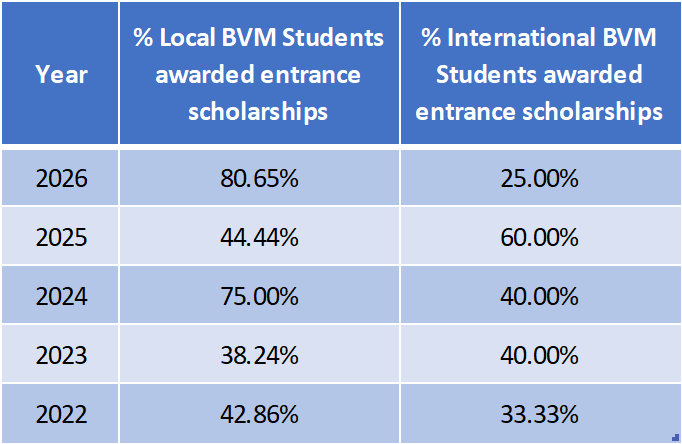
Every year, our BVM programme welcomes outstanding talent from around the world. The data below shows that our BVM students consistently excel, with a remarkable percentage or even perfect scholarship rate of entrants receiving prestigious entrance scholarships. If you’re a high-achieving student, your achievements are recognized and rewarded at CityUHK.
Local students
The University offers various types of scholarships for outstanding students enrolled in Bachelor’s degree programmes at the University. For details, please click here.
Non-local students
CityUHK has an Entrance Scholarship Scheme for international students with excellent academic performance who are admitted to full-time government-funded bachelor's degree programmes. Please click here for more information.
The Scheme offers three kinds of scholarships:
- Top Scholarship: Renewable full-tuition scholarship plus an annual living allowance (covering university-managed accommodation and partial living expenses) up to HKD60,000 (approximately USD7,700)*
- Full Tuition Scholarship: Renewable full-tuition scholarship
- Half Tuition Scholarship: Renewable half-tuition scholarship Applicants do not have to apply for these scholarships.
The appropriate level of scholarship is awarded based on merit. Students who receive the scholarship are required to attain a minimum required Cumulative Grade Point Average (CGPA) each year throughout their period of study in order to renew the scholarship.
*Subject to University approval

Below are some common queries about entry requirements and application. If you have any question is not answered here, we would encourage you to contact us at adm.bvm@cityu.edu.hk.
A: Veterinary medicine students should empathize with animals and be willing to advocate for their improved health and welfare. They should be passionate about the biological sciences, including a strong interest in health and disease. They should have good communication and problem-solving skills, a high level of academic ability, and strong motivation to complete a six-year programme with a high workload.
A: Most semesters comprise around 21 credit units, where each credit unit typically represents about one hour of scheduled contact time plus approximately one hour of out-of-class study per week. So, studying for a BVM requires a similar time commitment as a full-time job.
A: Yes, the BVM programme accepts CityUHK Bachelor’s degree students applying for a change of home major. Please follow Academic Regulation and Record Office for application period and guidelines. Students are required to fulfill the specific requirements below:
Specific Requirements:
- Applicants must fulfil the BVM-specific Minimum Entrance Requirements, especially the subject requirement of English, Mathematics, Chemistry, and Biology.
- The English requirement is a TOEFL score of 600 (paper-based test) or 100 (Internet-based test) or an overall IELTS score of 7 or levels equivalent to those specified above (other acceptable English tests).
- Applicants must also meet non-academic requirements.
- Potential applicants must be aware that a strong academic record will be necessary.
- All students must begin their BVM study in Year 1. However, credit transfer for individual courses may be considered case-by-case.
- The BVM ONLY accepts applications for a change of home major and declaring a second major in Semester A. Applicants must be aware of the Maximum Credit Units Permitted and ensure they do not exceed it.
- Shortlisted applicants will be invited to an interview, and the interview score and the applicant's CGPA will be considered when considering an offer.
A: Regrettably, you will not be considered if you have not achieved the required grades, as the programme is very competitive.
A: Not necessarily. The process is competitive every year, and we could only accept a small number of applicants who demonstrated high levels of academic achievement and fulfilled the non-academic animal-related experience upon admission.
A: Mature age students are eligible and will be considered case-by-case. All applicants must demonstrate competency in English, Mathematics, Biology, and Chemistry to levels equivalent to those specified for the other entry modes.
A: Yes, the applicant can reapply. We accept repeat results and will use your best results to assess your fulfilment of our entrance requirements and to calculate admission scores. No penalty will be imposed.
A: No. As English requirements are accredited by RCVS and AVBC, no flexibility can be granted. Our programme only accepts a TOEFL score of 600 (paper-based test) or 100 (Internet-based test) or an overall IELTS score of 7 or equivalent.
A: The characteristics of the spread of diseases through animal populations are studied using mathematical modelling. Secondary-school mathematics is required to understand how mathematical modelling works. Competency in mathematics is also required to understand other areas of veterinary medicine, e.g., diagnostic imaging, physiology, and pharmacology.
BVM Programme Office
| Office hours: | Mondays to Fridays: 09:00-12:30, 14:00-17:50 |
| Saturdays, Sundays and Public Holidays: Closed | |
| Address: | 10/F, Jockey Club One Health Tower, City University of Hong Kong |
| Email: | adm.bvm@cityu.edu.hk |
| Phone: | (852) 3442 8948 |