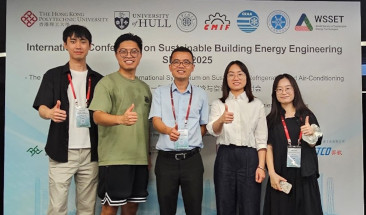
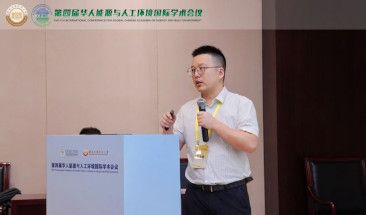
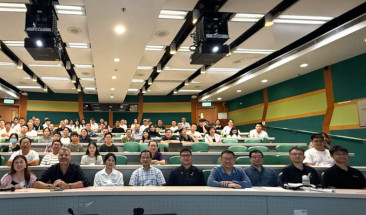
The International Conference on Sustainable Building Energy Engineering (SBEE2025) was held successfully in Hong Kong from 6 to 8 August 2025. The conference brought together leading academics, young researchers, and industry experts from around the world to exchange knowledge on building energy efficiency, renewable energy applications, and low-carbon technologies. Dr. Zengguang Sui, a postdoctoral fellow in the School of Energy and Environment (SEE) at City University of Hong Kong (CityUHK), and a member of Prof.
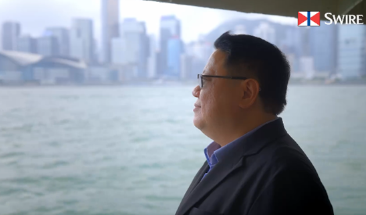
We are pleased to share that Professor Kenneth Leung, BBS, JP, Affiliated Professor of the School of Energy and Environment (SEE) at City University of Hong Kong (CityUHK), has been featured in a recent video by Swire Pacific, highlighting his lifelong dedication to marine conservation and environmental research.
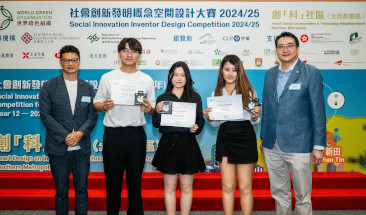
A team of undergraduate students from the School of Energy and Environment (SEE) at City University of Hong Kong has been awarded the Merit Award at the Social Innovation Inventor Design Competition 2024/2025, organized by the World Green Organisation. Their project, titled From Root to Rise, presents a visionary plan to transform Lau Fau Shan, historically known as a traditional fishing village, into a sustainable technology hub that integrates cultural preservation with environmental innovation.The project features architectural designs that blend New Chinese style with modern elements, crea
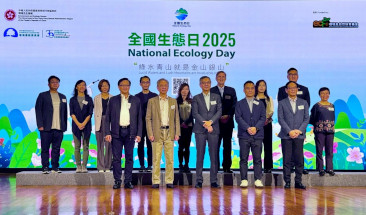
The School of Energy and Environment (SEE) at City University of Hong Kong (CityUHK), in collaboration with the Hong Kong Climate Change Forum (HKCCF), successfully hosted the National Ecology Day 2025 cum SEE Tech Talk on 23 August 2025. Organized by SEE at the invitation of the Environment and Ecology Bureau of the HKSAR Government, the event was recognised as one of the official activities of National Ecology Day 2025.Held at CityUHK, the Tech Talk brought together leading climate scientists and members of the public to explore pressing environmental challenges and emerging research. The mo
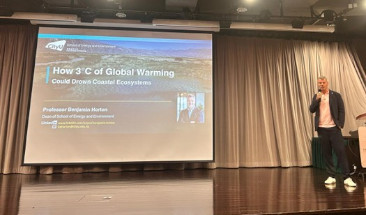
The School of Energy and Environment (SEE) is proud to share that our Dean, Professor Benjamin Horton, delivered a keynote lecture at the 3rd International Conference on Biodiversity, Ecology, and Conservation of Marine Ecosystems, held from 19 to 23 August 2025 at City University of Hong Kong.
On 15 August 2025, Prof. Edwin Tso, Associate Dean (Internationalisation and Outreach) of the School of Energy and Environment (SEE) at City University of Hong Kong, attended the Launching Ceremony for National Ecology Day (NED) 2025, an event that celebrates the nation’s commitment to ecological preservation and sustainable development.National Ecology Day serves as a critical platform to inspire collective action and foster a shared commitment to ecological conservation. Through such initiatives, the nation continues to work toward building a more sustainable and resilient future.Since 2023,
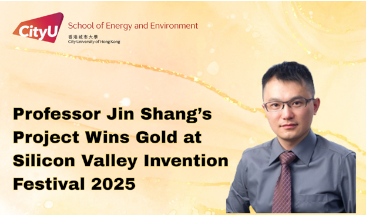
The School of Energy and Environment (SEE) at City University of Hong Kong is proud to announce that the project “Portable and Self-cleaning Nitric Oxide Generator”, led by Associate Professor Jin Shang, has been awarded a Gold Medal at the prestigious Silicon Valley International Invention Festival (SVIIF) 2025.
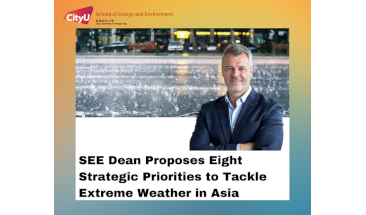
In response to the growing threat of extreme weather events across Asia, Prof. Benjamin Horton, Dean of the School of Energy and Environment (SEE) at City University of Hong Kong (CityUHK), has unveiled a bold eight-point manifesto aimed at transforming Hong Kong into a model for climate-smart urban development over the next 30 years.The proposal comes amid record-breaking rainfall, destructive typhoons, and intensifying heatwaves in the region. Hong Kong, for instance, experienced its highest daily rainfall for August and a T10 typhoon signal in July. These events, Professor Horton warns that