

SEE Dean Proposes Eight Strategic Priorities to Tackle Extreme Weather in Asia
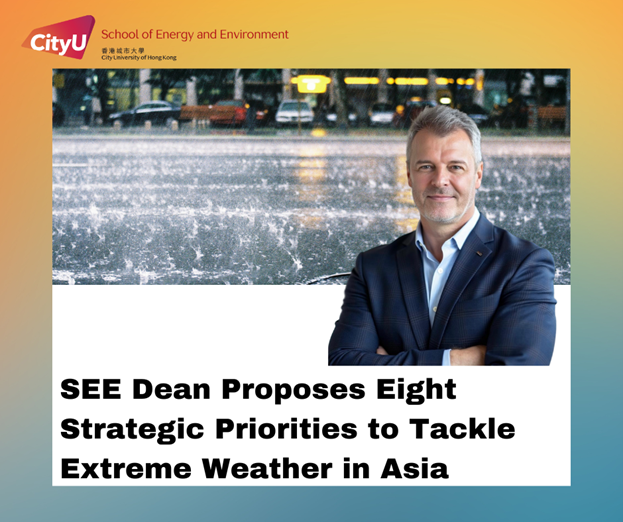
In response to the growing threat of extreme weather events across Asia, Prof. Benjamin Horton, Dean of the School of Energy and Environment (SEE) at City University of Hong Kong (CityUHK), has unveiled a bold eight-point manifesto aimed at transforming Hong Kong into a model for climate-smart urban development over the next 30 years.
The proposal comes amid record-breaking rainfall, destructive typhoons, and intensifying heatwaves in the region. Hong Kong, for instance, experienced its highest daily rainfall for August and a T10 typhoon signal in July. These events, Professor Horton warns that these are not isolated incidents but part of a clear and accelerating pattern of climate change unfolding in real time.
Drawing on his expertise and recent observations since relocating to Hong Kong, Prof. Horton outlined the following eight strategic priorities:
- Invest in climate science to better understand and respond to environmental changes.
- Accelerate renewable energy adoption, particularly offshore wind and solar technologies.
- Transform urban mobility through electrification, public transit, and hydrogen innovation.
- Green and cool the built environment with retrofitting, passive cooling, and smart design.
- Strengthen climate resilience by integrating nature-based coastal infrastructure.
- Engage the community through education, youth leadership, and civil society empowerment.
- Improve governance and transparency with cross-sector coordination and open data.
- Explore carbon capture and circular economy models to complement mitigation efforts.
Prof. Horton emphasized the vital role universities play in leading inclusive climate action and fostering a culture of sustainability. He also highlighted Hong Kong’s unique position to lead the region, given its institutional ties to Mainland China and access to scientific and financial resources.
While Hong Kong has made progress—such as a 24% reduction in greenhouse gas emissions between 2014 and 2022 and the launch of the Climate Action Plan 2050—challenges remain in transport and building emissions, which account for over 90% of the city’s electricity use.
“Ambition must match urgency,” said Prof. Horton. “We are not just fighting to reduce emissions; we are fighting for the city’s future resilience and competitiveness.”
With visionary leadership, regional cooperation, and community engagement, Hong Kong has the potential to become a beacon of climate-smart urban transformation—not only for Asia, but for the world.
Read the full article on CityUHK News Centre:
https://www.cityu.edu.hk/media/news/2025/08/14/tackling-extreme-weather-asia-eight-strategies-proposed-dean-school-energy-and-environment