Hong Kong (HK), while blessed with beautiful scenic terrain, has not been as well-endowed regarding natural resources – it has modest land suitable for agriculture, no significant rivers or forests, and only a handful of mineral resources.
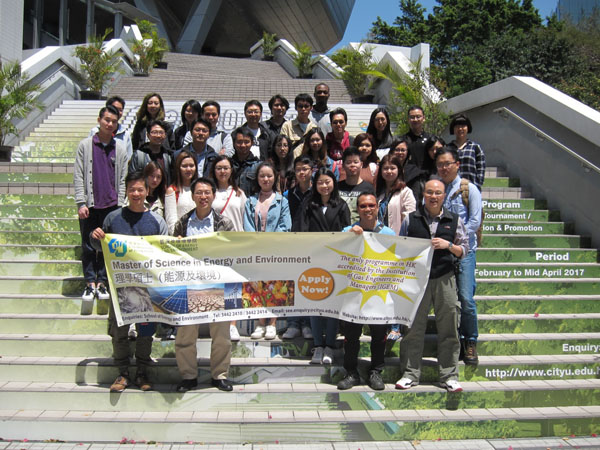
A group of 32 postgraduate students studying the course, SEE6102/SEE8112 Energy Efficiency and Conservation Technologies, went behind the classroom scenes to visit the building management system room, chillers and cooling towers at CityU on 1 April 2017 to see the operations of essential building facilities such as the chiller plant, cooling tower, and also renewable systems such as solar/hot water. Students understand how buildings energy usages are monitored and controlled.
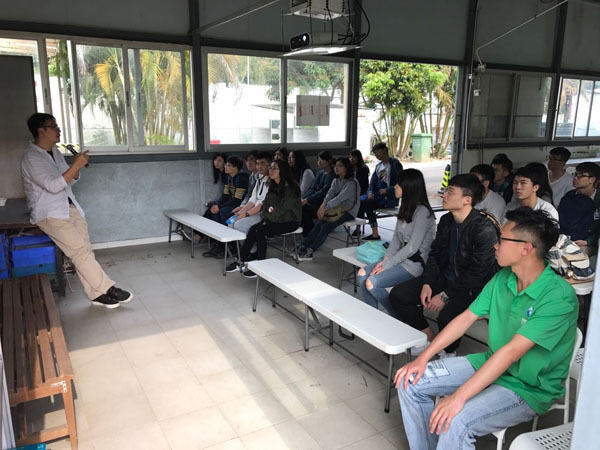
Students taking the undergraduate course, SEE4001 Engineers in Society, offered by the School participated in the visit to the Hong Kong Organic Waste Recycling Centre (HKOWRC) on 29 March 2017 (Wednesday).
In January 2017 the Hong Kong Government released its Climate Action Plan 2030+, giving details of targets to reduce the carbon intensity of the economy by 65-70% by 2030.
Tunç Durmaz1 and Aude Pommeret
Eight years on since the United Nations IPCC was awarded the Nobel Peace Prize in recognition of its effort in combating climate change, fossil fuel remains the most dominant global energy source.
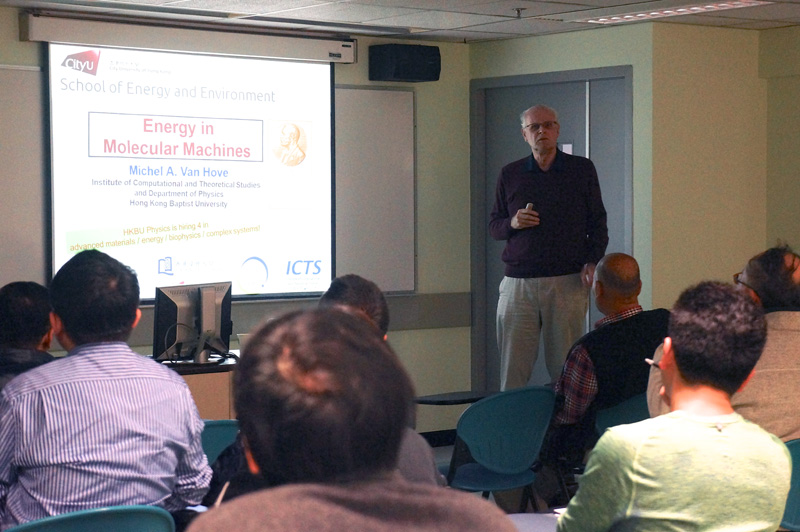
Prof Michel A Van Hove, Director of the Institute of Computational and Theoretical Studies and Head of Physics at the Hong Kong Baptist University, awed the audience at the SEE Colloquium with the design of molecular machines.
Prof Van Hove, an authority in the field of surface science, explained the working principles of molecular vehicles. Measuring just in the nanoscale, these molecular machines were assembled carefully and painstakingly by covalently linking organic molecules to form the engine, chassis and the wheels.
Prof Johnny C.-L. Chan, Chair Professor of Atmospheric Science and Director of the Guy Carpenter Asia-Pacific Climate Impact Centre, secured major funding in the latest round of the prestigious European Council (EC)/Research Grant Council (RGC) Joint Research Scheme.
The funding, worth almost HKD 2 M, shall allow Prof Chan to develop a computer modeling system to predict the frequency of tropical cyclone landfalls in the East Asia region as well as their intensities, which involves a suite of models that includes coupling with the ocean.
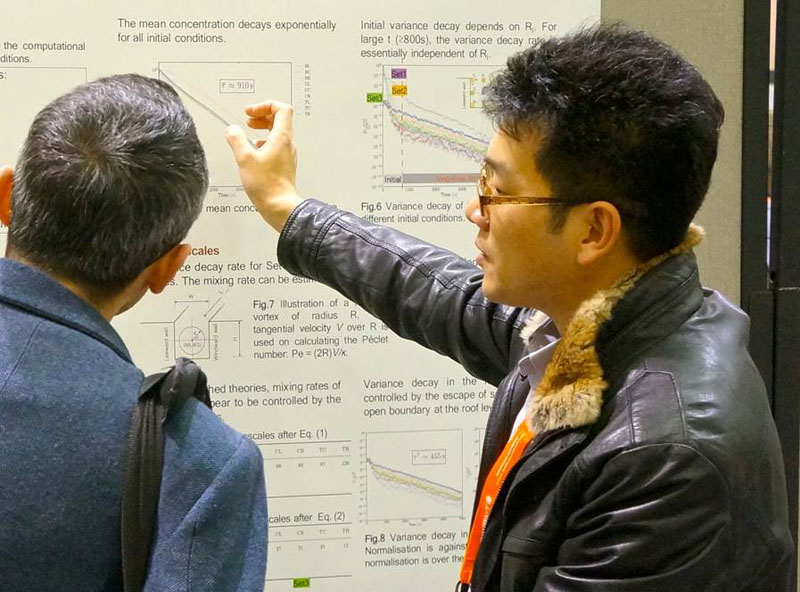
Congratulations to SEE PhD candidate, Guangdong Duan, for winning an Excellent Poster Award at The American Meteorological Society’s 97th Annual Meeting, Seattle.
Prof Irene M. C. Lo, Fellow Academician of the European Academy of Sciences and Arts, presented the advancement in designing magnetic nanoparticles for wastewater treatment at the inaugural SEE Colloquium.