

CityUHK School of Law: Interdisciplinary Research Excellence
CityUHK School of Law is committed to foster a broad research culture that integrates empirical, theoretical, and interdisciplinary approaches. Our research efforts explore the interaction between law and society drawing on perspectives from various fields of inquiry.
We are delighted to share some of our latest contributions, which reflect our dedication to advancing knowledge and addressing complex societal challenges through interdisciplinary scholarship.
Monographs
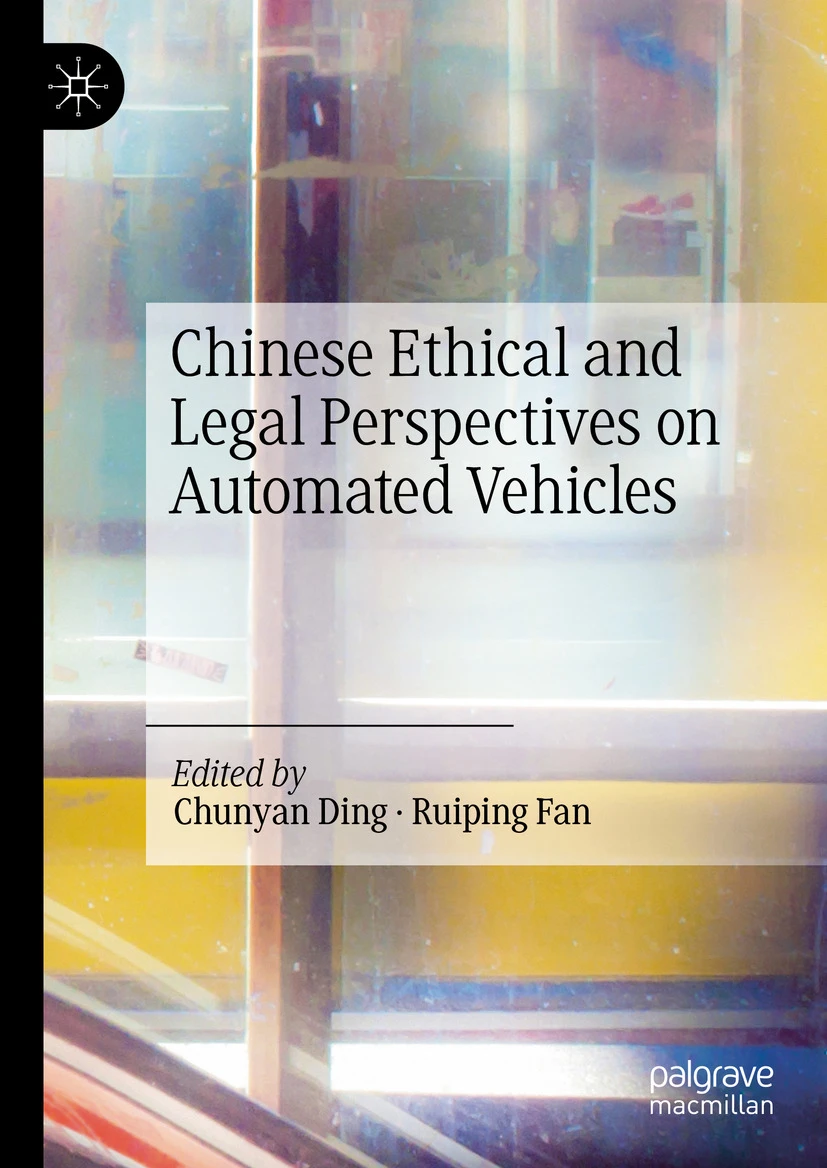 |
Abstract: This book explores the significance of automated vehicles from a Chinese perspective, bringing a wide range of scholarship to bear on the question. This project takes a deep dive into Chinese ethical and legal perspectives on automated vehicles, providing a valuable resource for the general public. It also prompts readers to compare and contrast Chinese and Western viewpoints regarding the use of automated vehicles as future transportation and their impact on human-machine relationships. By dedicating individual chapters to specific issues such as programming, safety, liability, privacy, and data protection, this book enables policymakers and general readers to gain a clear understanding of the societal implications of automated vehicles shaped by culture and law. Additionally, by including survey results from two representative Chinese cities with distinct cultural and legal backgrounds, it caters to the need for insights into general Chinese perspectives on the ethical and legal issues surrounding automated vehicles. This book will interest policymakers, technologists and scholars. |
Articles
|
|
Abstract: The Regional Comprehensive Economic Partnership (RCEP) is one of the most important mega-regional trade agreements signed to date. Yet, it failed to include an Investor-State Dispute Settlement (ISDS) mechanism in its investment chapter. What explains this omission? To unpack this, we examine international negotiations as a two-step process. In the first stage, we theorize that initial preferences towards ISDS are based on countries’ orientation toward foreign direct investment (FDI), experience with ISDS, and past treaty practice. Second, we theorize that during protracted negotiations, adverse regime developments and domestic politics can have a profound impact on treaty design. To test our framework, we examine the RCEP negotiations. Our analysis shows that mounting cases as well as the eroding norm of ISDS in other treaties lowered support for ISDS as the negotiations progressed. Then, a change of government in Malaysia shifted that country’s position dramatically, which tipped the balance against ISDS in the final round of negotiations. Our findings have important implications for the international investment regime. They highlight the factors that determine countries’ initial preferences while also demonstrating the importance of developments during the negotiations, which can lead to the abandonment of the institutional status quo. |
|
|
A notable sole-authored contribution on AI and law, published in a leading journal in the fields of computer science and artificial intelligence (Journal Metrics: Q1 (7/205) in JCR ranking in "Artificial Intelligence"; Journal Impact Factor: 14.9). Abstract: One trending application of LLM (large language model) is to use it for content moderation in online platforms. Most current studies on this application have focused on the metric of accuracy—the extent to which LLMs make correct decisions about content. This article argues that accuracy is insufficient and misleading because it fails to grasp the distinction between easy cases and hard cases, as well as the inevitable trade-offs in achieving higher accuracy. Closer examination reveals that content moderation is a constitutive part of platform governance, the key to which is to gain and enhance legitimacy. Instead of making moderation decisions correctly, the chief goal of LLMs is to make them legitimate. In this regard, this article proposes a paradigm shift from the single benchmark of accuracy towards a legitimacy-based framework for evaluating the performance of LLM moderators. The framework suggests that for easy cases, the key is to ensure accuracy, speed, and transparency, while for hard cases, what matters is reasoned justification and user participation. Examined under this framework, LLMs’ real potential in moderation is not accuracy improvement. Rather, LLMs can better contribute in four other aspects: to conduct screening of hard cases from easy cases, to provide quality explanations for moderation decisions, to assist human reviewers in getting more contextual information, and to facilitate user participation in a more interactive way. To realize these contributions, this article proposes a workflow for incorporating LLMs into the content moderation system. Using normative theories from law and social sciences to critically assess the new technological application, this article seeks to redefine LLMs’ role in content moderation and redirect relevant research in this field. |

These works collectively have advanced our understanding of law’s role in diverse societal contexts.
For a comprehensive list of School of Law’s research outputs, please visit: CityUHK Scholars