She Impacts@CityUHK | Survey on AI trust in work and health: half concerned about displacement, doctors still lead diagnosis
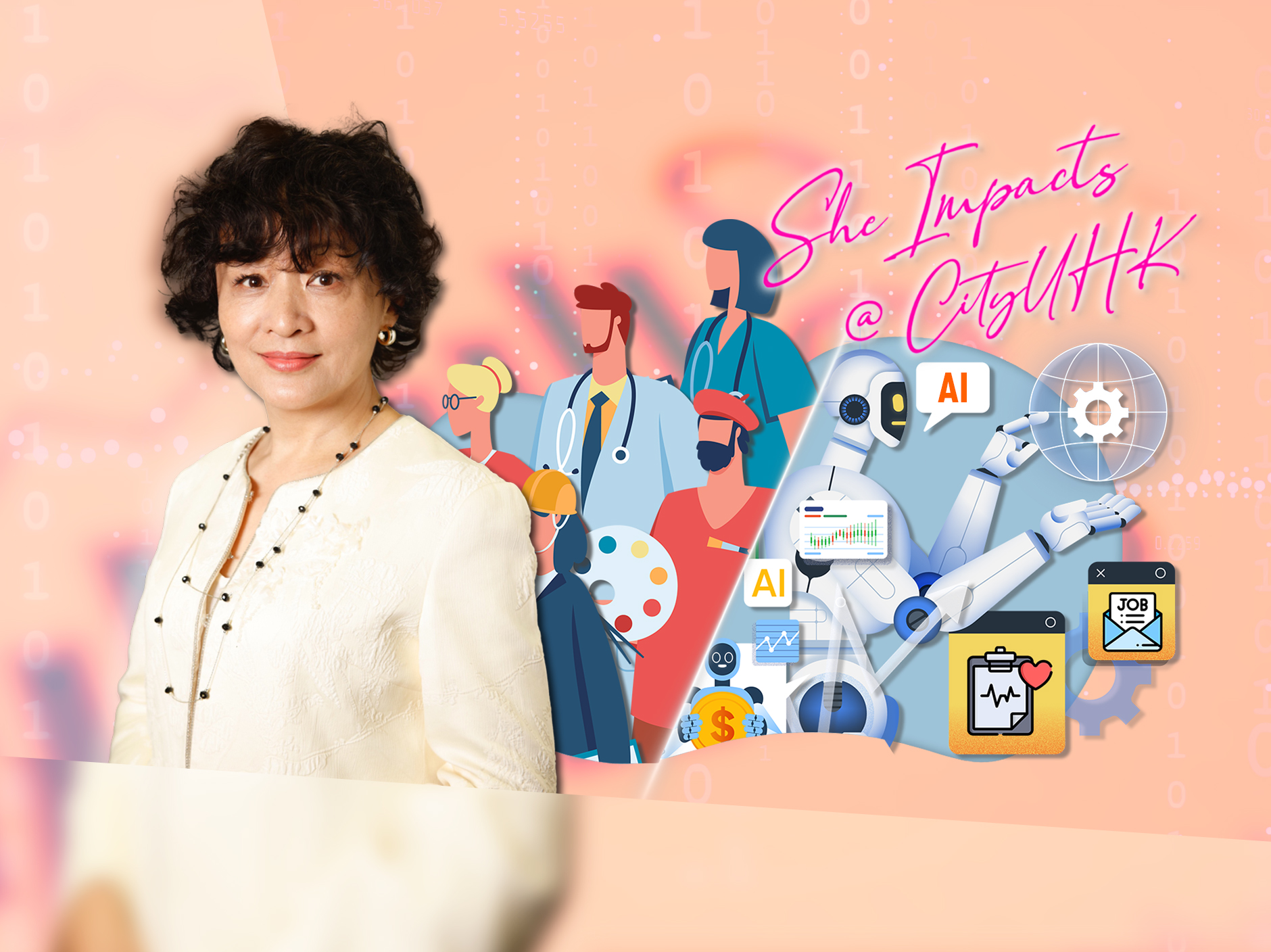
As the wave of artificial intelligence (AI) sweeps the globe, has technology truly integrated into everyday life and earned public trust? Professor Christine Huang Yi-hui, Chair Professor of the Department of Media and Communication in the College of Liberal Arts and Social Sciences at City University of Hong Kong (CityUHK), led a research team in conducting a three-wave longitudinal study spanning 18 months to examine public acceptance and trust in AI across two key scenarios: workplace employment and healthcare. The study revealed that while Hong Kong citizens’ willingness to use AI has continued to climb, anxiety over job displacement remains persistent; in critical clinical healthcare decisions, the public still firmly prefers doctors to take the lead and provide oversight.
To chart the dynamic evolution of public attitudes, the research team conducted three-wave longitudinal online surveys from February to April 2025, December 2025 to February 2026, and May to July 2026. In the latest third-wave survey, the team polled 1,362 Hong Kong citizens aged 20 or above, specifically analysing a longitudinal panel of 398 respondents who participated in all three waves to objectively capture the dynamic evolution of public attitudes since early 2025.
Rising willingness to use AI; Youth and middle-income earners most concerned
Data from the three-wave longitudinal study indicate that citizens’ willingness to use AI has risen steadily. The percentage of respondents with a higher willingness to use AI increased from 67.4% in early 2025 to 77.5% in mid-2026, marking a cumulative increase of 10.1 percentage points (see Figure 1). However, the growing prevalence of technology has not eliminated workplace unease. In the latest survey, 53.7% of respondents remained considerably concerned that their jobs would be displaced by AI, a level virtually unchanged from the previous year (see Figure 2).
Cross-tabulation by demographic characteristics reveals that workplace anxiety is heavily concentrated among three groups. Young adults aged 20 to 34, at the formative stage of their careers, felt the most acute pressure, with 61.3% expressing concerns about their job security (see Figure 3). Among bachelor’s degree holders, 60.6% worried about being replaced by AI (see Figure 4). And middle-income citizens, with a monthly household income between HK$30,000 and HK$60,000, were similarly uneasy, with nearly six in ten (56.6%) expressing concern about job displacement (see Figure 5).
Notably, after controlling for demographic variables, the study found that citizens with “high AI literacy”—those who are proficient in using AI tools, understand AI technical logic and can critically evaluate information—demonstrate a significantly higher willingness to use AI and report lower levels of concern about their jobs being replaced by AI.
Professor Huang pointed out that the most notable finding of the survey is that while citizens are increasingly willing to use AI, concerns about job displacement have not diminished. She emphasised that enhancing public “AI literacy” is essential for addressing these concerns. “The fear of job displacement is particularly pronounced among respondents aged 20 to 34 and those with a bachelor’s degree,” she said. “For young people seeking employment or career advancement, the rapid development of AI inevitably makes them worry about whether their existing knowledge and skills can cope with future job demands. Therefore, in addition to teaching citizens how to use AI tools, it is essential for the government, educational institutions and enterprises to enhance public AI literacy to help individuals adapt to future workplace transformations.”
Consulting AI for health concerns? Professional oversight remains essential for diagnosis
When feeling unwell, have you ever tried consulting AI for medical advice? The survey analysed the use of AI for health management behaviour of the 1,362 respondents in the third wave, revealing a significant gap between intention and actual use in digital and intelligent healthcare. Although nearly six in ten (57.6%) respondents expressed a willingness to use AI for health management (see Figure 6), only 34.5% frequently used AI to check symptoms, obtain lifestyle advice or monitor chronic conditions (see Figure 7). This indicates a pattern of “willing but infrequent” use. In terms of actual use, higher levels of AI usage for health management remained concentrated among young people aged 20 to 34 (38.0%) (see Figure 8), bachelor’s degree holders (40.2%) (see Figure 9), and those with a monthly household income exceeding HK$60,000 (43.0%) (see Figure 10).
More critically, regarding professional clinical diagnosis, the public demonstrated a high degree of prudence. Among different healthcare models, “Doctor-led, AI-assisted” gained the highest level of endorsement (62.5%), higher than “Doctor-only independent diagnosis” (59.5%) and “AI-led, doctor-reviewed” (48.2%). In contrast, only 24.9% trusted “AI-only independent diagnosis”, reflecting the public's continued cautious attitude towards AI's involvement in major medical decisions (see Figure 11).
Commenting on the digital and intelligent healthcare findings, Professor Huang noted that Hong Kong citizens exhibit a “willing but infrequent” pattern regarding the use of AI for health management. Helping interested citizens understand how and when it is appropriate to use AI is one of the key issues to address in advancing the use of AI for health management.
“The survey also found that citizens are not willing to leave all health issues to AI. For checking symptoms, searching for health information, or understanding treatment options in routine situations, citizens can use AI on their own,” Professor Huang explained. “However, when it comes to actual clinical diagnosis, the vast majority still want doctors to oversee the process. The ‘Doctor-led, AI-assisted’ model is the most trusted, while fully autonomous diagnosis by AI is the least trusted. Although AI can serve as a helpful assistant for citizens managing their health and for doctors conducting assessments, the public continues to place its trust in the judgment of professional healthcare practitioners for critical medical decisions.”
Through this 18-month longitudinal study, Professor Huang and her research team drew upon robust empirical research in communication to provide vital insights into public trust and policy formulation in the era of human-AI coexistence. The research team also included Dr Ren Wujiong, Postdoctoral Fellow in the Department of Media and Communication, and PhD students Gao Shuang, Lyu Xiangxin, Cai Qinxian, Zhang Leyi, Chang Bo, Liu Haodong, Zhan Qinhui, and Huang Ke.
About the “She Impacts@CityUHK” Series
CityUHK is committed to attracting outstanding research talent from around the world and actively nurturing the next generation of scholars. Recently, CityUHK's Hong Kong Institute for Advanced Study (HKIAS) and Communications and Institutional Research Office jointly hosted the “Getting Noticed, Getting Networked” workshop. Esteemed guests, including Professor Dame Madeleine Atkins, Senior Fellow of the HKIAS and President-Emeritus of Lucy Cavendish College at the University of Cambridge, shared valuable experiences of female scholars in research communication, personal branding and professional development.
Championing the spirit of the workshop, this series will introduce outstanding women scholars from CityUHK, showcasing their important role in driving knowledge innovation and social progress through their research stories and academic insights.