She Impacts@CityUHK | Driving the green transition with data: mobilising policy and economic tools for a net-zero future
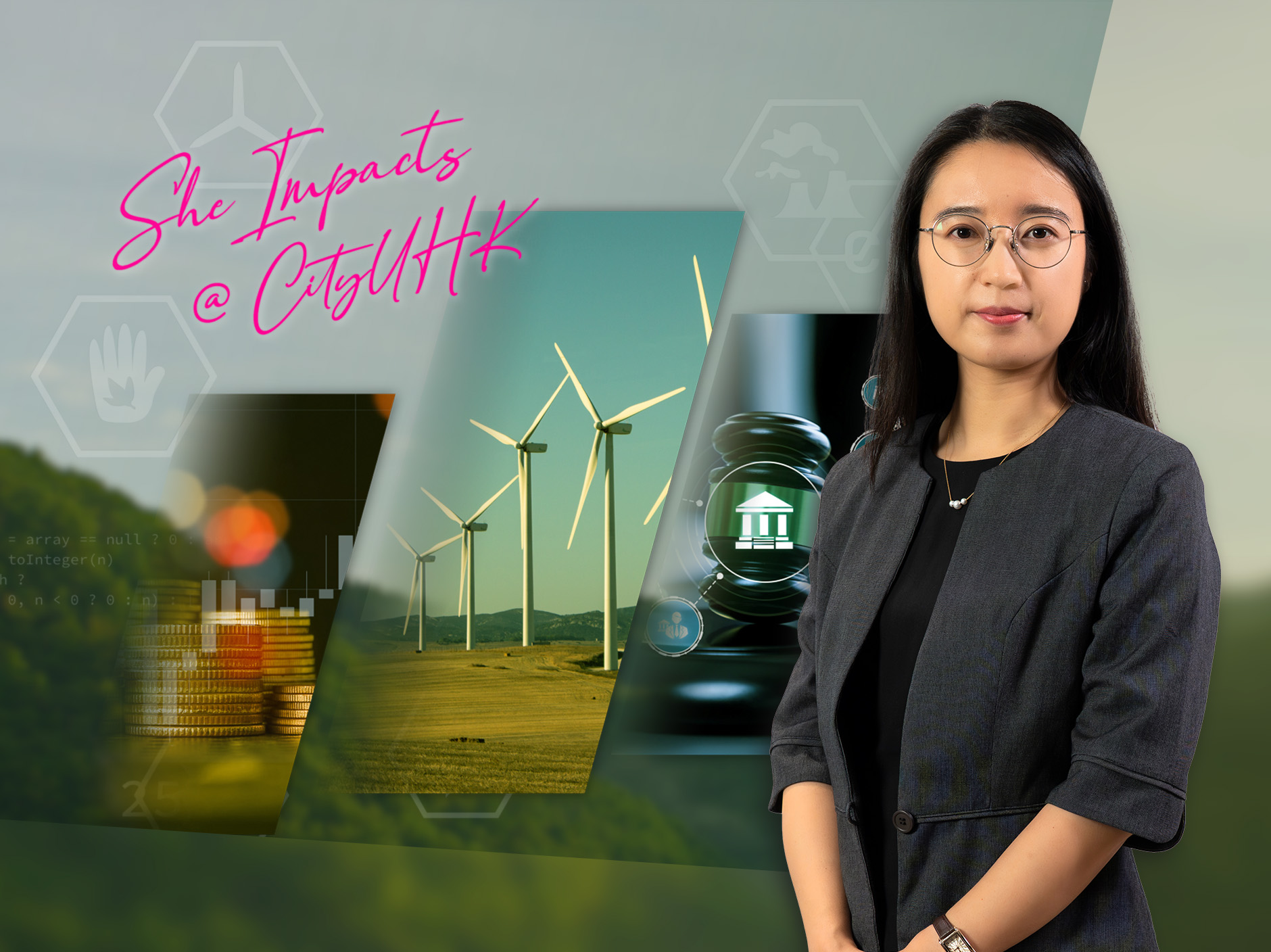
As the world moves collectively towards a net-zero vision, the success of the green transition hinges on both technological breakthroughs and effective implementation. Professor Chen Peipei, from the School of Energy and Environment at City University of Hong Kong (CityUHK), is dedicated to the challenge of translating this green transition into reality. Focusing on energy economics and technology policy, she has developed a systematic implementation blueprint based on three pillars: technology, capital and policy. Her work precisely evaluates the cost-effectiveness and implementation pathways of the energy transition, using data to empower both the transition process and policymaking.
Advancing the green transition requires integrating various factors effectively. Professor Chen emphasises, “A truly viable green transition strategy relies on the close collaboration of technology, capital and policy, rather than any single factor alone.” To accurately assess global progress in the energy transition, she and her research team constructed unit-level models covering global energy infrastructure, enabling them to track the dynamic evolution of power generation assets. By dynamically mapping the abatement costs of decarbonisation technologies against their emission-reduction potential, the team successfully outlined a phased blueprint for global energy transition, providing precise answers to practical questions: what needs to be built, at what cost, and in what timeframe.
In addition to outlining transition pathways, establishing appropriate market mechanisms and policy frameworks is crucial for turning carbon neutrality into reality. Professor Chen notes, “From an engineering perspective, many decarbonisation technologies already exist. However, the real bottleneck lies in market feasibility and policy execution.” To address this, she employs data-driven market models and financial instruments to direct capital towards high-impact green technologies. Simultaneously, she actively advocates for a “Just Transition”, balancing decarbonisation with social equity and energy security to foster synergy between policy and market forces.
Reflecting on her academic approach, Professor Chen expresses deep gratitude to her PhD supervisor, Professor Meng Jing, and her postdoctoral mentor at the University of Cambridge, Professor David Reiner. From cultivating self-conviction to weathering the inevitable setbacks of academic life, her mentors’ guidance, particularly the reminder that “academia is a lifestyle”, taught her to face challenges with composure, patience and resilience.
After gaining extensive research experience at Cambridge, Professor Chen joined CityUHK through the Presidential Assistant Professor Scheme, after presenting her research vision directly to the University’s leadership. The research autonomy and scope for professional growth offered by the programme, combined with CityUHK’s strong commitment to nurturing young scholars, deeply appealed to her and ultimately led her to join the School of Energy and Environment. CityUHK provides comprehensive support, including robust research funding, PhD student quotas and a reduced teaching load during the first year, enabling her to focus on conducting forward-looking research. She also brings the same support and encouragement she received from her mentors to her team, dedicating herself to nurturing the next generation of scholars and translating research outcomes into real-world impact.
Addressing the next generation of aspiring researchers, Professor Chen encourages them to step into the spotlight and proactively share the stories behind their research with society. “We often tend to let our papers speak for themselves, but in today’s fast-moving world, impactful research requires active communication,” she explains. “Translating complex technical findings into clear, accessible insights for policymakers, industry leaders and the public is vital if our science is to drive real change.” She urges young scholars to overcome self-doubt, actively engage in public discourse and exert influence through their research.
About the “She Impacts@CityUHK” Series
CityUHK is committed to attracting outstanding research talent from around the world and actively nurturing the next generation of scholars. Recently, CityUHK's Hong Kong Institute for Advanced Study (HKIAS) and Communications and Institutional Research Office jointly hosted the “Getting Noticed, Getting Networked” workshop. Esteemed guests, including Professor Dame Madeleine Atkins, Senior Fellow of the HKIAS and President-Emeritus of Lucy Cavendish College at the University of Cambridge, shared valuable experiences of female scholars in research communication, personal branding and professional development.
Championing the spirit of the workshop, this series will introduce outstanding women scholars from CityUHK, showcasing their important role in driving knowledge innovation and social progress through their research stories and academic insights.