


Published on Advanced Energy Materials (19 February 2025)
Author(s): Mingzi Sun, Bolong Huang
Abstract
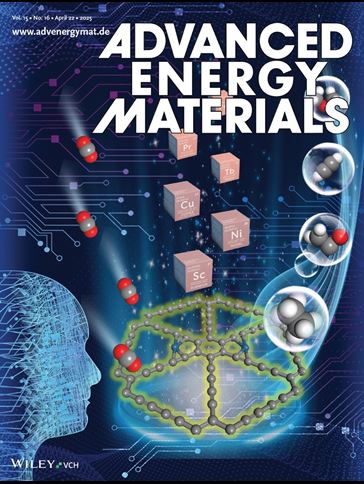
Although CO2 reduction reaction (CO2RR) has achieved significant progress in past years, the C2+ products are mainly limited to a few products, while many other products have rarely been reported in experiments with a limited understanding of the underlying mechanisms. Accordingly, in this work, machine learning (ML)-based theoretical investigations is conducted to uncover the reaction mechanisms for the conversion to challenging C₂+ products (C2H6, CH3OCH3, CH2CO, and C2H2) during CO2RR on graphdiyne-supported atomic catalysts (GDY-ACs) with well-defined active sites. Using the first-principles machine learning (FPML) predictions, key factors limiting the diversity of C2+ products are identified. The conversions to C2H6 are mainly hindered by large rate-determining step (RDS) barriers (>4 eV). The formation of CH2CO meets the competitive reactions due to similar reaction pathways with C2H6, which also undergoes further hydrogenation easily to other C2+ products. The CH3OCH3 formation is hindered by large dehydration barriers caused by steric hindrance induced by the neighboring adsorption of C1 intermediates. FPML predictions also reveal the significance of binding configuration parameters in realizing efficient and accurate predictions. This work offers not only important references to the low selectivity of specific C2+ products but also critical theoretical insights into CO2RR mechanisms.
 |
 |
Read more: https://advanced.onlinelibrary.wiley.com/doi/full/10.1002/aenm.202500177