

CityUHK and HKU Researchers Develop Robust New Gel to Improve Reliability of Wearable Medical Devices
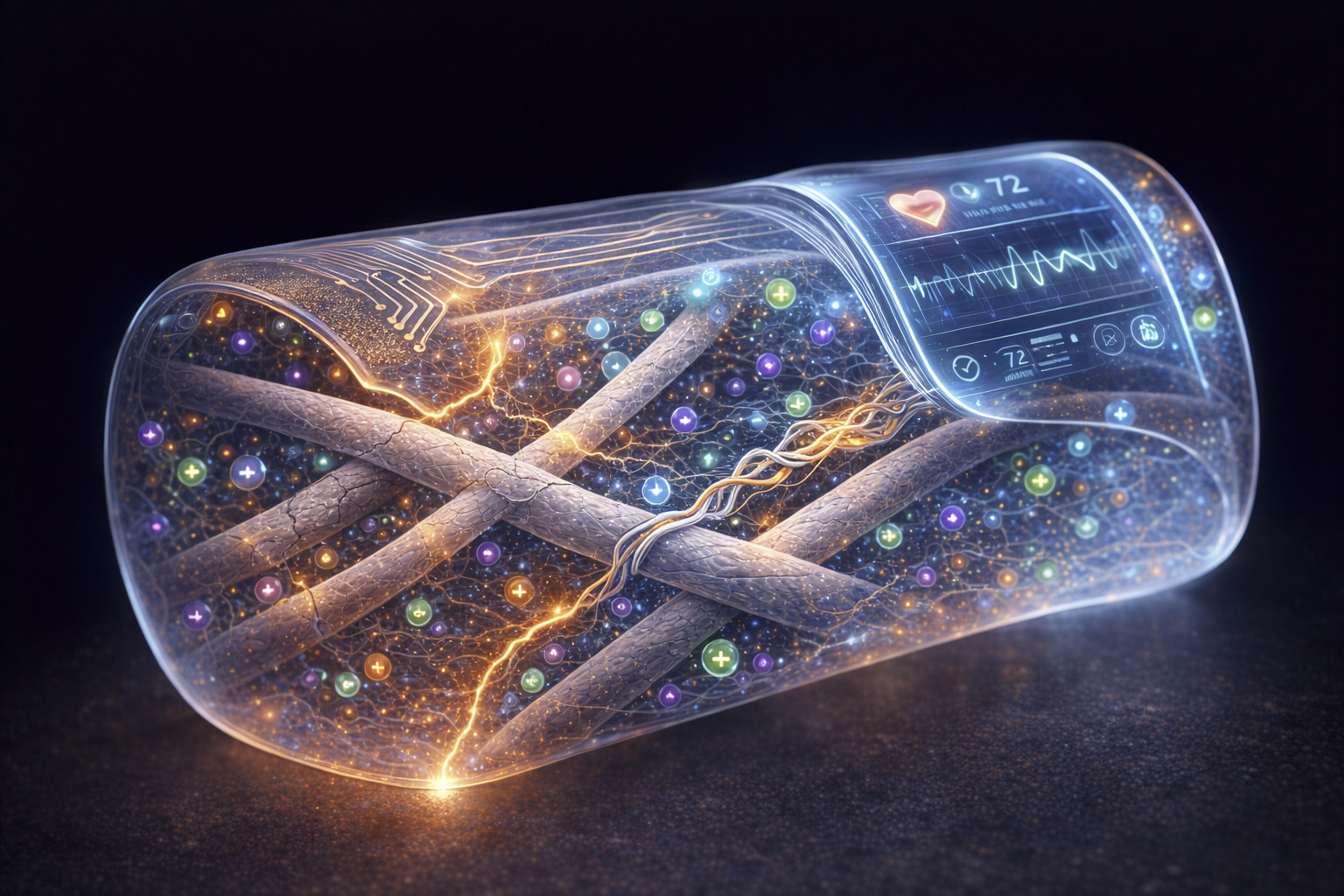
The College of Biomedicine is pleased to announce a significant breakthrough in materials science achieved by researchers from City University of Hong Kong (CityUHK) and The University of Hong Kong (HKU). Professor XU Lizhi at HKU and Professor SHI Peng, Professor in the Department of Biomedical Engineering at CityUHK, have developed a new class of composite ionogels that promises to dramatically enhance the durability and reliability of wearable medical devices.
Overcoming Limitations of Soft Materials for Long-Term Health Monitoring
Ionogels-polymer networks swollen with liquid ions-are highly promising for applications in soft robotics, energy systems, and bioelectronic interfaces due to their excellent ionic conductivity and environmental stability. However, their practical use has been severely constrained by a persistent challenge, as traditional soft materials often lack sufficient mechanical durability and frequently succumb to structural degradation, loss of adhesion, or unstable electrical performance when subjected to body movements and fluctuating environmental conditions.
To address these critical challenges in long-term health monitoring, the research team adopted an innovative interfacial engineering approach. By precisely tailoring the chemical interactions between the solvent and the solid components, they successfully engineered composite ionogels capable of maintaining stable performance under high mechanical stress and diverse environmental conditions. This stability, combined with the material's inherent breathability, anti-drying properties, and antibacterial activity, enables its function as an advanced "e-bandage" for chronic wound healing-capable of simultaneously delivering drugs, providing electrical stimulation, and exerting antibacterial effects.
Promising Applications for Next-Generation Healthcare
The breakthrough innovation ensures that wearable sensors and medical devices can maintain stable skin adhesion and consistent electrical conductivity even during active body movement. The robust nature of these composite ionogels offers immense potential for real-world healthcare applications, ranging from continuous physiological monitoring to dynamic diagnostic tools and advanced wound care. The research, which was conducted in collaboration with the Advanced Biomedical Instrumentation Centre Limited and the Hong Kong Centre for Cerebro-Cardiovascular Health Engineering, has been published in Science Advances.
This collaborative success underscores CityUHK's commitment to fostering impactful, interdisciplinary research that bridges materials science and biomedical engineering, ultimately driving advancements in healthcare technology for patients worldwide.