

Professor Zongli Zheng Develops GenomePAM to Advance CRISPR Gene-Editing Technology
Professor Zongli Zheng’s Lab from the Department of Biomedical Sciences (BMS) has led a groundbreaking
study newly published in Nature Biomedical Engineering. The research introduces GenomePAM, an
innovative
method that makes it easier and faster to study the “PAM” patterns needed for CRISPR-Cas gene-editing
tools to work in mammalian cells.
CRISPR-Cas genome editing involves engagement before commitment, but traditional methods to understand the
engagement – the PAM sequence – are often slow, costly, and laborious, yielding typically 5- to 6-bit
width. GenomePAM overcomes these limitations and achieves at least 10-bit width by leveraging naturally
occurring highly repetitive DNA sequences in the human genome. By integrating GenomePAM with the AI model
AlphaFold 3, they discovered an extensive collection of new Cas nucleases with enhanced PAM selectivity.
Beyond PAM characterization, GenomePAM allows for simultaneous comparison of activities and fidelities
among different Cas nucleases on thousands of match and mismatch sites across the genome. At the
genome-scale, GenomePAM demonstrates that genomic accessibility of a given Cas nuclease differs among
cells of different tissue types. The findings could accelerate the development of more precise and
versatile gene-editing technologies for therapeutic uses.
The study was led by Miao Yu, a PhD candidate in BMS of CityUHK and previously a research assistant in the
Ming Wai Lau Centre for Reparative Medicine of Karolinska Institutet, with contributions from other lab
members and scientists from GenEditBio and in collaborations with Shengdar Q. Tsai of St. Jude Children’s
Research Hospital, and Ben Kleinstiver of Massachusetts General Hospital & Harvard Medical School.
Reference:
Yu M., Ai L., Wang B., Lian S., Ip L., Liu J., Li L., Tsai SQ, Kleinstiver BP, & Zheng Z. (2025).
GenomePAM directs PAM characterization and engineering of CRISPR-Cas nucleases using mammalian genome
repeats. Nature Biomedical Engineering. https://doi.org/10.1038/s41551-025-01464-y
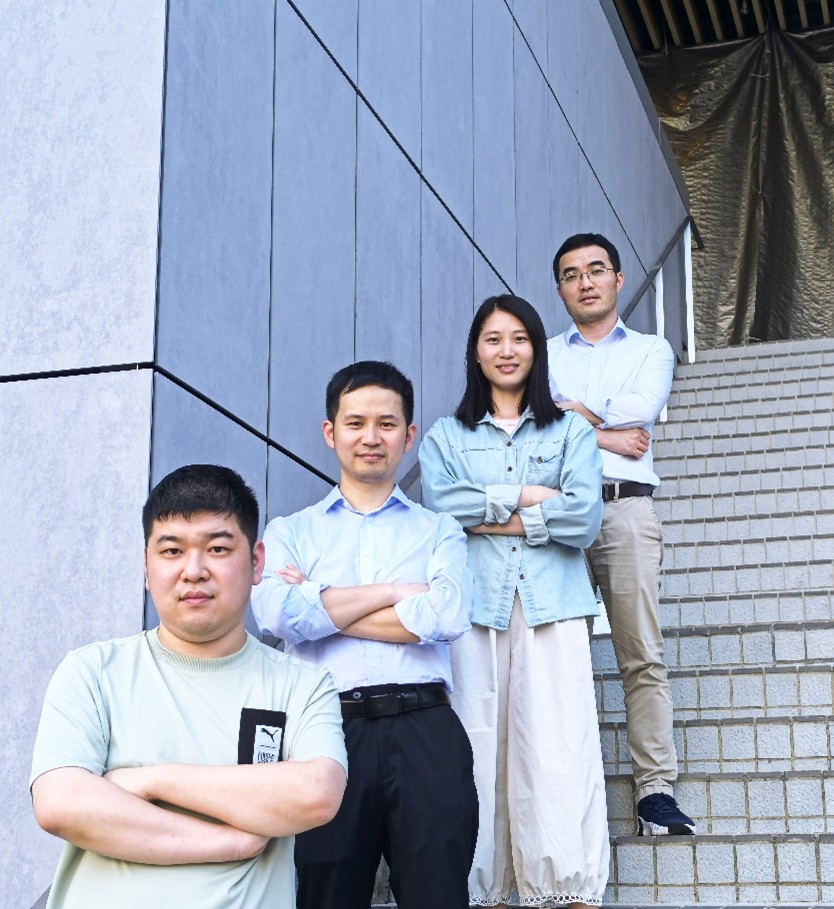
The research team includes (from left) Mr Miao Yu, the first author of the study, and lab members Dr Bang Wang, Ms Limei Ai, and Prof Zongli Zheng.