
The Vancouver Summer Programme (VSP) was arranged by the University of British Columbia (UBC). There are several course packages available within this programme. I chose the ‘MED I July’ course package, focusing on Medical Laboratory Science. I participated in this programme through my home institution, City University of Hong Kong (CityUHK).
My package included Course A and Course B. Course A mainly focused on the physiology and disease of the hepatic, urinary, and gastrointestinal systems. For example, our instructor listed several markers that can be used to diagnose various liver disorders. AST, ALT, ALP, GGT, and NTD were five serum enzymes mentioned in the lectures that are generally measured in liver function tests. Any abnormal level of these enzymes may indicate a disease. A classic example is that an elevated level of AST, ALT, GGT, and NTD is an indicator of hepatitis and cirrhosis. Our instructor reminded us to check the patient's background and medical history to identify further what type of disease the patient suffered from. For instance, cirrhosis is commonly caused by alcohol abuse; the patient may have a higher chance of having cirrhosis if they have alcoholism. The biomarkers and common causes of diseases were beneficial for the case studies. They gave me a mindset for identifying the disorder the patient would most likely suffer from. We also had a presentation on a case study about a patient who suffered from diabetes, and explained how diabetes led to renal disease and anaemia. Below are the mindsets I drew for analysis.
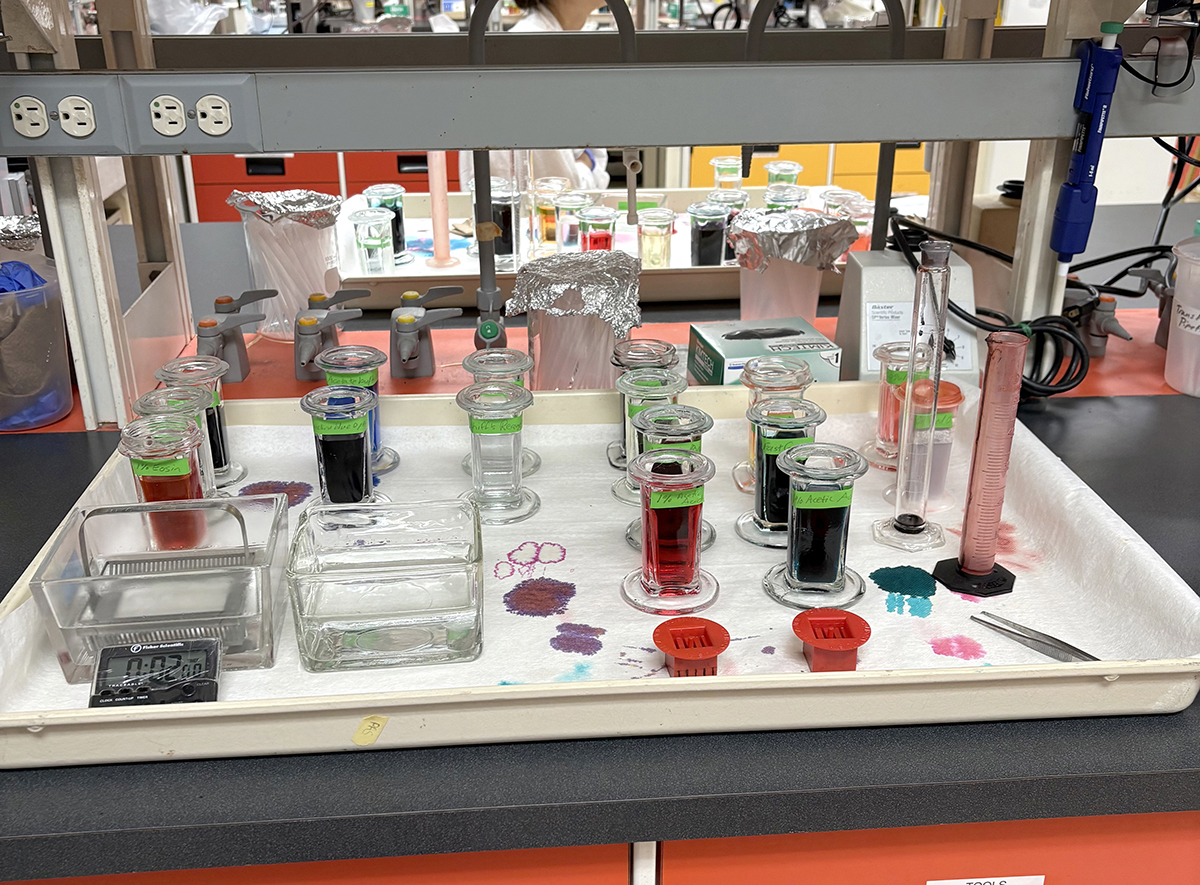
Course B mainly focused on molecular biology, histochemistry, and cell culturing. Each category had an experiment related to the topic. For instance, our experiment involved analysing the ApoB allele. The analysis was done by performing PCR and agarose gel electrophoresis, and examining the DNA bands using SYBR Safe (fluorescent dye) under a UV transilluminator. Regarding histochemistry, we had chances to try H&E stain, Toluidine Blue O, Periodic Acid Schiff (PAS), and Masson’s Trichrome to stain the mice's unknown tissue (pyloric tissue). We also had the opportunity to stain mammalian steatotic liver using Oil Red O. After staining, we based our determination on the morphology and appearance of the slides to identify the unknown tissue. We shared our lab results through a presentation. Regarding cell culturing, we grew the Guinea Pig Lung Fibroblasts (GPLF) cell line in a T25 flask under a Class II biosafety cabinet and practised aseptic techniques. We examined the medium under the inverted phase contrast microscope to determine the status of cells and performed cell counting using a haemocytometer after incubation.
The schedule of the lectures and lab sessions was quite intense. We had two presentations, final exams, three quizzes, and big lab sessions. Time management for preparing the presentations, exams, quizzes, and lab sessions was one of the significant challenges. To ensure enough time for preparation, I needed to wake up earlier to start my revision and work on the presentation slides. Communication was also a difficulty that I encountered during the course, especially when working in lab sessions and group projects. As we came from different cultures and our first language was not English, we sometimes had problems if we misunderstood others. This was common because they had different expressions for the same sentence. I realised that using simple sentences, listening carefully, and asking questions when in doubt helped avoid misconceptions, improving our working efficiency.
Besides improving my communication skills, the hands-on experiments taught me about the techniques and their principles. Using the staining as an example, the foundational concepts we learned about how the stains interact with their targets helped me to understand their characteristics, function, and some points to note during the operation. For instance, we used Oil Red O when looking for lipid droplets in the target tissue. We also noticed that the tissue must be obtained as freshly frozen from a cryostat, not a rotary microtome, because the microtome requires organic xylene for slip covering, which may interact with the lipid droplets and affect the staining results. We also had the chance to use a pipette aid under the Class II Biosafety Cabinet (BSC) and practise our aseptic techniques during cell culturing. For example, our instructor reminded us to clean our equipment using alcohol before putting it into the BSC, ensure the interior surface of the cap was facing down after we had opened the bottle, and close the bottle immediately after use. The experience of working in a Class II BSC was valuable because we will encounter this again in the future.
To wrap up, the Vancouver Summer Programme provided opportunities to learn new knowledge about histochemistry, consolidate my knowledge of molecular biology, and practise different laboratory techniques. From my perspective, the experiences at UBC were valuable and meaningful, giving me a lot of inspiration for learning and applying practical skills. These will be extremely helpful in pursuing my career as a medical laboratory technologist in the future.

Last modified: 29 October 2025