
This self-reflection report details my experiences and learning achievements during the intensive one-month Vancouver Summer Programme at the University of British Columbia (UBC), which took place from 11 July to 11 August 2025. The programme focused on two courses within the Anatomy Science course package: 'Principles of Body Structure and Function' and 'Introduction to Clinical Neuroanatomy'. Although traditional lectures formed the core of the curriculum, integrating virtual reality (VR) glasses and Sketchfab 3D models into laboratory sessions significantly enhanced the learning process. This reflection highlights the specific knowledge gained in each course, acknowledging the supplementary role of technology.
The MED J course package delves into two anatomical fields that are both independent and complementary.
Firstly, Course A: Principles of Body Structure and Function.
This course provides a comprehensive foundation in functional anatomy by systematically exploring the body region by region and system by system.
Regional Anatomy: We examined the detailed architecture of the thoracic (emphasising the cardiovascular and pulmonary systems), abdominal (focusing on the digestive and renal systems) and pelvic (covering the reproductive systems) cavities. Understanding the structural relationships within each cavity was paramount.
Musculoskeletal System: Moving beyond mere identification, the course emphasised conceptual understanding of how muscles and bones work together. We examined the functional design of the upper and lower limbs, recognising their roles in movement, as well as in supporting the overall human form.
System Integration: A key learning objective was to grasp how these regional structures functionally interrelate within and across organ systems (e.g. how thoracic structures facilitate respiration and circulation and how abdominal organs process nutrients and eliminate waste).
Secondly, Course B: Introduction to Clinical Neuroanatomy.
This course focuses on the intricate organisation and function of the central nervous system (CNS), constantly linking structure to clinical relevance.
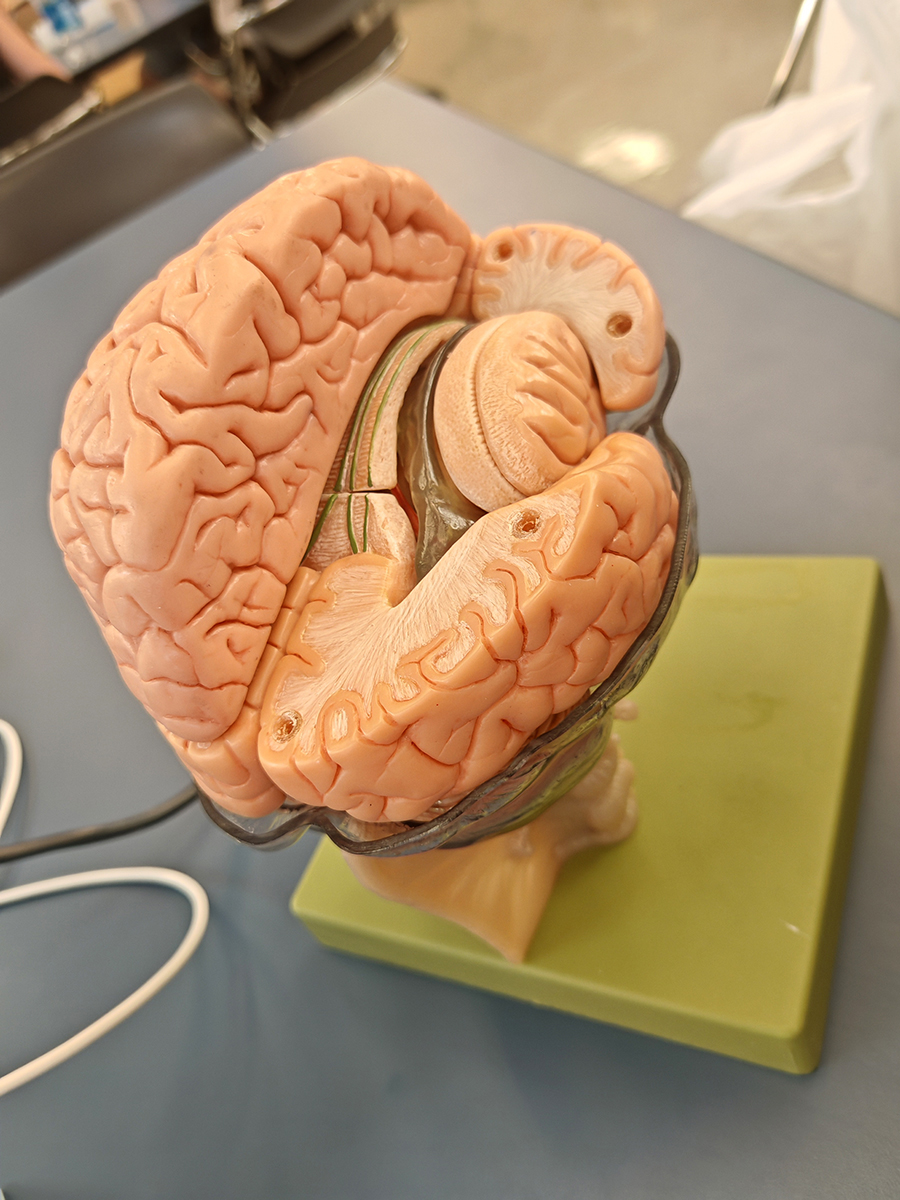
CNS Components: We studied the spinal cord and brainstem in detail, dividing the latter into modules covering ascending and descending tracts, and specific cranial nerves V, VII, IX, X, XI and XII, as well as the nuclei controlling eye movements, hearing and balance (CN II, III, IV, VI, VIII). We also studied the cerebellum, cerebrum (including the cortex, subcortical fibres and thalamus), basal ganglia and limbic system (including CN I – olfactory).
Functional Systems: The course covered major functional pathways, including motor and sensory systems, as well as the critical blood supply to the brain. Higher cognitive functions were also introduced.
Clinical Correlation: Throughout the course, emphasis was placed on understanding how damage to specific neuroanatomical structures (e.g. tracts, nuclei and cranial nerves) manifests as clinical deficits. This provided essential context for the importance of precise anatomical knowledge.
Although lectures and textbooks provide the necessary theoretical framework, the experimental classes in both courses utilised VR headsets and Sketchfab 3D models to offer a valuable spatial dimension to complex anatomical concepts.
Spatial Visualisation: In 'Human Structure and Function', 3D models of organs such as the heart and abdominal organs, as well as musculoskeletal relationships (e.g. the forearm muscle groups or the gluteal region), helped me to visualise complex spatial relationships and structural layers (e.g. the epicardium, myocardium, and heart valves) more effectively than static images did. In Clinical Neuroanatomy, navigating virtual models of the brainstem, tracing cranial nerve pathways and visualising the spatial arrangement of basal ganglia nuclei in relation to the internal capsule helped me to understand challenging spatial concepts more easily.
Supplementary Exploration: Accessing Sketchfab models outside the laboratory provides opportunities for self-directed review and reinforcement of complex topics covered in lectures. For example, I could review the branching patterns of arm and leg vessels or cranial base foramina (Human Structure and Function) and the complex course of cranial nerves within the brainstem (Neuroanatomy). This technology is a powerful tool for transforming two-dimensional diagrams into three-dimensional understanding.
The UBC Anatomy Science Summer Course that I participated in was academically rigorous and highly rewarding. The structured 'Principles of Body Structure and Function' and 'Introduction to Clinical Neuroanatomy' courses provided comprehensive, clinically relevant foundational knowledge in their respective fields. The strategic use of VR and Sketchfab 3D models in the laboratory environment effectively complemented the lectures, improving our spatial understanding of complex structures, such as the layers of the heart and the cranial nerve pathways within the brainstem. They also helped us to understand the spatial relationships within body cavities and the CNS. This integrated approach reinforces the anatomical knowledge that is critical for future health science studies and highlights the value of diverse teaching tools in disciplines involving spatial complexity. This experience has given me a stronger foundation and a deeper understanding of the intricate structures of the human body and nervous system.

Last modified: 29 October 2025