Professor Jin Shang’s Team Publishes Breakthrough Study on Gas Separation in Nature Communications
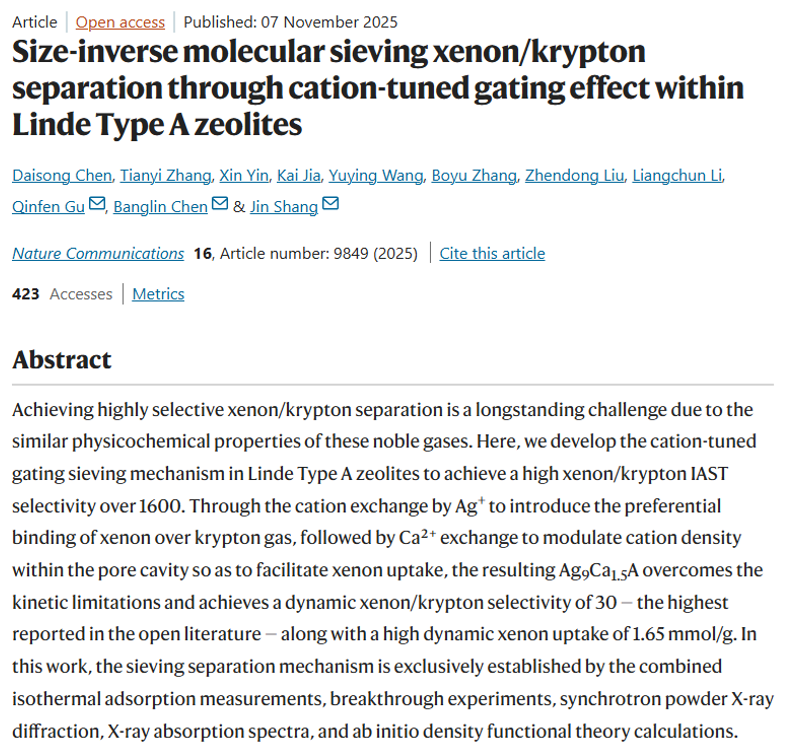
The School of Energy and Environment (SEE) warmly congratulates Mr. Daisong Chen, a PhD student under the supervision of Prof. Jin Shang, Associate Professor at SEE, on the publication of their latest research article in Nature Communications, titled “Size-inverse molecular sieving xenon/krypton separation through cation-tuned gating effect within Linde Type A zeolites”.
This groundbreaking study reveals a cation-tuned gating mechanism within Linde Type A zeolites, one of the most classical and widely used molecular sieves, that enables a counterintuitive size-inverse molecular sieving for xenon/krypton separation. The discovery achieves record selectivity and redefines the molecular sieving paradigm for challenging gas separations.
Because this breakthrough was achieved using well-established industrial adsorbents, it holds strong potential for rapid application in energy-intensive gas separation processes, contributing to emission reduction and cleaner industrial operations.
Importantly, this work represents a new case study and major advancement of the molecular trapdoor mechanism, a concept first discovered by Prof. Jin Shang over a decade ago. It deepens our understanding of gas admission and diffusion in porous crystalline materials and opens new directions for the rational design of next-generation adsorbents.
Prof. Shang expressed his gratitude to all team members and collaborators, noting that “this achievement highlights the power of collaboration bridging advanced materials design and adsorption science.”
This milestone reinforces CityUHK’s leadership in adsorption-based gas separation research and reflects SEE’s commitment to advancing sustainable technologies for clean energy and environmental protection.
The full article is available at: https://www.nature.com/articles/s41467-025-64823-y