


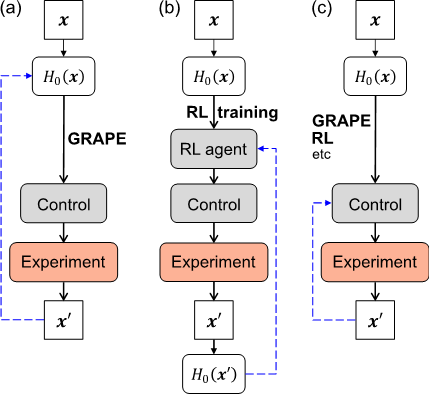
One of the main goals of quantum metrology is to find ways to approach the highest possible precision for measuring unknown parameters. While optimal controls, typically found by gradient-based methods, provide a practical route to this goal, it is only optimized for a specific set of parameters and the entire algorithm must be rerun for a new set, making the procedure inefficient especially for an ensemble of systems with parameters varying in ranges. A "generalizable" method that can systematically update optimal controls with minimal cost is then desirable.
Based on a previous work of generalizable optimal control found by reinforcement learning for estimating a single parameter, we consider the situation involving multiple parameters in this paper. We have found that, in cases where controls are "complete", an analytical method which efficiently generates optimal controls for any parameter starting from an initial result found either by GRAPE or reinforcement learning can be applied. When the controls are restricted, the analytical scheme is invalid but reinforcement learning still retains a level of generalizability. Lastly, in cases where controls cannot compensate the shift in the Hamiltonian due to change in parameters, no generalizability is found. We argue that the generalization of reinforcement learning is through a mechanism similar to the analytical scheme.
Our results provide insights on when and how the optimal control in multi-parameter quantum metrology can be generalized, thereby facilitating efficient implementation of optimal quantum estimation of multiple parameters, particularly for an ensemble of systems with ranges of parameters.
Read more at Physical Review A:
https://doi.org/10.1103/PhysRevA.103.042615
29 Apr 2021