

UN FIRST Programme Gathers Global Partners to Spark Collaboration and Expand Impact
On 3 September 2025, the UNESCO-endorsed Fostering Innovation for Resilience and Sustainable Transformation (FIRST) programme, led by the City University of Hong Kong (CityUHK), brought together its international partners for a vibrant and forward-looking virtual meeting.
The session was chaired by Ir Prof. Edwin Tso—Programme Director of FIRST and Associate Dean (Internationalisation and Outreach) at the School of Energy and Environment (SEE), CityUHK. Designed to foster collaboration, the meeting served as a platform for exchanging ideas and building momentum as the programme enters its next phase.
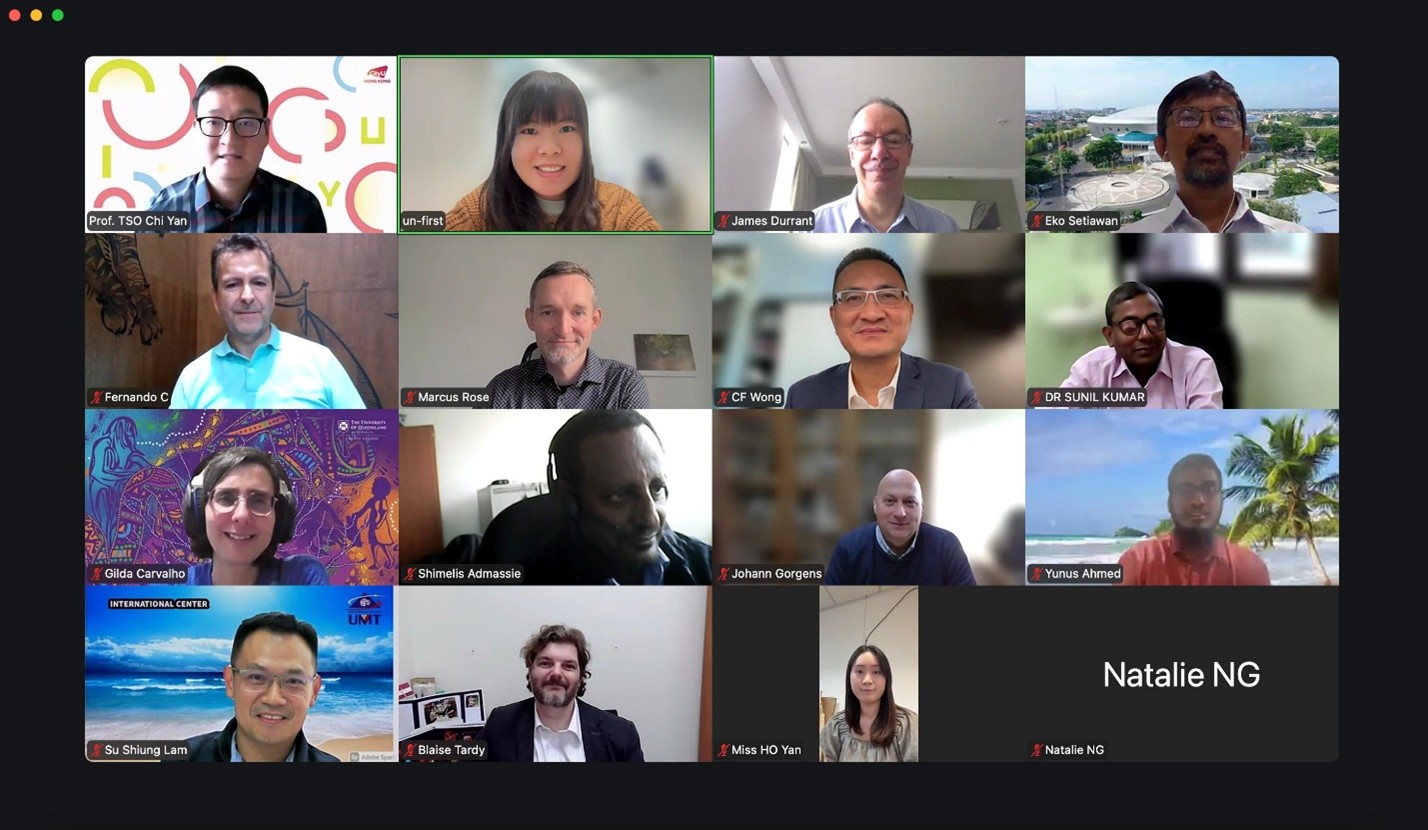
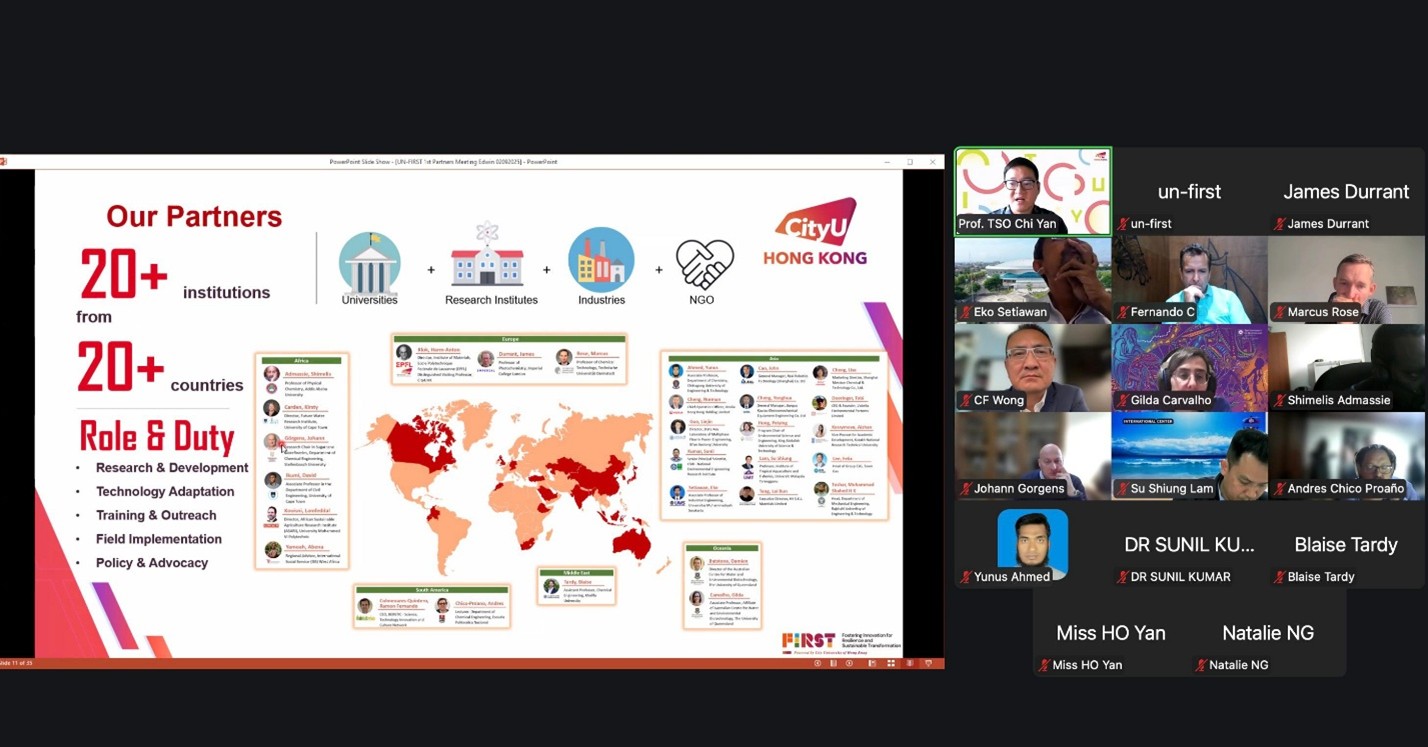
Attendees of the meeting (Left to right, top to bottom): Prof. Edwin Tso (SEE, CityUHK), Prof. James Durrant (Photochemistry, Imperial College London and Distinguished Visiting Professor, CityUHK), Prof. Eko Setiawan (Industrial Engineering, Universitas Muhammadiyah Surakarta), Prof. Dr. Ramon Fernando Colmenares-Quintero (Chief Executive Officer, BERSTIC - Science, Technology Innovation and Culture Network), Prof. Marcus Rose (Chemical Technology, Technische Universität Darmstadt), Mr. Chuen-fai Wong (Former Commissioner for Climate Change, Environment and Ecology Bureau (Environment Branch), HKSAR Government Secretariat), Prof. Gilda Carvalho (Affiliate of Australian Centre for Water and Environmental Biotechnology, The University of Queensland), Prof. Shimelis Admassie (Physical Chemistry, Addis Ababa University), Prof. Johann Görgens (Research Chair in Sugarcane Biorefineries, Department of Chemical Engineering, Stellenbosch University), Prof. Su Shiung Lam (Institute of Tropical Aquaculture and Fisheries, Universiti Malaysia Terengganu), Dr. Andres Chico-Proano (Department of Chemical Engineering, Escuela Politecnica Nacional), Prof. Yunus Ahmed (Department of Chemistry, Chittagong University of Engineering & Technology), Dr. Sunil Kumar (Senior Principal Scientist, CSIR - National Environmental Engineering Research Institute) and Prof. Blaise Tardy (Chemical Engineering, Khalifa University)
Rather than a formal introduction, the gathering focused on mutual discovery. Partners shared their passions, areas of expertise, and aspirations for how this global initiative can drive real-world impact. The group reflected a broad spectrum of disciplines, including climate and environmental policy, clean energy and materials innovation, marine and ecosystem health, and social services and sustainability education. This diversity reflects the core mission of the FIRST network: to bridge sectors and co-create locally adapted, globally scalable solutions.
Prof. Tso presented a concise overview of the programme’s vision: to transform scientific innovation into accessible technologies that empower communities and address urgent sustainability challenges.
The programme’s four focus areas include:
- Cooling surfaces that require no energy input
- Ultra-affordable, printable solar energy films
- Converting biomass waste into clean energy
- Human-powered sanitation systems that produce potable water
The meeting also spotlighted the first pilot site, scheduled to launch in Hunan, China in mid-October this year—an exciting milestone underscoring the shift from planning to implementation.
Partners expressed keen enthusiasm for deeper involvement, offering ideas for community outreach, proposing new engagement models, and identifying potential collaborators to join the network. The dialogue was rich with possibilities, reinforcing that FIRST is more than a project—it is a growing movement.
The FIRST programme is rooted in the shared values of the United Nations Sustainable Development Goals, especially:
- SDG 6 – Clean Water and Sanitation
- SDG 7 – Affordable and Clean Energy
- SDG 11 – Sustainable Cities and Communities
- SDG 13 – Climate Action
Built on technology, partnerships, and purpose-driven progress, the FIRST network continues to expand—co-creating solutions, scaling impact, and advancing a more resilient, inclusive, and sustainable future for communities worldwide.
More information about the FIRST Programme can be found at the official website: https://un-first.cityu.edu.hk/.