

Professor Benjamin Horton Contributes to Global Sustainability Pathways at ICASF 2025
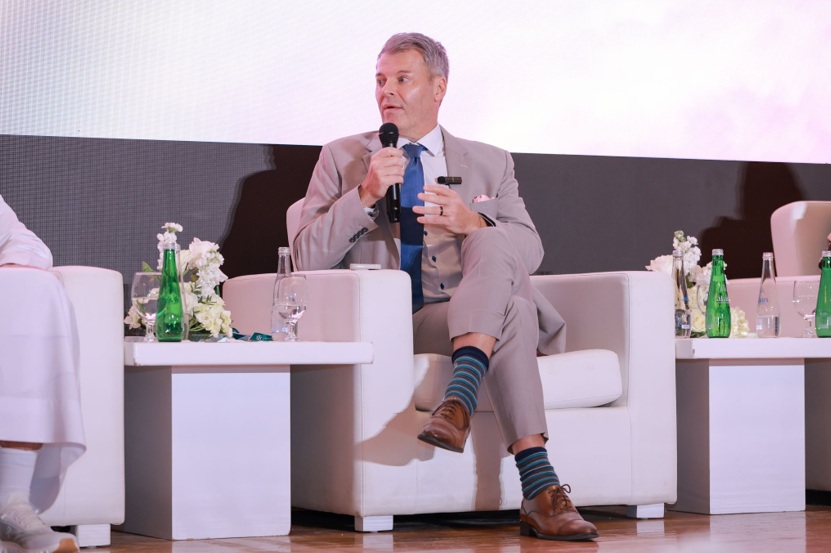
Prof. Benjamin Horton joins the panel discussion at the 3rd International Conference on Advancing Sustainable Futures 2025 at Abu Dhabi University.
At the 3rd International Conference on Advancing Sustainable Futures (ICASF 2025), hosted by Abu Dhabi University, Prof. Benjamin Horton, Dean of the School of Energy and Environment (SEE) and Chair Professor of Earth Science at City University of Hong Kong (CityUHK), participated in a distinguished panel discussion alongside experts from Ireland, Poland, and the United Arab Emirates.
The session, titled “Green Revolution 2.0: Strategic Collaborative Pathways Between Industry, Academia, and Government for Global Sustainability”, brought together leading experts to explore how cross-sector collaborations can drive the next phase of the Green Revolution.
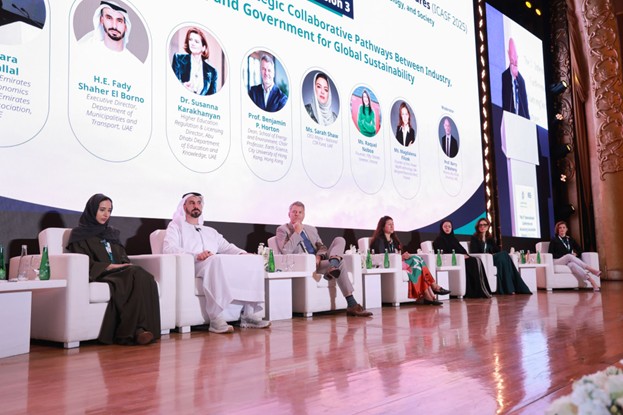
The dialogue emphasized the importance of harnessing the complementary strengths of industry, academia, and government to foster scalable solutions for global sustainability. Panelists highlighted opportunities to advance green technologies and shape sustainable policies through strategic partnerships, thereby contributing to long-term environmental resilience and international development.
In his remarks, Prof. Horton highlighted the challenge of bridging the gap between academic innovation and real-world deployment is one of the greatest challenges in climate adaptation. He outlined CityUHK’s approach to advancing sustainability through:
- Investing in Basic Science: Understanding problems thoroughly before scaling solutions;
- Translational Research Platforms: Establishing Climate Innovation Accelerators to move discoveries beyond the lab;
- Public–Private Partnerships: Building consortia where academia, industry, and government collaborate for impact;
- Living Labs & Pilot Deployments: Testing technologies in real-world environments to accelerate adoption.
Prof. Horton further stressed the urgent need for actionable science to tackle climate challenges across Asia and the world. Reflecting on his firsthand experiences with extreme weather events in Hong Kong, China, and Singapore, he emphasized that universities must go beyond producing knowledge. They have a responsibility to ensure research outcomes are effectively communicated to and applied by those positioned to act, including governments, businesses and communities.
“Universities have a responsibility to address the grand challenge of climate change,” said Prof. Horton. “They are uniquely positioned to tackle this issue because climate adaptation is inherently interdisciplinary — combining science, engineering, economics, and social policy. Universities bring together these diverse fields under one roof, making them ideal hubs for innovation and collaboration.”
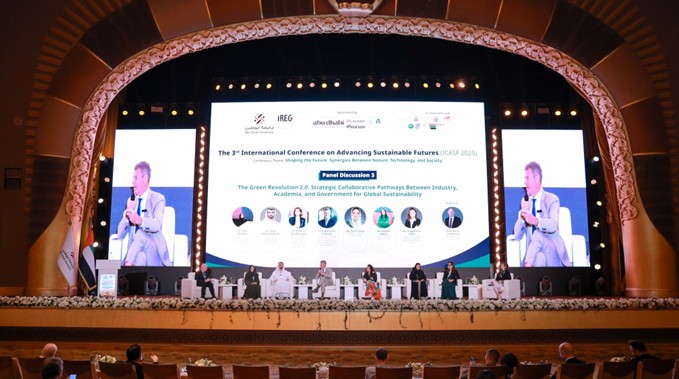
Prof. Horton’s participation at ICASF 2025 underscores SEE’s commitment to advancing sustainability through global collaboration, interdisciplinary research, and industry partnerships. By engaging in international dialogues and translating research into real-world impact, CityUHK continues to drive innovation and leadership in energy and environmental solutions — shaping a more resilient and sustainable future from Hong Kong to the world.