


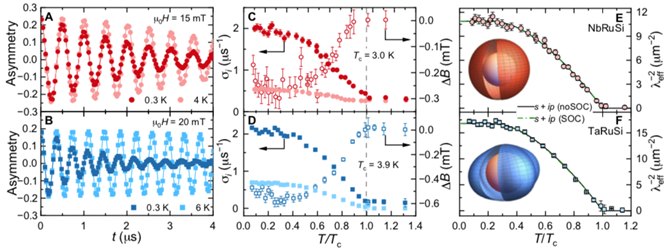
The crystalline symmetry is a defining factor of the electronic band topology in solids, where many-body interactions often induce a spontaneous breaking of symmetry. Superconductors lacking an inversion center are among the best systems to study such effects or even to achieve topological superconductivity and realize Majorana zero modes. Here, we demonstrate that TRuSi materials (with T a transition metal) belong to this class. Their bulk normal states behave as three-dimensional Kramers nodal-line semimetals, characterized by large antisymmetric spin-orbit couplings and by hourglass-like dispersions protected by glide reflection. Our muon-spin spectroscopy measurements show that certain TRuSi compounds spontaneously break the time-reversal symmetry at TRuSi while unexpectedly showing a fully gapped superconductivity. Their unconventional behavior is consistent with a unitary (s + ip) pairing, reflecting a mixture of spin singlets and spin triplets. Hence, by combining an intrinsic time-reversal symmetry-breaking superconductivity with nontrivial electronic bands, TRuSi compounds provide an ideal platform for investigating the rich interplay between unconventional superconductivity and the exotic properties of Kramers nodal-line/hourglass fermions.
Read more at Science Advances:
https://www.science.org/doi/10.1126/sciadv.abq6589
28 Oct 2022