

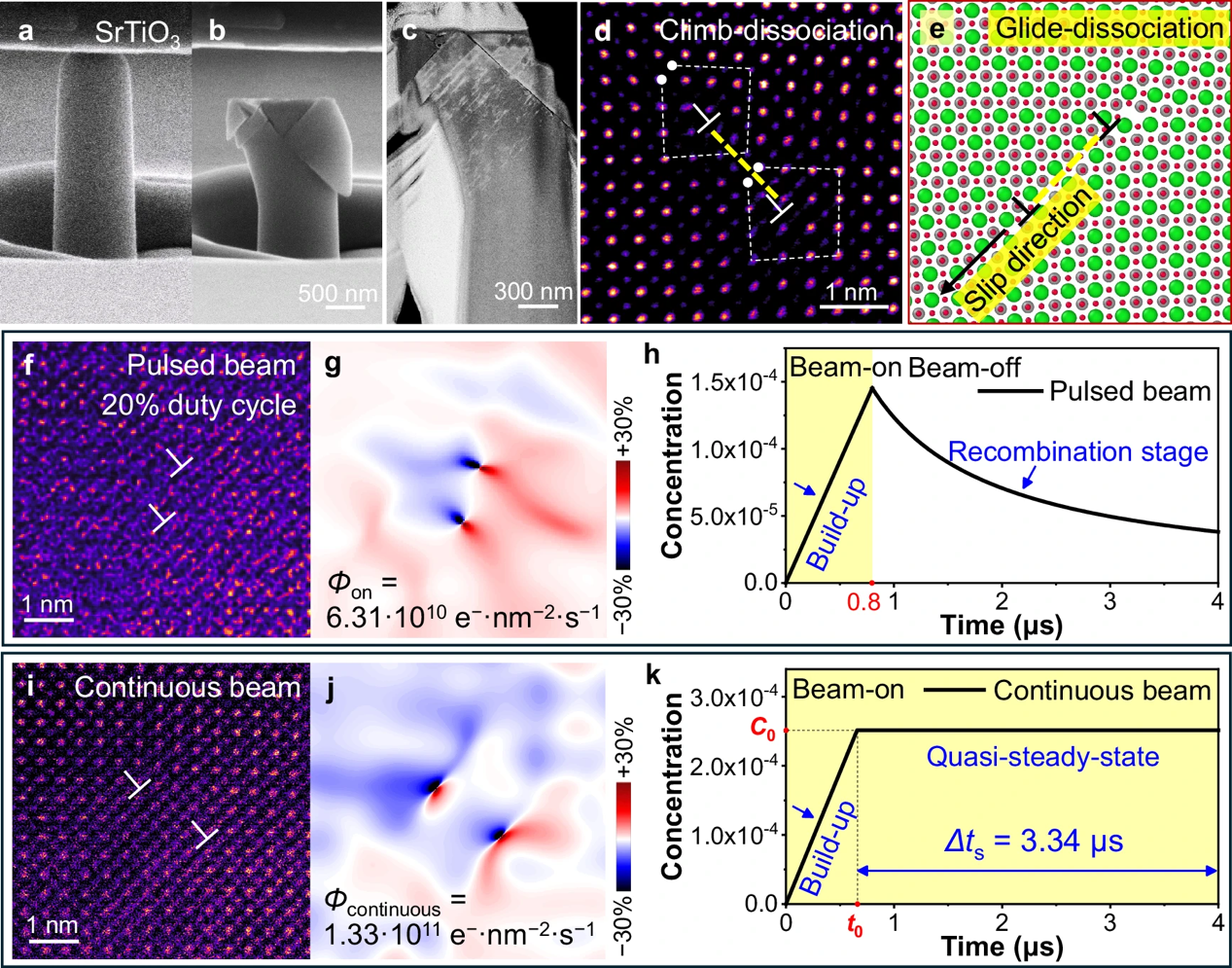
A collaborative research team co-led by Profs. Shijun Zhao, Yang Lu, and Fu-Rong Chen has resolved a long-standing theory-experiment contradiction by directly imaging intrinsic glide-dissociated dislocations in perovskite crystals at sub-angstrom resolution. Using an electrostatic dose modulator (EDM)-based pulsed electron beam, they captured the native mobile dislocation structures in CsPbBr₃ and SrTiO₃ — configurations long predicted by simulations but persistently masked by beam-induced artifacts under conventional STEM imaging.
The discovery stems from an unrecognized beam-driven physical mechanism: the widely observed sessile climb-dissociated structures are not intrinsic to deformed perovskites, but emerge when sustained electron irradiation accumulates point defects that bypass the thermal barrier for room-temperature climb. In their native state, dislocations dissociate into collinear glide pairs to enable high plasticity. Once defect concentrations exceed a critical threshold, an irreversible glide-to-climb transition takes place, with equilibrium dissociation widths governed by core electrostatics — compact for anion-terminated cores and expanded for cation-terminated ones.
This finding clarifies the physical origin of perovskites’ exceptional room-temperature plasticity, and establishes EDM pulsing as a universal, non-destructive atomic-resolution platform for beam-sensitive materials. It enables targeted defect engineering for flexible deformable electronics, high-performance semiconductors and toughened ceramics, accelerating rational, property-by-design material development. Here is the full article published in Nature Communications.