

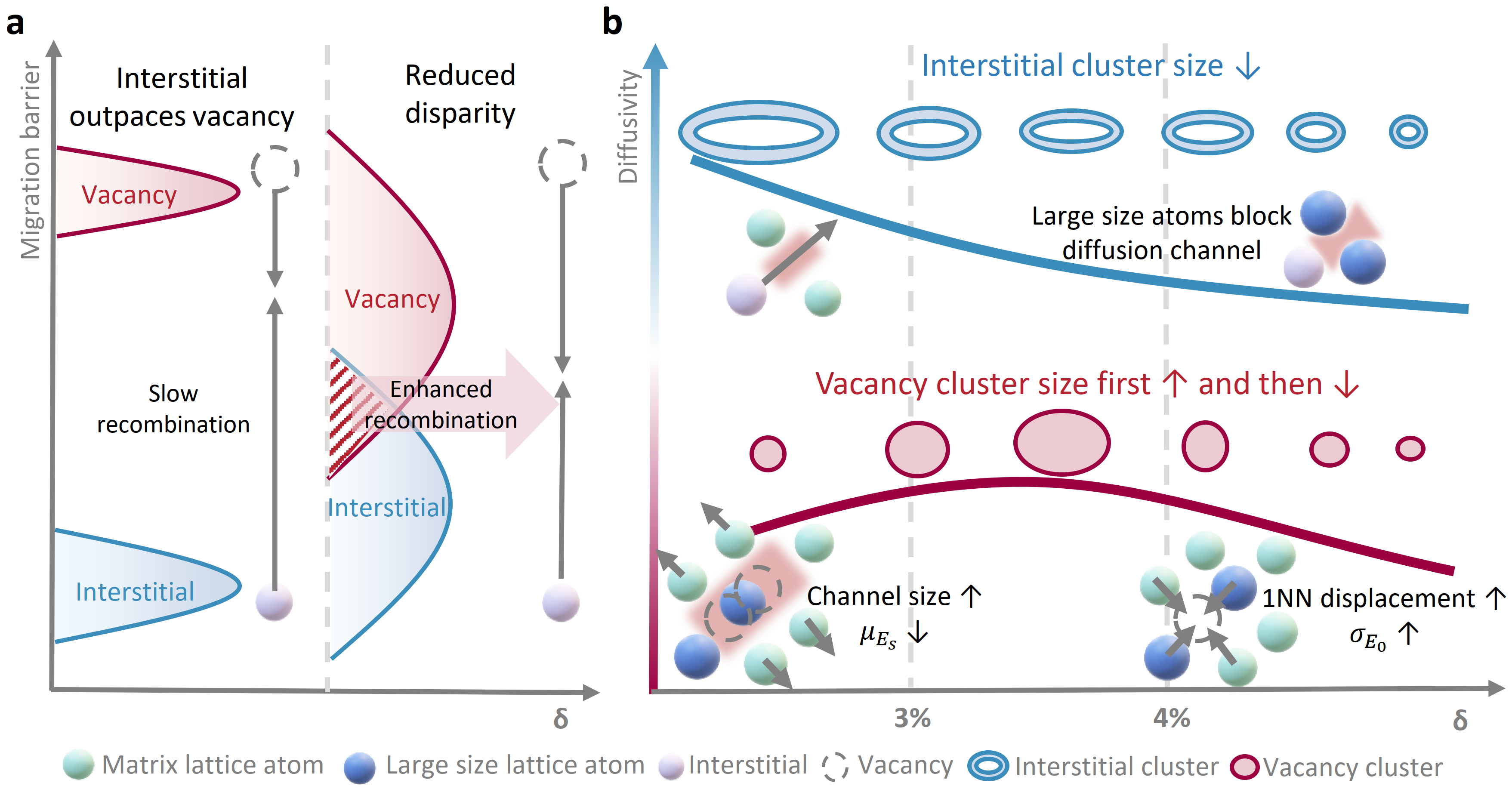
Published in Nature Communications, a team co-led by Prof. Shijun Zhao from City University of Hong Kong has developed an original approach to create irradiation-resistant metallic alloys by engineering local lattice distortion, addressing the pressing challenge of radiation-induced mechanical degradation in nuclear structural materials. The single-phase Ni₈₀Mo₂₀ alloy, with a record-high 4.82% atomic size mismatch, the highest among face-centered cubic concentrated alloys, exhibits negligible irradiation damage at 8 dpa, with defect movement effectively halted.
The innovation hinges on a novel mechanism of a two-stage lattice distortion effect: while moderate distortion balances interstitial and vacancy mobility to enhance recombination, severe distortion (>4%) simultaneously traps both defect types via a rugged energy landscape, suppressing long-range diffusion and preventing harmful cluster formation. This work establishes a simple, universal design paradigm for radiation-tolerant materials, eliminating the need for complex nanostructures. It further enables durable components for next-generation fission and fusion reactors, advancing safe, carbon-free nuclear energy to combat climate change. Here is the full article published in Nature Communications.