

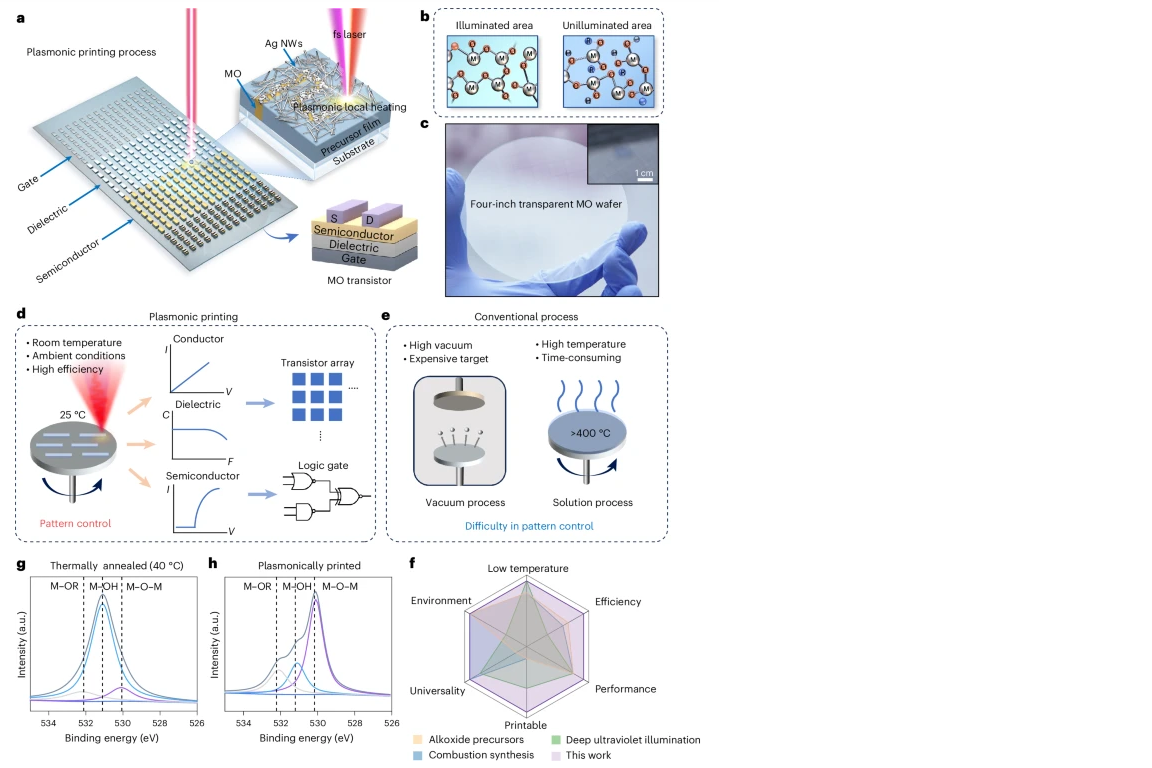
Solution-processed metal oxide (MO) thin-film transistors present substantial promise for next-generation large-area, low-cost electronics. However, challenges like prolonged high-temperature annealing (at >400 °C) and a lack of universal, high-resolution printing technology hinder their widespread applications. Here we report a processing technology, termed ‘plasmonic printing’, for fabricating high-performance, solution-processed all-MO thin-film electronics under room temperature and ambient conditions. This process leverages femtosecond-laser-excited silver nanowires to induce plasmonic local heating, facilitating rapid (<0.3 s) and localized conversion of MO precursors into high-quality MO thin films, including conductor, dielectric and semiconductor. Remarkably, these MO thin films exhibit superior electrical performance without the requirement of special gases or high-temperature treatment, thereby enhancing the fabrication efficiency. Furthermore, precise pattern control is demonstrated, enabling the fabrication of high-density, solution-processed all-MO transistor arrays (48,400 transistors per square centimetre) and integrated logic gates with uniformity and precision. This technology presents a promising pathway for the cost-effective and high-throughput printing of high-density, complex, multilayered solution-processed MO electronics, delivering performance on par with vacuum-based counterparts.
Read more at The Nature Materials:
https://www.nature.com/articles/s41563-025-02268-w
Photo caption:
a, Schematic illustration of the plasmonic printing process. Ultrafast, high-quality, localized MO conversion can be rapidly achieved under room temperature and ambient conditions, through the plasmon excitation of Ag NWs by a mixed fs laser beam to generate local heat for activating the formation of MO. After printing, excess Ag NWs can be physically wiped away, whereas the unconverted precursor can be etched away by 3% w/v OA. A printed transistor structure with a bottom gate and a top contact is illustrated in the bottom-right corner. b, Schematic of the chemical bonds within the illuminated area and unilluminated area of the MO thin film. M, metal cation; O, oxygen; H, hydrogen; R, alkyl group. c, Photograph of a four-inch wafer-scale transparent MO array fabricated by the plasmonic printing process. Scale bar, 1 cm (inset). d,e, Comparison of the plasmonic printing approach (d) and a conventional fabrication method (e) of MO thin films. f, Radar comparison of the plasmonic printing process and three representative low-temperature solution processes for MO in terms of low-temperature processing, efficiency (time to achieve complete MO condensation), performance (conductivity, dielectric constant and mobility), printability (capability of pattern control of MO), universality (applicability across a wide range of MOs) and environment (processing atmosphere: the maximum value represents the ambient conditions). g,h, O1s XPS results of 40 °C-annealed and plasmonically printed ITO (M–O–M lattice, 530.1 eV; M–OH metal hydroxide, 531.1 eV; M–OR bonds, 532.1 eV).
12 Dec 2025