

Parity-violating interactions are ubiquitous phenomena in particle physics. If they are significant during cosmic inflation, they can leave imprints on primordial perturbations and be observed in correlation functions of galaxy surveys. Importantly, parity-violating signals in the four-point correlation functions (4PCFs) cannot be generated by Einstein gravity in the late Universe on large scales, making them unique and powerful probes of high-energy physics during inflation. However, the complex structure of the 4PCF poses challenges in diagnosing the underlying properties of parity-violating interactions from observational data. In this work, we introduce a general framework that provides a streamlined pipeline directly from a particle model in inflation to galaxy 4PCFs in position space. We demonstrate this framework with a series of toy models, effective-field-theory-like models, and full models featuring tree-level exchange-type processes with chemical-potential-induced parity violation. We further showed the detection sensitivity of these models from BOSS data and highlighted potential challenges in data interpretation and model prediction.
Research theme: Astro & Particle Physics
Read more at Physical Review D:
https://journals.aps.org/prd/abstract/10.1103/wzrq-8r8m
Photo caption:
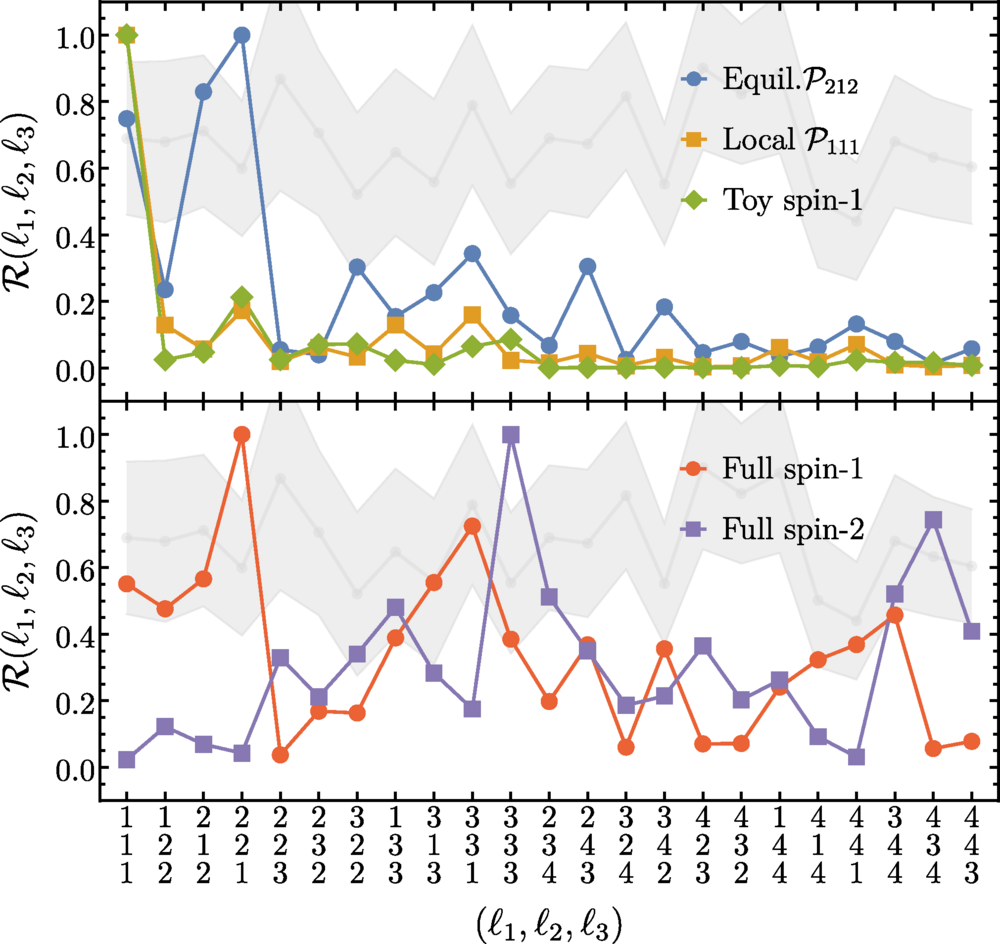
Angular dependence of parity-violating galaxy 4PCF coefficients for the toy and full models discussed in Sec. II. For each model, we show the relative size ℛ(ℓ1,ℓ2,ℓ3) defined by Eq. (49). Contactlike toy models, equil×𝒫212, Local×𝒫111, and toy spin-1, are shown as blue, yellow, green lines, respectively, in the upper panel, while full models, spin-1 and spin-2, are red and purple lines in the lower panel. The coefficient for contactlike models concentrates in a few angular bins, whereas a full model exhibits nontrivial angular correlations distributed across a broader range of angular bins. The gray line indicates the averaged BOSS CMASS data with respect to the north and south Galactic caps, along with the 1𝜎 error band due to the diagonal entries in the covariance matrix estimated according to multidark-patchy mocks.
20 Nov 2025