

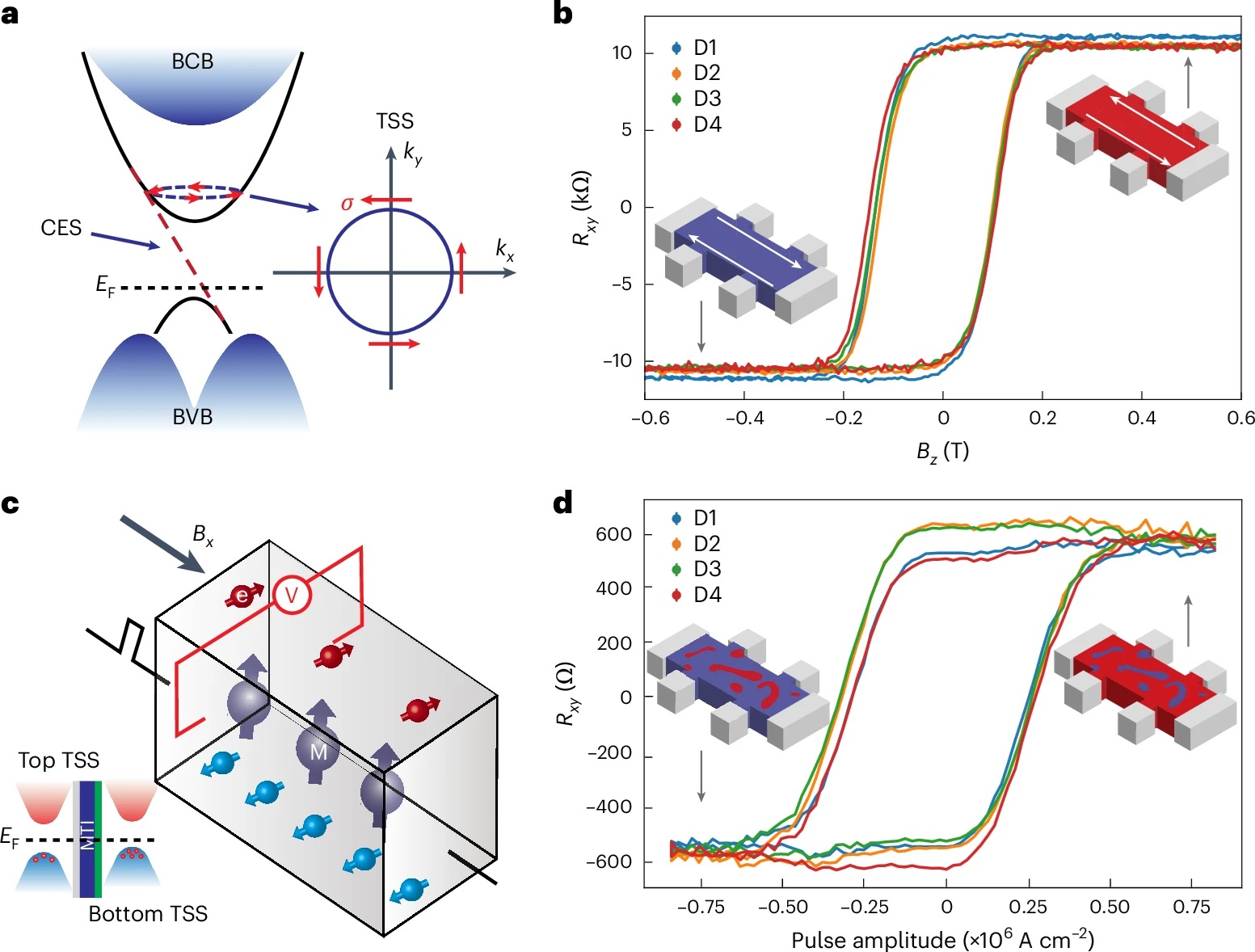
This study presents a cryogenic in-memory computing architecture utilizing magnetic topological insulators (MTIs) as memristors—termed magnetic topological memristors (MTMs). These devices exploit the chiral edge states (CESs) and topological surface states (TSSs) to achieve high-efficiency and low-stochastic switching based on the anomalous Hall effect. The authors demonstrate proof-of-concept machine learning inference at 2 K using four MTMs to classify iris flower data with accuracy up to 96%. Simulations of MTM-based neural networks show comparable or superior performance to traditional CMOS and magnetic memristor approaches in tasks such as MNIST/CIFAR-10 image recognition and quantum state preparation. The MTI devices offer analog, stable multistate switching with excellent scalability. These findings pave the way for hardware-efficient cryogenic electronics crucial for scalable quantum computation and demonstrate a new frontier of using topological quantum materials for neuromorphic and quantum-classical hybrid systems.
Read more at Nature Materials:
https://www.nature.com/articles/s41563-024-02088-4#citeas
Photo caption:
a, Left: sketch of the band structure of the MTI. BCB, bulk conduction band; BVB, bulk valence band. The red arrows represent the spin direction on the TSS. The Fermi level (EF) is indicated (Supplementary Fig. 1). Right: spin-momentum locking mechanism of the TSS. b, The out-of-plane magnetic field switching of the four MTI devices D1–D4 used in this work. Insets: the expected magnetic domain state and chiral edge conduction when the magnetization is fully switched down (left) and up (right). c, Right: the mechanism of the current-induced SOT switching of the MTI. The red and light blue arrows indicate the spin accumulation generated by the top and bottom TSSs, and the blue arrow indicates the local magnetic moment. Left: schematics of surface bands at the top interface (AlOx/MTI, grey) and the bottom interface (MTI/GaAs, green), resulting in an asymmetric carrier distribution of excited holes. d, The pulse write current-induced switching of the four MTI devices. Insets: the expected magnetic multidomain states when the MTI is switched down (left) and up (right). b and d are obtained using pulse measurements and the amplitude of the reading current is 83 and 8.3 × 10³ A cm−2, respectively. There is a 30 mT magnetic field along the x direction for all current-induced SOT experiments.
27 Jan 2025