

PHYSICAL REVIEW LETTERS 134, 220801 (2025)
Encoding quantum information via time-bin entangled states has had a profound impact on the development of quantum communications. However, dispersive propagation limits their achievable transmission distances. Here we describe a regime for nonlocal dispersion cancellation where the sum of arrival times of photons undergoing identical dispersion remains highly correlated. We exploit this effect to mitigate dispersive effects in a quantum key distribution fiber link, allowing an increase in the secret key rate by over a factor of 5 after 80 km of optical fiber dispersion.
Read more at Physical Review Letters:
https://journals.aps.org/prl/abstract/10.1103/PhysRevLett.134.220801
Photo caption:
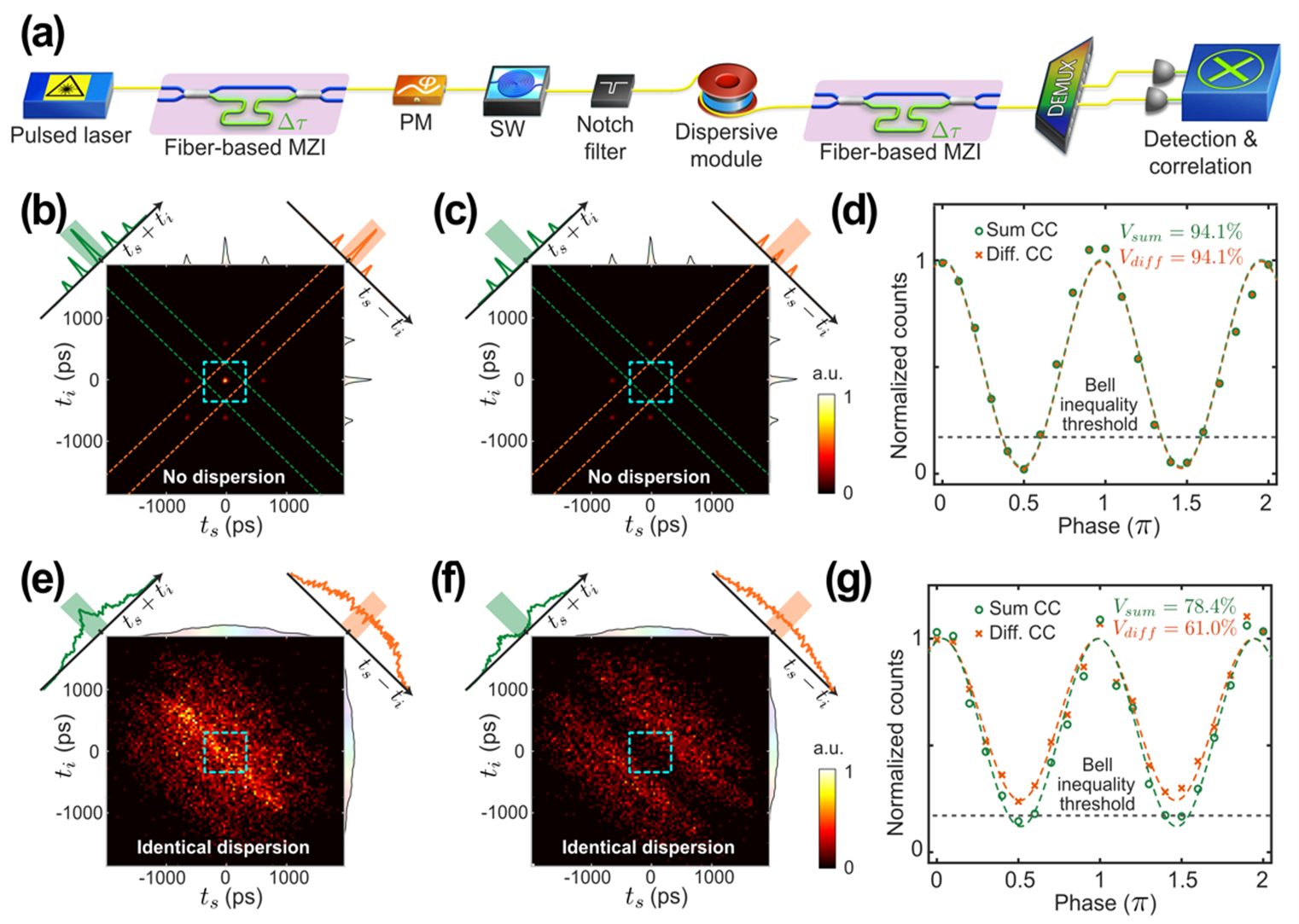
Experimental quantum interference results. (a) Experimental Setup. MZI: Mach-Zehnder interferometer (delay of ∆τ=644 ps); PM: phase modulator; SW: spiral waveguide; DEMUX: demultiplexer. The same MZI is used for both the state preparation and analysis. Biphoton time-of-arrivals maps of (b) constructive and (c) destructive quantum interferences without introducing any dispersion, along with the histograms of their sum (t_s+t_i, green curves) and difference (t_s-t_i, orange curves) correlations. (d) Quantum interference patterns obtained by retrieving the post-selected sum (green circles) and difference (orange crosses) correlations within the blue dashed box, together with their corresponding fit shown by the dashed curves. Biphoton time-of-arrivals map of (e) constructive and (f) destructive quantum interferences after propagation through a total of 200 km SMF-equivalent dispersion with the histograms of their sum and difference correlations. (g) Resulting quantum interference patterns for the post-selected region in both cases. Error bars are omitted since they are smaller than the markers used for the data points.
05 Jun 2025
Atomic, Molecular, and Optical Physics
Atomic, Molecular, and Optical Physics