


Complex-valued neural networks process both amplitude and phase information, in contrast to conventional artificial neural networks, achieving additive capabilities in recognizing phase-sensitive data inherent in wave-related phenomena. The ever-increasing data capacity and network scale place substantial demands on underlying computing hardware. In parallel with the successes and extensive efforts made in electronics, optical neuromorphic hardware is promising to achieve ultra-high computing performances due to its inherent analog architecture and wide bandwidth. Here, we report a complex-valued optical convolution accelerator operating at over 2 Tera operations per second (TOPS). With appropriately designed phasors we demonstrate its performance in the recognition of synthetic aperture radar (SAR) images captured by the Sentinel-1 satellite, which are inherently complex-valued and more intricate than what optical neural networks have previously processed. Experimental tests with 500 images yield an 83.8% accuracy, close to in-silico results. This approach facilitates feature extraction of phase-sensitive information, and represents a pivotal advance in artificial intelligence towards real-time, high-dimensional data analysis of complex and dynamic environments.
Read more at Nature Communications:
https://www.nature.com/articles/s41467-024-55321-8
Photo caption:
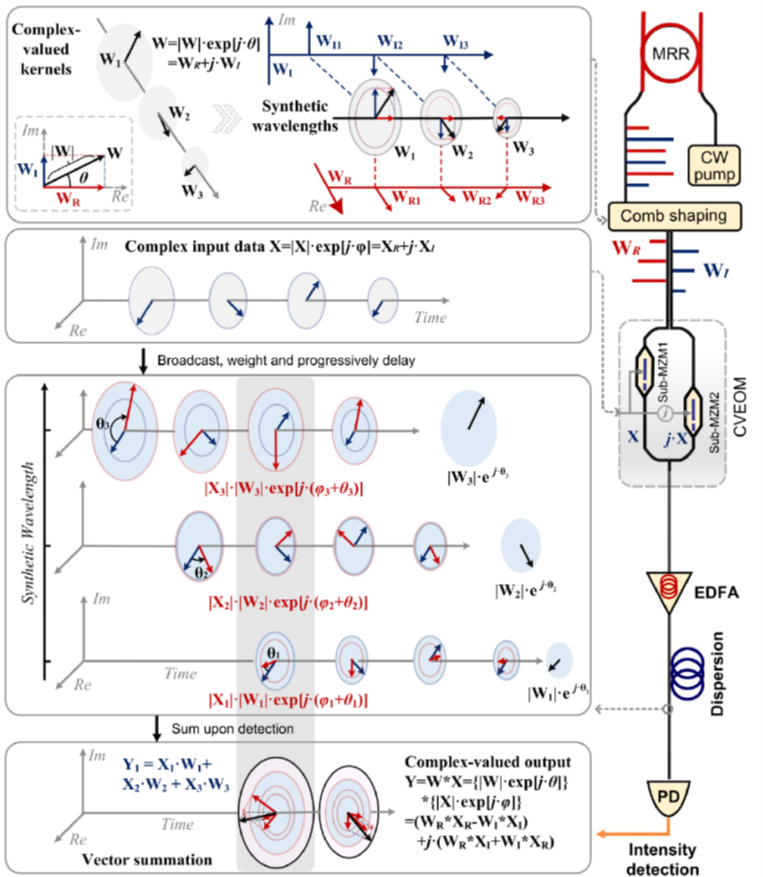
Operation principle of the CVOCA, consisting of the experimental setup (right panel) and the corresponding signal flow of the complex-valued convolution process (left panel). The arrows denote phasors in the complex-valued plane. CW Pump: continues-wave pump laser. EDFA: erbium doped fibre amplifier. MRR: micro-ring resonator. CVEOM: complex-valued electro-optical modulator. PD: photodetection.45 ps) of the superconducting nanowire single-photon detectors. OIC: on-chip interferometer cascade, SW: spiral waveguide, NF: notch filter, FBG: fiber Bragg grating, PM: phase modulator, IM: intensity modulator, DEMUX: demultiplexer
02 Jan 2025