


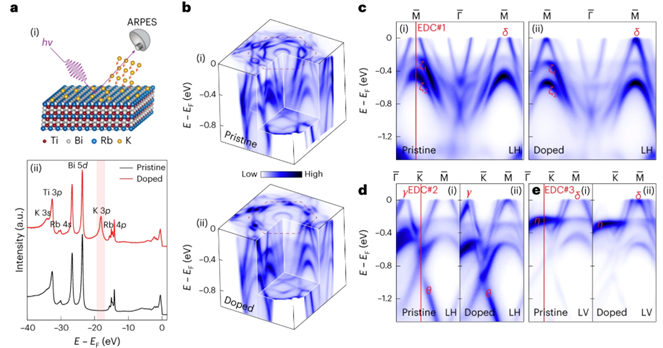
Electronic nematicity that spontaneously breaks rotational symmetry is a generic phenomenon in correlated quantum systems including high-temperature superconductors and the AV3Sb5 (A can be K, Rb or Cs) family of kagome superconductors. However, the underlying mechanism of nematicity in these systems is hard to identify because of its entanglement with other ordered phases. Recently, a family of titanium-based kagome superconductors ATi3Bi5 have been synthesized, where electronic nematicity occurs in the absence of charge order. It provides a platform to study nematicity in its pure form, as well as its interplay with orbital degrees of freedom. Here we reveal the band topology and orbital characters of the multiorbital RbTi3Bi5. We use polarization-dependent angle-resolved photoemission spectroscopy with density functional theory to identify the coexistence of flat bands, type-II Dirac nodal lines and non-trivial topology in this compound. Our study demonstrates the change in orbital character along the Fermi surface contributed by the kagome bands, implying a strong intrinsic interorbital coupling in the Ti-based kagome metals. Furthermore, doping-dependent measurements uncover the orbital-selective features in the kagome bands, which can be explained by d–p hybridization. Hence, interorbital coupling together with d–p hybridization is probably the origin of electronic nematicity in ATi3Bi5.
Read more at Nature Physics:
https://www.nature.com/articles/s41567-023-02215-z
21 Sep 2023