


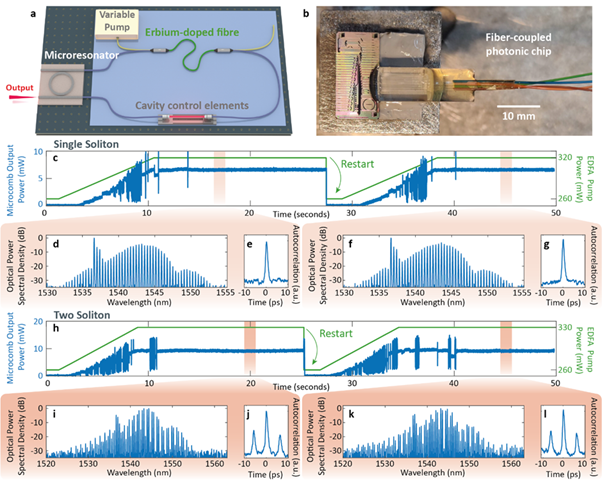
In many disciplines, states that emerge in open systems far from equilibrium are determined by a few global parameters. These states can often mimic thermodynamic equilibrium, a classic example being the oscillation threshold of a laser that resembles a phase transition in condensed matter. However, many classes of states cannot form spontaneously in dissipative systems, and this is the case for cavity solitons that generally need to be induced by external perturbations, as in the case of optical memories.
Here we show that the slow non-linearities of a free-running microresonator-filtered fibre laser can transform temporal cavity solitons into the system’s dominant attractor. This phenomenon leads to reliable self-starting oscillation of microcavity solitons that are naturally robust to perturbations, recovering spontaneously even after complete disruption. These emerge repeatably and controllably into a large region of the global system parameter space in which specific states, highly stable over long timeframes, can be achieved.
Read more at Nature:
https://www.nature.com/articles/s41586-022-04957-x
10 Aug 2022