


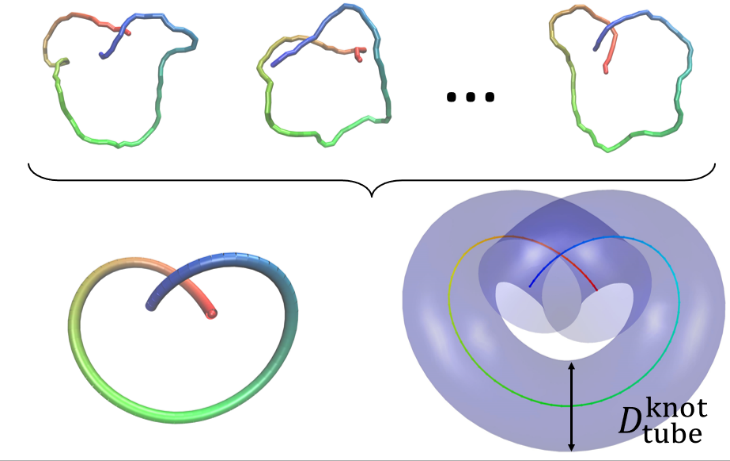
Knotting commonly occurs in long polymers and strongly affects polymer behavior, but the theoretical understanding of polymer knots is very limited. In this work, we apply the tube model to understand polymer knots and reveal many intriguing knot properties. The tube model assumes that the polymer segments in a knot core are confined within a virtual tube due to topological entanglements and presents a simplified view of knotted polymer conformations that appear irregular and disordered. To materialize the conceptual tube, we generate a large number of knotted polymer conformations by Monte Carlo simulations and superimpose them to obtain the tube. After comparing the tubes for polymer knots with and without excluded volume (EV) interactions, we find that EV interactions substantially reduce the accessible tube diameters but only weakly affect the tube axis. The tube model quantitatively explains the dramatic bending variation within knot cores, which can be applied to explain an intriguing phenomenon: knot positioning in a polymer with non-uniform bending stiffness. Overall, the tube model converts the complicated knotting problem to a tube-confinement problem, which is more tackleable by theory and can be used to calculate the shape, fluctuation, and free energy of polymer knots.
Read more at Macromolecules:
https://pubs.acs.org/doi/abs/10.1021/acs.macromol.1c01483
12 Oct 2021