


High-entropy alloys exhibit exceptional mechanical properties at cryogenic temperatures, due to the activation of twinning in addition to dislocation slip. The co-existence of multiple deformation pathways raises an important question regarding how individual deformation mechanisms compete or synergize during plastic deformation. Using in-situ neutron diffraction, we demonstrate the interaction of a rich variety of deformation mechanisms in high-entropy alloys at 15 K, which began with dislocation slip, followed by stacking faults and twining, before transitioning to inhomogeneous deformation by serrations. Quantitative analysis showed that the cooperation of these different deformation mechanisms led to extreme work hardening. The low stacking fault energy plus the stable face-centered-cubic structure at ultralow temperatures, enabled by the high-entropy alloying, played a pivotal role bridging dislocation slip and serration. Insights from the in-situ experiments point to the role of entropy in the design of structural materials with superior properties.
Read more at Science Advances:
https://advances.sciencemag.org/content/6/13/eaax4002
The paper was featured in Phys.org:
https://phys.org/news/2020-03-multi-stage-deformation-high-entropy-alloys-ultra-low.html
The paper was also featured in CityU Research:
https://www.cityu.edu.hk/research/stories/2020/03/28/multi-stage-deformation-process-high-entropy-alloys-ultra-low-temperatures-revealed
Press release from Japan Atomic Energy Agency (Japanese only):
https://www.jaea.go.jp/02/press2019/p20032801/
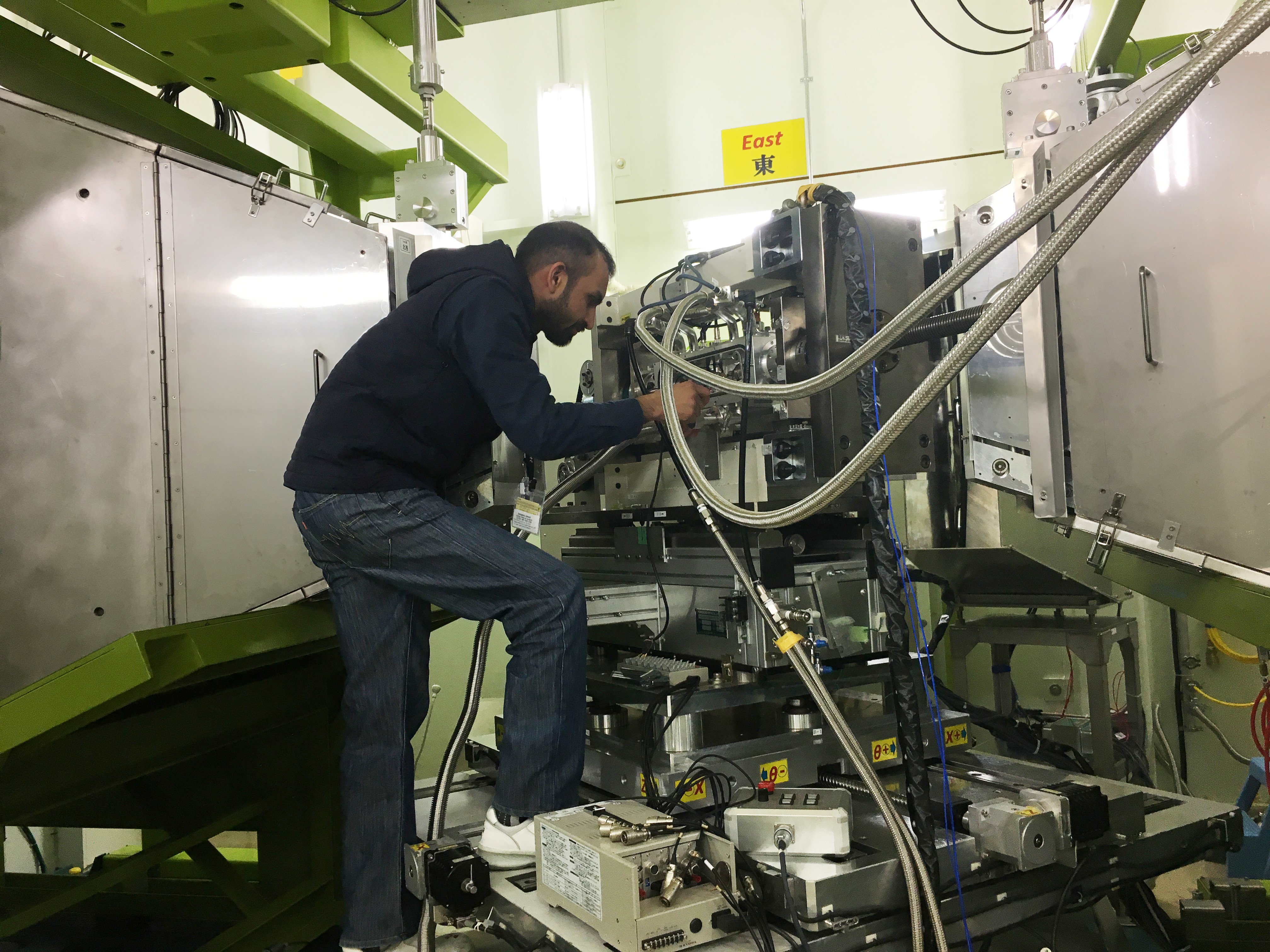
[Photo caption] Muhammad Naeem prepares the experiment at TAKUMI, an engineering materials diffractometer at Japan Proton Accelerator Research Complex (J-PARC) used to perform in-situ neutron diffraction measurements multiple HEA samples, which all showed a multi-stage deformation process.
27 Mar 2020